
Voice Over Scene Types: Examples for Filmmakers

2026-06-20T04:00:39-04:00

Voice over, known in screenwriting as V.O., is off-screen audio narration that shapes how an audience understands a story without a character appearing on screen. The main voice over categories are Character V.O., Narrator V.O., and Institutional V.O., each with a distinct narrative function and formatting convention. Knowing the examples of voice over scene types used in film, television, and commercial media gives you a concrete framework for choosing the right approach on any project. This article breaks down each type with real examples, explains the diegetic versus non-diegetic distinction, and offers practical guidance for applying these styles.

Examples of voice over scene types: the main categories

Voice over categories span narration, commercials, audiobooks, video games, e-learning, corporate training, trailers, and promos. Each serves a different storytelling or communication purpose. Understanding the primary three narrative categories is the starting point for any filmmaker or content creator.

Character V.O.

Character V.O. represents a character’s internal thoughts, memories, or reflections. The tag in a screenplay reads NAME (V.O.), signaling that the voice belongs to someone already in the story. The Shawshank Redemption is the defining example. Red’s narration does not describe what the audience already sees. It reveals his emotional state and moral perspective, which is information the visuals alone cannot deliver. Classic films demonstrate that character V.O. is a core narrative device, not decorative filler.
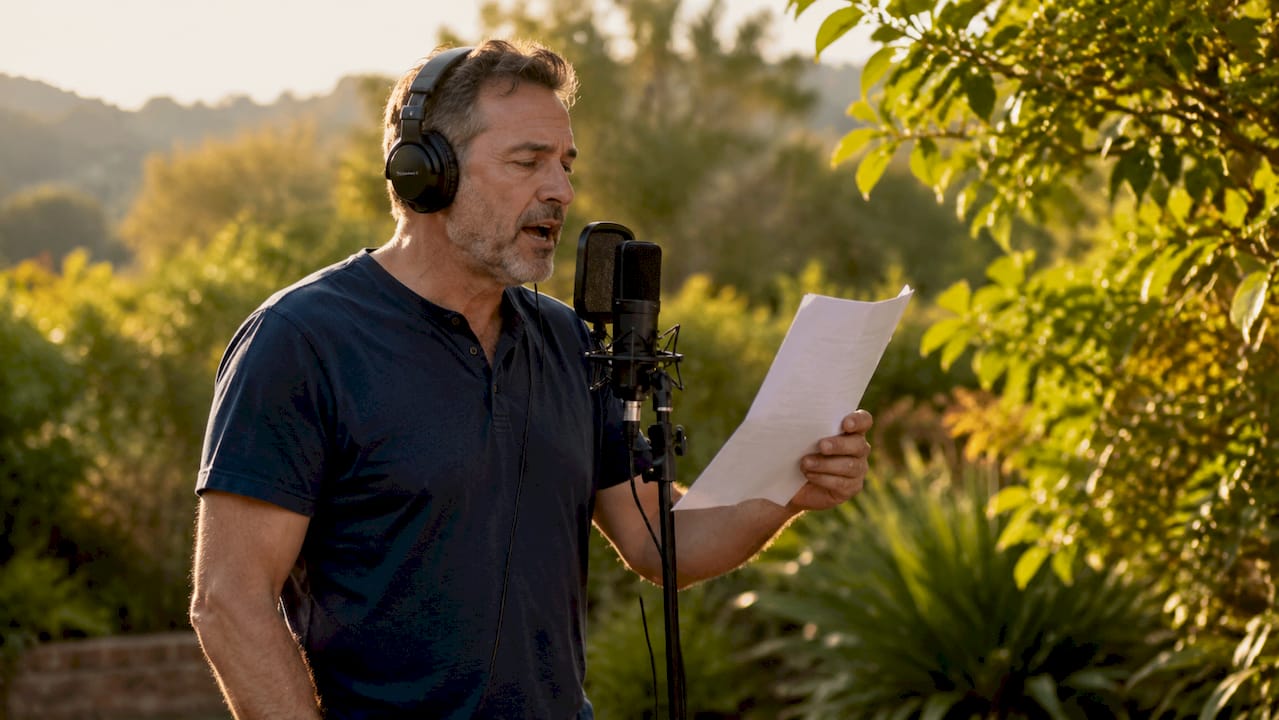
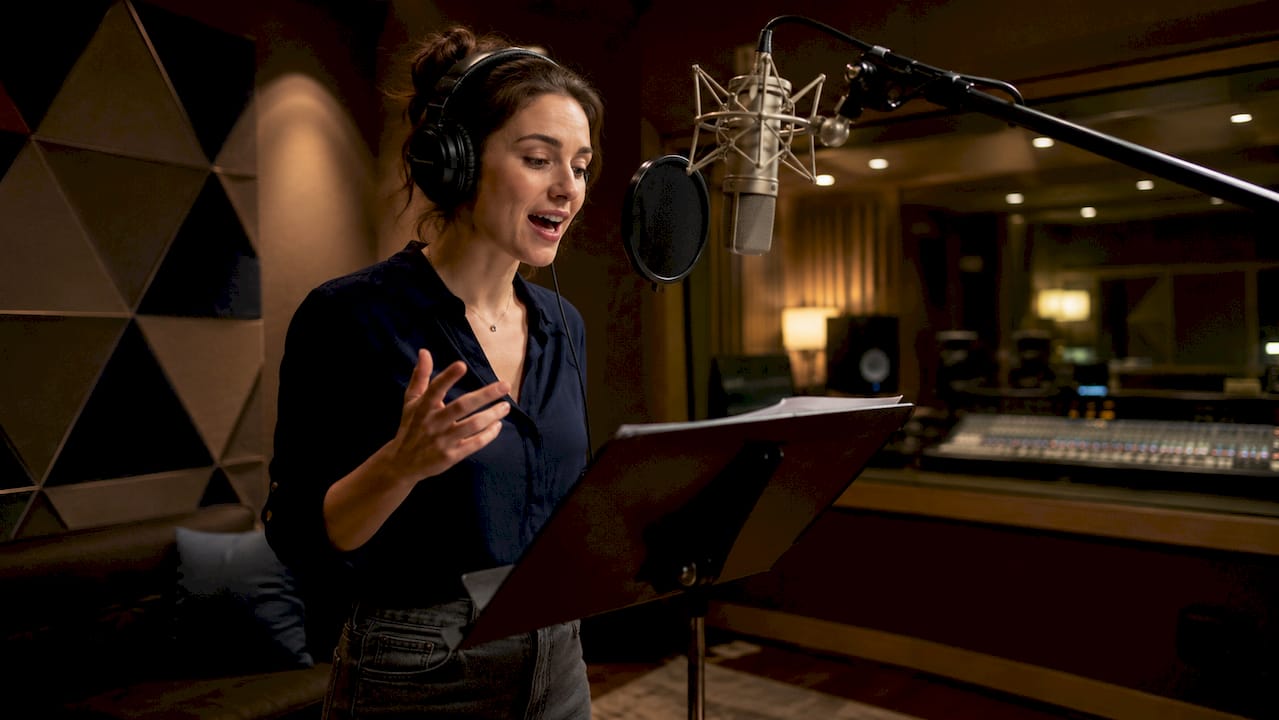
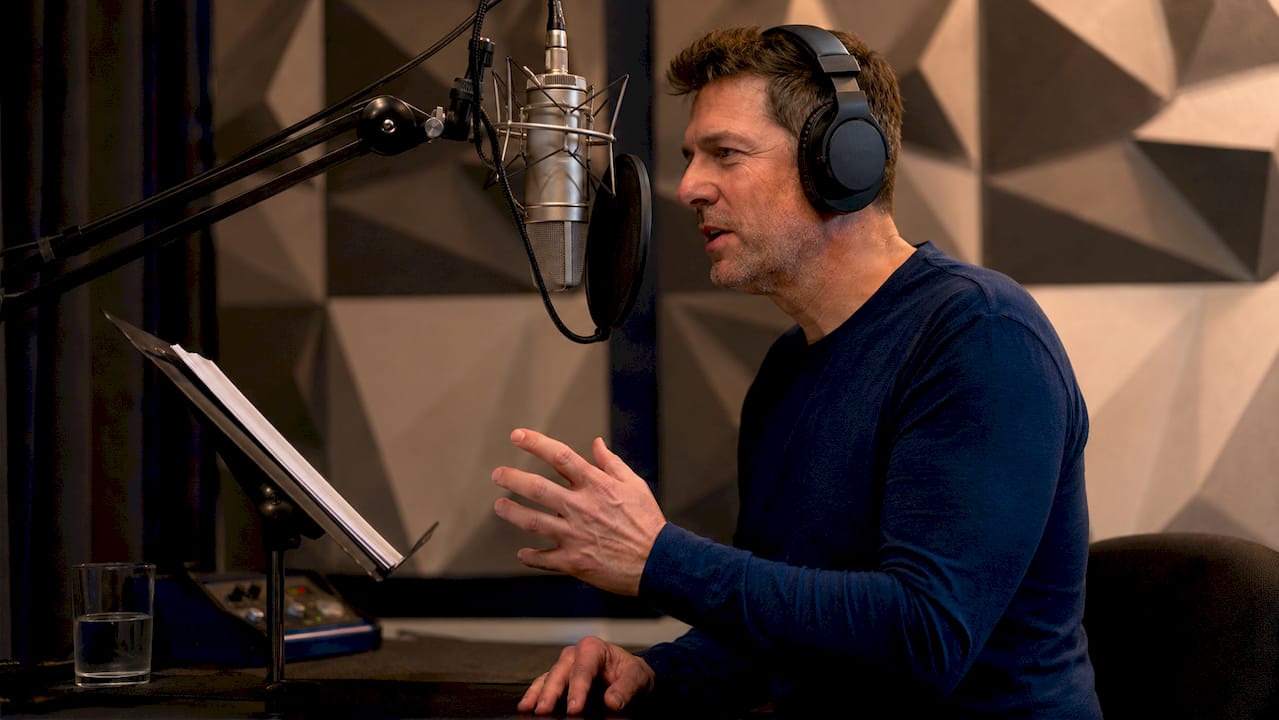
Voice actor recording character voice over in studio

Narrator V.O.

Narrator V.O. comes from a voice outside the story’s character list. The screenplay tag reads NARRATOR (V.O.). This voice provides meta-commentary, guides the audience through time jumps, or frames the story from a distance. Fairy tales use this format by default. Documentary films also rely on it heavily, with a narrator who never appears on screen but shapes how the audience interprets every image. Proper formatting tags between Character V.O. and Narrator V.O. prevent casting confusion during production.

Institutional V.O.

Institutional V.O. comes from a named source within the story world: a news anchor, a government broadcast, a training video playing in the background. The screenplay uses a source line to identify the origin. This type grounds the story in a recognizable social reality. A character watching a news report while the anchor’s voice fills the room is a classic example. The voice carries authority because it belongs to an institution, not an individual.

Epistolary V.O.

Epistolary V.O. uses letters, diary entries, or recorded messages read aloud as a framing device. Bridget Jones’s Diary and The Color Purple both use this structure. The voice feels intimate because it mimics private writing made public. This type works well when a story spans long time periods or when the narrator is physically absent from the main action.

  • Character V.O.: Internal monologue, memory, reflection. Tagged NAME (V.O.) in scripts.
  • Narrator V.O.: External storytelling voice. Tagged NARRATOR (V.O.) in scripts.
  • Institutional V.O.: News anchors, training tapes, government announcements with source lines.
  • Epistolary V.O.: Letters or diary entries read aloud as a narrative frame.

Pro Tip: Write the V.O. script before recording. Writing narration first avoids redundancy with visuals and keeps the audio focused on what the audience cannot see.

Diegetic vs. non-diegetic voice over: what’s the difference?

The diegetic versus non-diegetic distinction is one of the most misunderstood concepts in voice over work. Getting it right changes how you cast, direct, and write narration.

Diegetic voice over is heard by characters within the story world. Non-diegetic voice over exists only for the audience. The character speaking it is unaware they are narrating. This single distinction changes the entire emotional contract between the story and the viewer.

Type Heard by characters? Example Audience effect
Diegetic V.O. Yes Forrest Gump bench narration Feels grounded, communal
Non-diegetic V.O. No Fight Club internal monologue Creates intimacy, unreliability

Forrest Gump uses diegetic narration. Forrest tells his story to strangers on a bench. The people around him can hear him. This makes the narration feel social and warm. Fight Club uses non-diegetic narration. The Narrator speaks directly to the audience in a voice no other character can hear. That choice creates a sense of conspiracy and unreliability that defines the film’s tone.

“The moment you decide whether your voice over is diegetic or non-diegetic, you’ve already made a major directorial decision about trust, distance, and audience relationship.”

Non-diegetic narration gives the audience privileged access to a character’s mind. Diegetic narration keeps the audience at the same level as the other characters in the story. Neither is superior. The choice depends entirely on the emotional effect you want. Explore how vocal performance shapes film tone to understand how delivery amplifies this distinction.

Specialized voice over scene types and their unique functions

Beyond the main categories, several specialized voice over styles carry distinct genre functions. Recognizing them helps you use them with intention rather than by accident.

Noir and crime thriller V.O.

Noir voice over works as ironic counterpoint, not literal description. Noir narration should never describe what the audience already sees on screen. A detective tying his shoes does not need narration. A detective tying his shoes while the narration reflects on betrayal and fate creates tension. The voice adds a layer of meaning the visuals cannot carry alone. This is the defining rule of noir V.O.: add irony or theme, never redundancy.

Comedy and meta-satire V.O.

Comedy V.O. sometimes breaks the fourth wall entirely. The narrator interacts with characters, corrects the story, or comments on the absurdity of events. Arrested Development uses this format with a narrator who judges characters in real time. This style works because the audience is in on the joke. The narrator becomes a character in their own right without ever appearing on screen.

Documentary narration styles

Documentary narration comes in three distinct forms:

  • Voice of God: An authoritative, anonymous narrator who presents facts without personal investment. Ken Burns documentaries use this style.
  • First-person narration: The filmmaker or subject speaks directly, creating intimacy and subjectivity.
  • Poetic narration: Language prioritizes imagery and emotion over information. Night and Fog is the landmark example. Its unemotional delivery over horrifying footage creates a confrontational emotional impact that emotional narration would undercut.

E-learning and corporate V.O.

E-learning and corporate voice over prioritizes clarity over atmosphere. The goal is information transfer, not emotional engagement. Pacing is slower. Sentences are shorter. The tone is warm but neutral. This style appears in compliance training, product tutorials, and onboarding videos. It is one of the broadest categories of voice over by volume in the commercial market.

Pro Tip: For corporate and e-learning scripts, read each sentence aloud before recording. If it sounds unnatural spoken, rewrite it. Listeners process audio differently than text.

How to select and apply voice over styles for your project

Choosing the right voice over style is a production decision, not just a creative preference. The wrong style creates friction between the audio and the story.

  1. Define the narrative function first. Ask what the voice over needs to do. Is it revealing character psychology? Providing context? Selling a product? The function determines the category before any other decision is made.

  2. Match the style to genre conventions. Audiences carry expectations. A noir film with a warm, optimistic narrator feels wrong immediately. A corporate training video with a brooding, ironic narrator loses the audience in seconds. Genre conventions exist because they work.

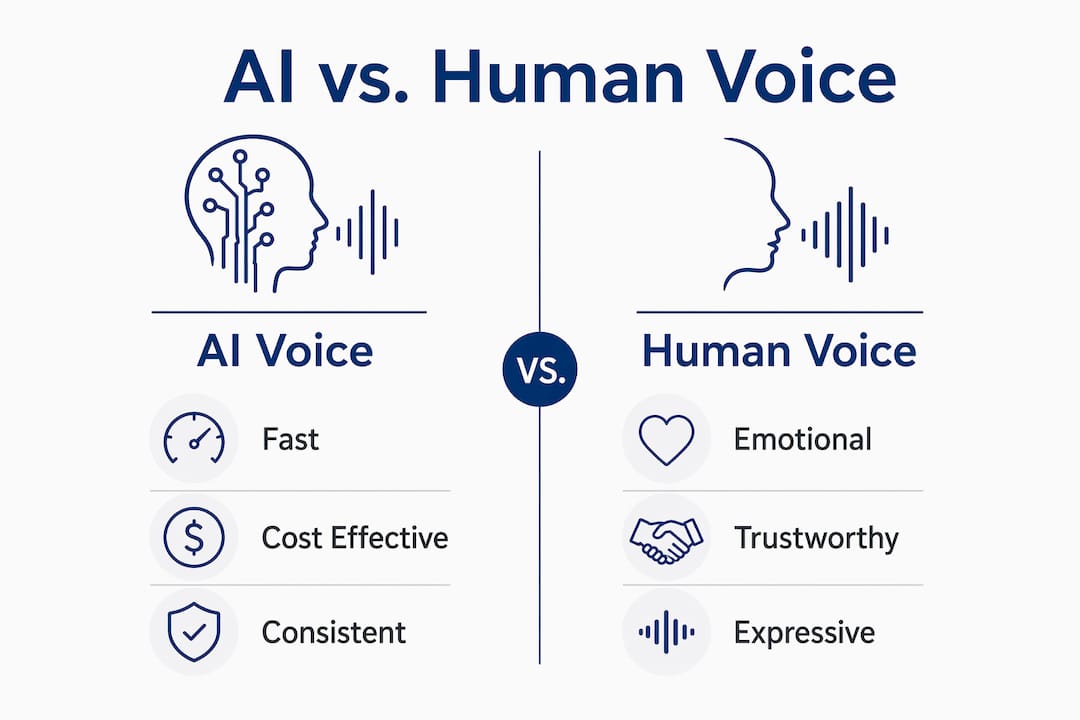
  3. Decide between professional human talent and AI voice. Hybrid production models use professional human voice talent for flagship, long-lived content and AI voice for high-volume or operational content. This approach balances quality and budget without forcing an all-or-nothing choice. Read more about voice talent selection to understand when human nuance is non-negotiable.

  4. Write the script before you cast. Writing narration before recording keeps the script focused on what the visuals cannot show. It also gives voice talent something concrete to interpret rather than improvise around.

  5. Consider pacing and scene rhythm. Voice over that fights the edit creates confusion. The narration should breathe with the cut, not compete with it. Study voice and scene pacing to understand how timing affects audience comprehension.

  6. Test with a scratch track. Record a rough version of the narration yourself before hiring talent. This reveals whether the script works at the right length and whether the tone fits the visuals.

  7. Audit for redundancy. If the narration describes what the audience already sees, cut it. Voice over earns its place by adding information, emotion, or irony that the image cannot deliver alone.

Key takeaways

Voice over scene types are defined by their narrative function, and matching the right type to your project’s storytelling goal is the single most important production decision you will make.

Point Details
Three core categories Character V.O., Narrator V.O., and Institutional V.O. each serve distinct narrative roles.
Diegetic vs. non-diegetic Whether characters hear the narration determines audience trust and emotional distance.
Specialized styles matter Noir, documentary, and comedy V.O. follow genre-specific rules that shape audience response.
Write before you record Scripting narration first prevents redundancy with visuals and improves production clarity.
Hybrid production works Use human talent for flagship content and AI voice for high-volume operational material.

What I’ve learned about voice over that most articles miss

Most discussions of voice over treat it as a technical category problem. Pick the right label, format the script correctly, and you are done. That framing misses the point entirely.

The voice over types that resonate are the ones where the writer understood what the image could not say. Red’s narration in The Shawshank Redemption does not work because it is correctly tagged as Character V.O. It works because it carries moral weight the visuals alone cannot hold. The category is just the container. What goes inside it is the actual craft.

The choice between professional human talent and AI voice is real and worth taking seriously. AI voice has improved dramatically and fits well for e-learning updates, operational content, and high-volume production. But for content where emotional authenticity is the product, human nuance is not a luxury. It is the deliverable. The growing trend toward hybrid models reflects this reality. Smart producers are not choosing one or the other. They are using both deliberately.

The biggest mistake I see is treating voice over as an afterthought. Narration written after the edit is almost always redundant. It describes what the audience already sees because the writer is reacting to the cut rather than shaping it. Write the voice first. Let it guide the edit. That sequence changes everything about the final result.

— kribi

Work with a voice that fits your project
https://gregeschmeyervoice.com

Every voice over scene type covered here demands a different performance. A noir monologue requires irony and restraint. A documentary narrator needs authority without emotional manipulation. A commercial voice needs warmth and clarity in the same breath. Gregeschmeyervoice delivers across all of these formats, with a grounded, conversational style that clients consistently describe as authentic and production-ready. Greg Eschmeyer brings experience across commercials, documentaries, narrative media, and corporate content, with fast turnaround and no generic delivery. Visit Gregeschmeyervoice.com to hear demos and connect directly for your next project.

FAQ

What are the main types of voice over in film?

The three primary categories are Character V.O., Narrator V.O., and Institutional V.O. Each serves a distinct narrative function and uses different screenplay formatting conventions.

What is the difference between diegetic and non-diegetic voice over?

Diegetic voice over is heard by characters within the story, while non-diegetic voice over is heard only by the audience. Forrest Gump uses diegetic narration and Fight Club uses non-diegetic internal monologue.

When should I use a professional voice actor instead of AI?

Professional human talent is the right choice for flagship content where emotional authenticity drives the audience response. AI voice fits high-volume or frequently updated operational content where efficiency matters more than nuance.

How do documentary narration styles differ from film narration?

Documentary narration uses Voice of God, first-person, or poetic styles, each with different levels of authority and subjectivity. The contrast between vocal tone and imagery, as in Night and Fog, is a defining technique that film narration rarely uses.

Should I write the voice over script before or after editing?

Write the script before recording. Scripting narration first prevents redundancy with visuals and keeps the narration focused on information the audience cannot get from the image alone.
Voice Over Scene Types: Examples for Filmmakers2026-06-20T04:00:39-04:00

Top 4 jmcvoiceover.com Alternatives for 2026

2026-06-18T22:42:03-04:00

Getting consistent, authentic voice over for commercials, narration, or campaigns is difficult when vendor reliability and recording quality vary widely. Most established voice over services hide pricing, require manual quotes, and do not provide real demo flexibility before contact. This comparison details pricing, audition access, and delivery strengths among top services so agencies and production teams can match the right talent to their project scope.

Table of Contents

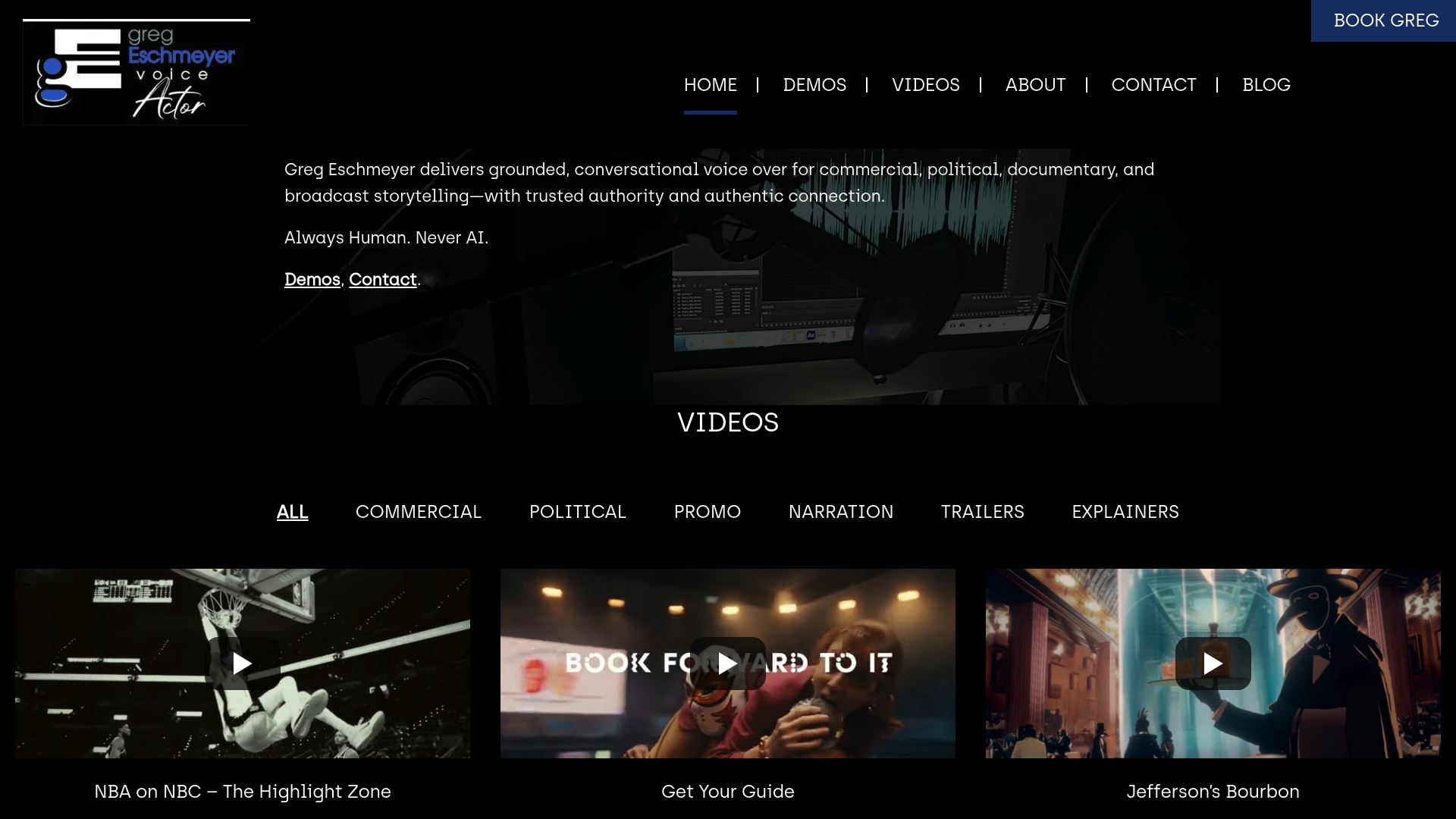
Greg Eschmeyer Voice

https://gregeschmeyervoice.com

At a Glance

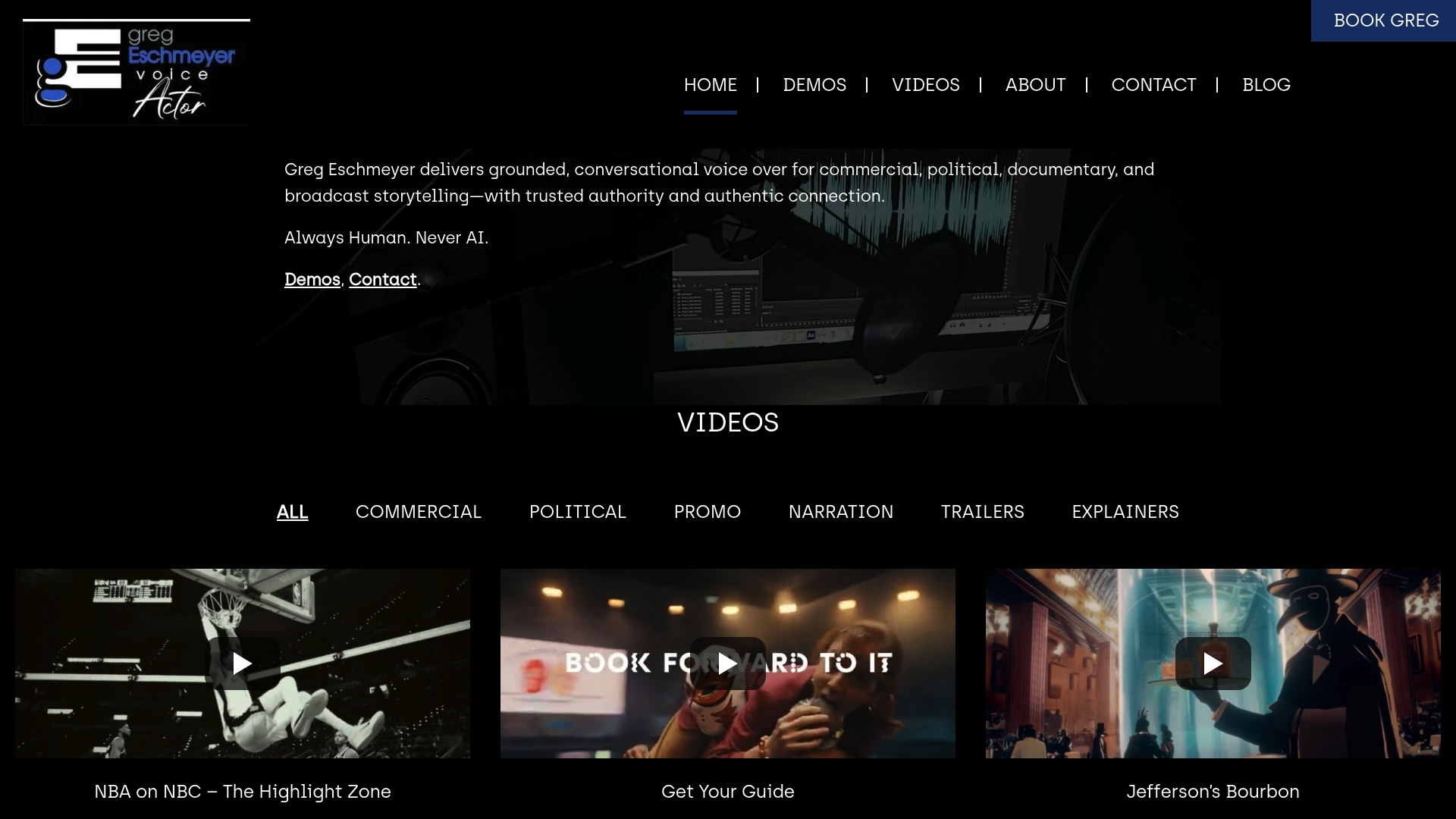
Always Human. Never AI. Greg Eschmeyer delivers grounded, conversational voice over across commercials, political spots, documentaries, and broadcast storytelling. Multiple demo recordings are available online for casting and audition checks.

Core Features

Greg performs a grounded, conversational voice over style that favors authenticity and authority. He covers a wide range of media, including commercial advertisements, political campaign spots, documentary narration, and broadcast storytelling. Multiple demo recordings appear online so clients can compare tones and select suitable takes.

Key Differentiator

Greg Eschmeyer focuses on authentic connection and trusted authority in delivery. His primary strength is a natural, conversational read that aims to sound like a real person speaking rather than a produced announcer. That approach suits projects that need emotional truth and believable narration.

Pros

Greg gives professional, high quality vocal delivery combined with responsive communication. Clients report multiple options in recordings, which reduces direction time during post production. Testimonials emphasize quick turnaround and reliability, and his relatable voice helps adverts and documentaries land emotionally with listeners.

Cons

  • Website page errors limit access to additional technical information or embedded tools.

Who It’s For

Content creators, advertising agencies, broadcasters, and political campaigns needing authentic, relatable voice over talent will find Greg a strong match. Producers who want a conversational delivery that reads like a real person will benefit from his style and available demo variety.

Unique Value Proposition

Multiple demo recordings and varied takes let you cast quickly and give directors options without extra sessions. That workflow reduces time spent on session notes and re direction during editing. For short form media and campaign spots this often shrinks scheduling friction and decision cycles.

Real World Use Case

A political campaign hires Greg for video spots and radio ads to connect with voters in a conversational tone. The campaign uses his multiple demo takes to pick the one that best matches their message and to speed approval across teams.

Pricing

Pricing is not publicly listed. Greg offers personalized quotes that reflect project scope, usage, and deliverables. Contact through the demos or contact pages to request a rate and a timeline.

Website: https://gregeschmeyervoice.com

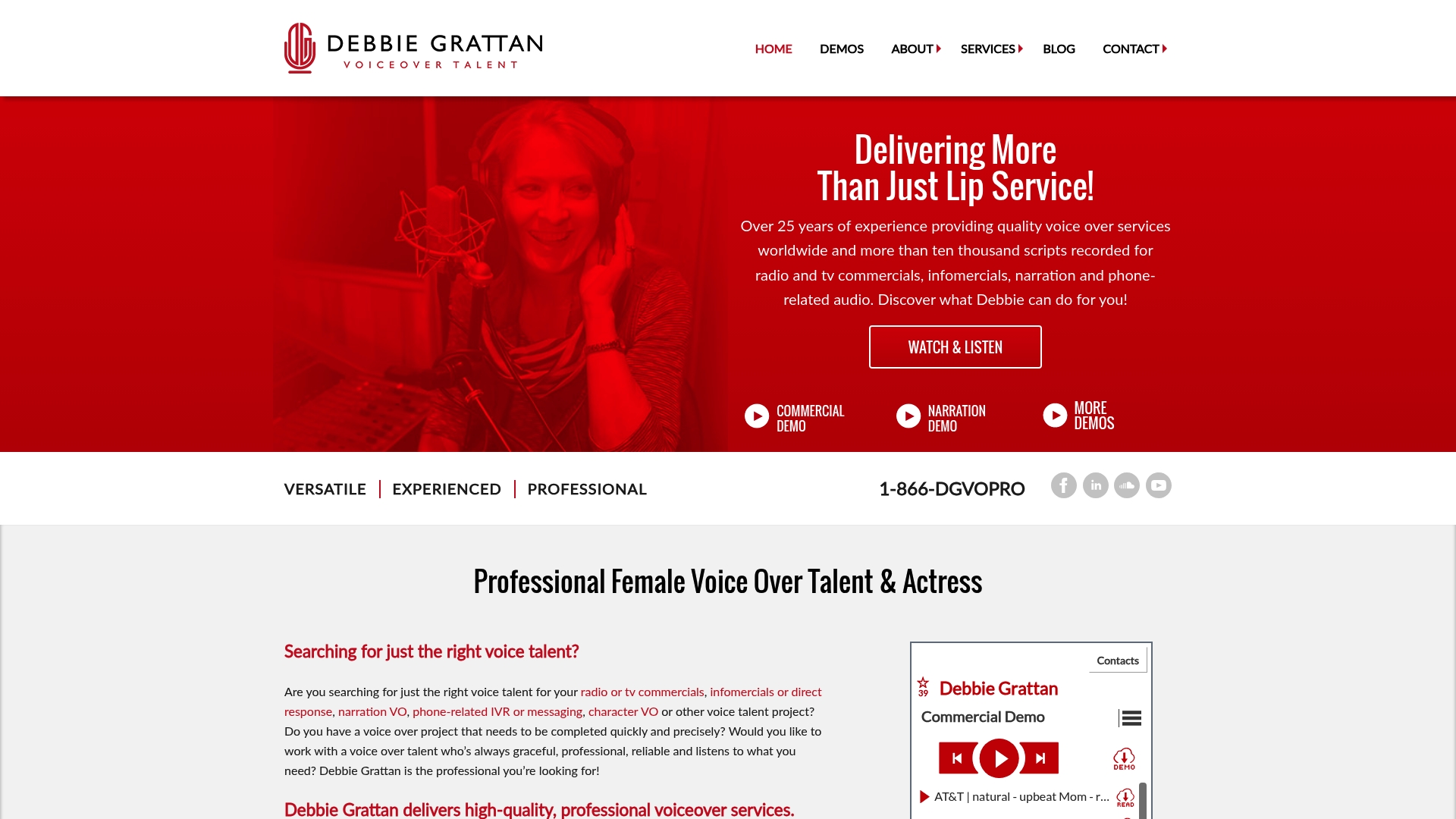
Debbie Grattan Voiceover Services

https://debbiegrattan.com

At a Glance

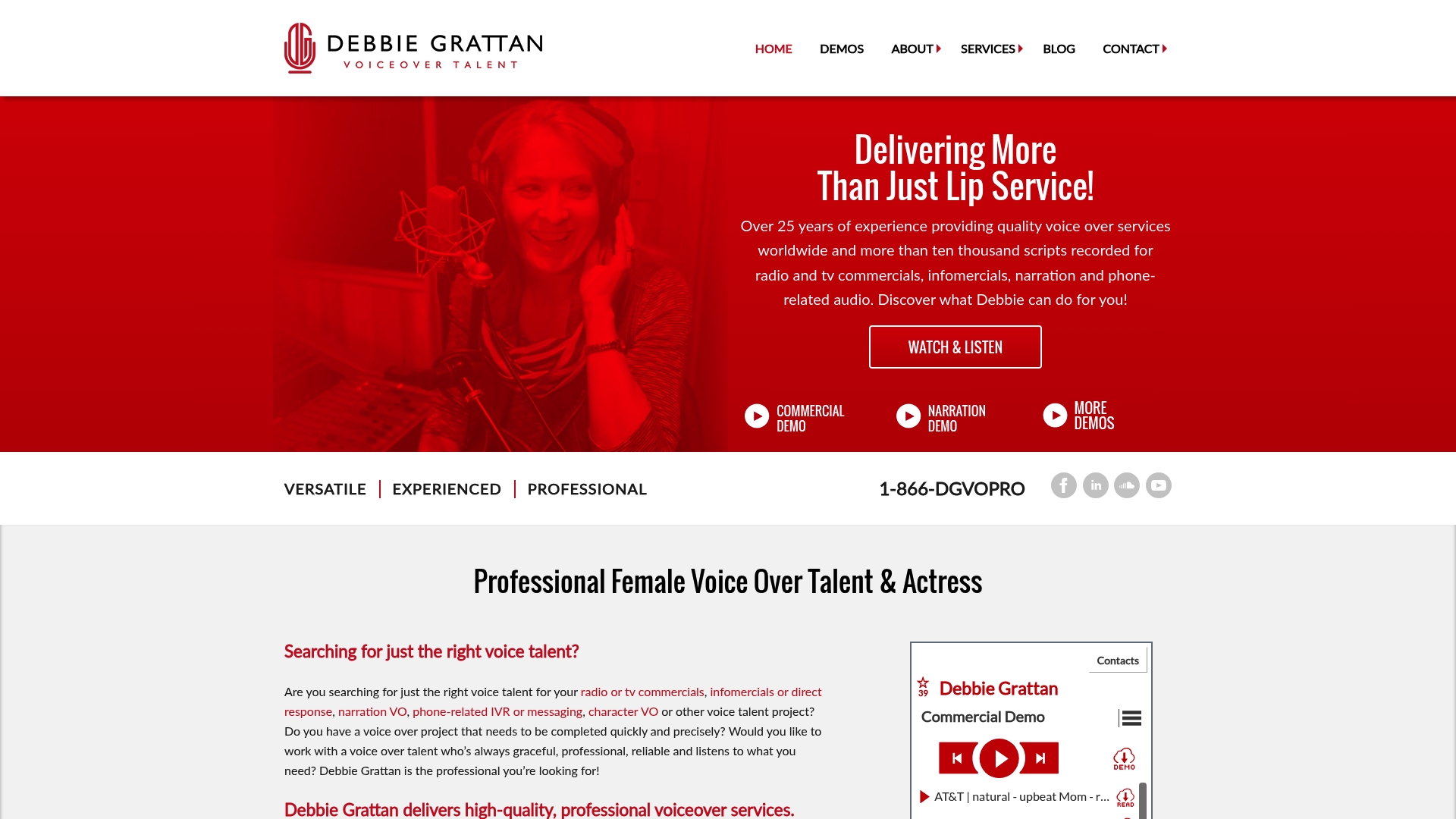
Debbie Grattan reports over 25 years of professional voiceover experience. She focuses on commercials, infomercials, narration, and phone system audio for advertising, healthcare, and corporate clients. Her marketing materials emphasize quick turnaround and tailored vocal choices for each script.

Core Features

Debbie delivers a wide range of voice styles including commercial read, narration, character work, and phone prompts, backed by a high-quality recording studio setup. She provides customizable demos and claims a fast response time for project requests. Her background in acting and recording underpins the polished performances clients describe.

Key Differentiator

Her longevity and scope of deliveries set her apart. The vendor advertises over 25 years of experience and a history of work across commercials, narration, and phone prompts. That depth of experience translates into multiple vocal options during sessions and fewer retakes, which can shorten editing and post-production time.

Pros

Debbie brings breadth of experience and clear vocal control across styles, which helps when projects need a reliable single talent for spots, narration, and IVR. Clients report fast turnaround and an easy workflow, meaning agencies can hit tight broadcast deadlines without juggling multiple talents. Her in-studio recordings produce clean audio that reduces noise cleanup and speeds editing in post-production. Personalized demos and initial takes tailored to the script cut back on revision cycles and time spent in the edit bay.

Cons

  • Pricing details are not publicly available, so agencies must request a custom quote before budgeting.

  • The site does not list platform compatibility or file-delivery specs, which can complicate technical handoffs for some production workflows.

  • No published rate card or package breakdown exists, which makes price comparisons with other voice talents harder.

When It May Not Fit

If you need a fixed per-spot rate published upfront, this service may not fit. Large scale casting platforms that automate rate comparisons will provide clearer price signals. Projects that require specific delivery formats or API-based file transfers may face uncertainty because compatibility details are not listed.

Who It’s For

Commercial clients, marketing agencies, and corporate communications teams that need a seasoned female voice talent will find this service appropriate. Producers who value multiple vocal options from the first session will benefit from her approach. Small teams that prefer direct contact and custom quoting will also match this offering.

Real World Use Case

A marketing agency needs a national TV commercial delivered on a compressed schedule. Debbie records multiple reads for the script, supplies clean studio files, and turns the project around quickly. The agency uses the selectable reads to A B the spots and signs off without a second recording session.

Pricing

Pricing is not listed on the public site and returns an error according to the product record. Prospective clients must contact Debbie for a quote and delivery terms. Expect to request a custom rate and confirm file-format and turnaround details before booking.

Website: https://debbiegrattan.com

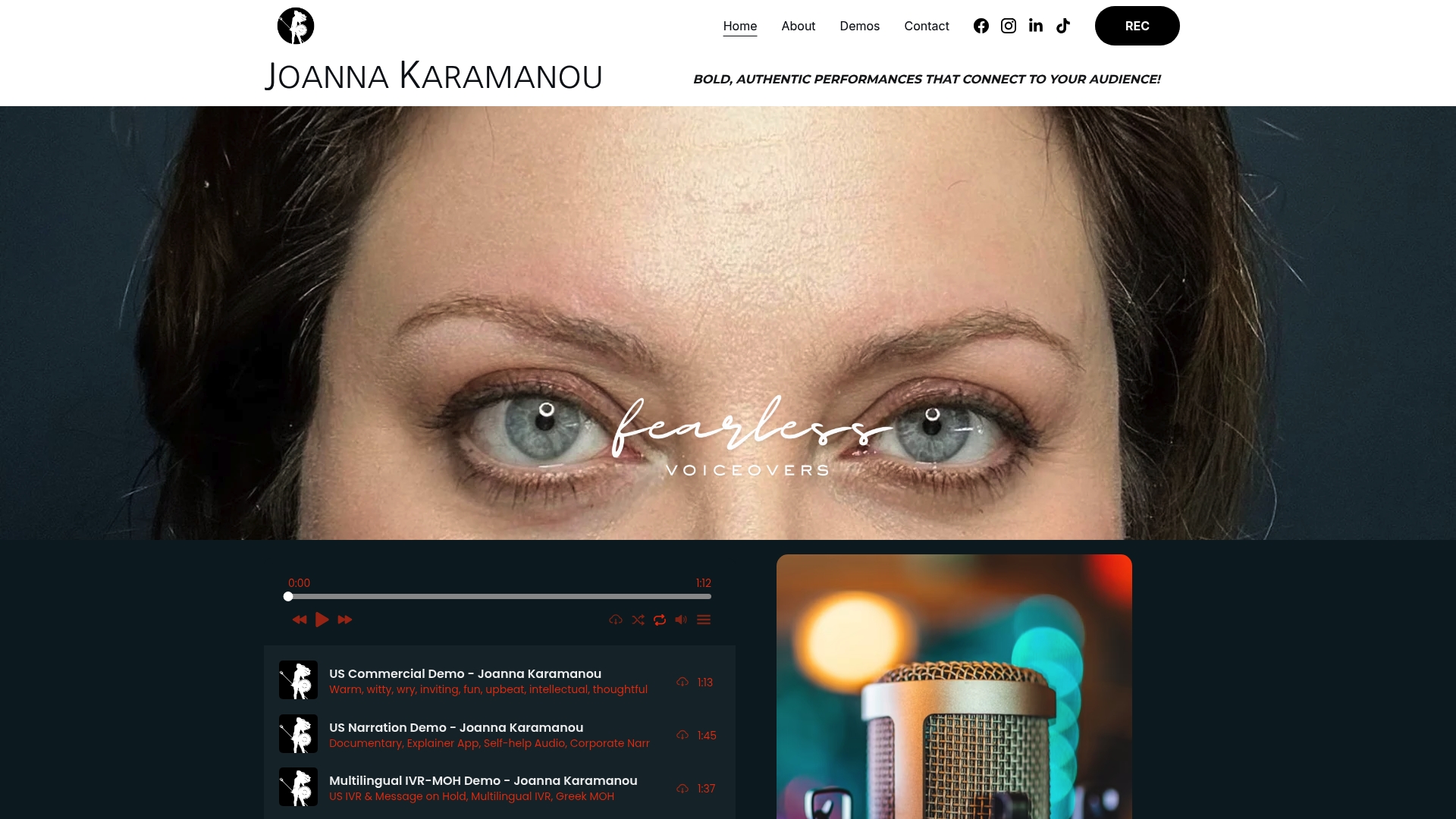
Fearless Voiceovers by Joanna Karamanou

https://fearlessvo.com

At a Glance

Joanna records from a sound treated home studio and offers on site sessions in the Boston area. She performs in English and Greek, and delivers dialect work drawn from acting and linguistics training. That mix makes her a strong choice when you need emotionally truthful reads with quick turnarounds.

Core Features

Fearless Voiceovers delivers broadcast quality audio from a sound treated studio and supports remote live directed sessions when clients cannot attend in person. Joanna performs in multiple dialects and languages, and she adapts tone and pacing for advertising, narration, and corporate work. Fast delivery and personalized direction are standard parts of her workflow.

Key Differentiator

Joanna combines an actor’s sensitivity to character with formal linguistic training to shape phrasing, vowel color, and cadence for each script. That approach produces emotionally specific performances that read as human and conversational. Compared with Gregeschmeyervoice, Joanna leans more on dialect versatility and one on one direction for projects with multilingual needs.

Pros

Fearless Voiceovers produces clean, broadcast ready recordings backed by in studio acoustics and professional gear, which reduces time spent on cleanup. The service adapts to remote direction or local sessions in Boston, and that flexibility helps agencies meeting tight schedules. Joanna’s actor and linguist background contributes to natural accents and believable character work, and clients report fast project delivery.

Cons

  • Mainly focused on voiceover services, not suitable for video or other media production or other multimedia services.
  • Location based in Boston for on site recording, and remote sessions are required for clients outside the area.
  • Pricing details are not publicly specified, so budgeting requires contacting Joanna for a quote.

When It May Not Fit

If you need a single vendor to handle recording, editing, and full video post production, this service will feel narrow. If you require studio work outside the Boston area and cannot do remote direction, scheduling may add complexity. Organizations that need published pricing or packaged plans will need to request a proposal.

Who It’s For

Marketing teams and content creators who need authentic, human reads across accents will find Joanna useful. Agencies planning global campaigns that require English and Greek voice work will benefit from her linguistic skills. Small production houses that can manage their own post work and prefer one on one direction will get the most value.

Real World Use Case

A marketing agency hires Joanna to record a set of radio and online spots in multiple accents for a regional campaign. She records in studio, applies directed retakes during a live session, and delivers files ready for the agency to place in edits. The campaign meets its delivery date with consistent vocal tone across versions.

Pricing

Pricing is not specified. Contact Joanna for a custom quote based on project length, usage, and whether on site recording is required.

Website: https://fearlessvo.com

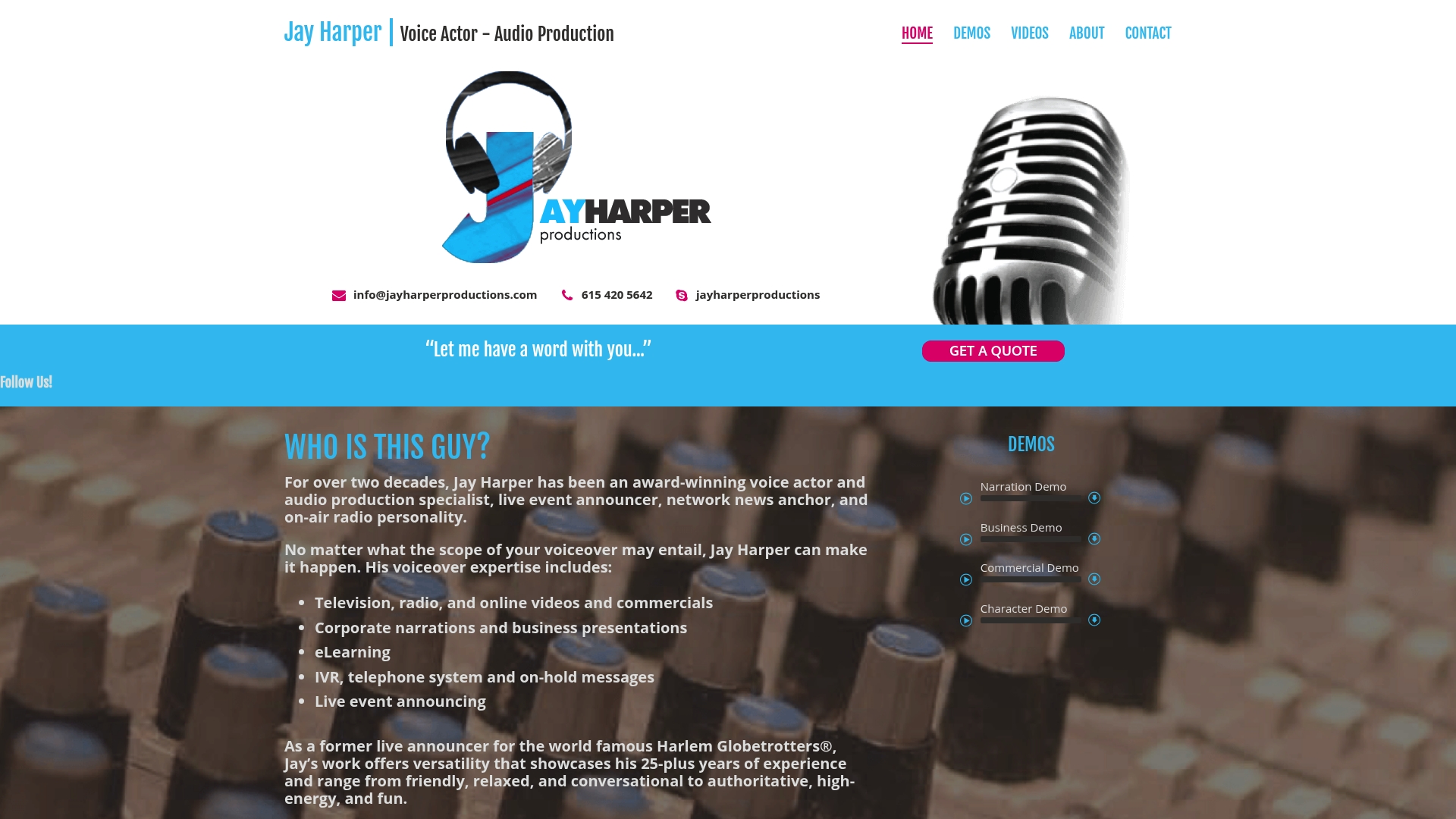
Jay Harper Productions

https://jayharperproductions.com

At a Glance

Jay Harper Productions reports over 25 years of experience in professional voice work. That longevity shows up in steady client references, demo samples, and international representation. The studio is based in Nashville and handles commercials, corporate narration, eLearning, IVR, and live event announcing.

Core Features

Jay Harper records voiceovers for television, radio, online video, and commercials while also handling corporate narration and presentation voice work. The service covers eLearning narration, IVR and telephone system messages, plus live event announcing. Clients can request demo samples and references, and the talent offers international representation for bookings.

Key Differentiator

The main differentiator is that Jay Harper pairs decades of reported industry experience with a versatile vocal range and professional recording gear. That experience claim suggests reliability for campaigns that need consistent, broadcast ready reads across multiple media. This offering suits projects that require textbook commercial delivery and event announcing rather than intimate, conversational performance.

Pros

Jay Harper brings a clearly seasoned voice and a flexible delivery that adapts to authoritative commercial reads and scripted corporate narrations. The studio uses professional recording equipment to deliver clean audio, and client feedback cited in materials emphasizes quick turnaround and adaptability. Long standing client relationships and available demo reels make it straightforward to evaluate fit before committing to a booking.

Cons

  • Limited public pricing or packaged rates make budgeting difficult before contact.
  • No listed digital integrations or file delivery automation for agency workflows.
  • No detailed public information on accessibility accommodations or extended services.

When It May Not Fit

If you need transparent, tiered pricing that you can review immediately online, this service may not fit. If your workflow depends on automated delivery or API integration with agency tools, this offering lacks publicly listed digital features. If you need bespoke accessibility services documented up front, the public information is limited.

Who It’s For

This service suits organizations and production companies that need an experienced, broadcast capable voice for commercials, corporate presentations, and live announcing. It fits producers who prioritize proven delivery and fast studio turnarounds. It is less suitable for teams requiring self service pricing or integrated digital workflows.

Real World Use Case

A national advertiser hires Jay Harper to voice a cross platform campaign and the result delivers a consistent tone for TV, radio, and online spots. The production team reviews demo samples, selects reads that match the brand, and receives files ready for broadcast. The same talent also records the client’s IVR messages to maintain a unified brand voice.

Pricing

Public pricing is not listed. The website returns a pricing page error, so you must request a quote directly from the studio for rates and package details.

Website: https://jayharperproductions.com

Comparing Voice Over Services Among Leading Options

Select the voice over service that best aligns with your project’s needs by evaluating features such as specialization, key advantages, and accessibility.

Service Core Focus Areas Key Differentiator Pricing Limitation
Gregeschmeyervoice Commercials, documentaries, storytelling Natural conversational reads and quick turnaround Price not published Website errors limit access to technical details
Debbie Grattan Voiceover Services Commercials, narration, infomercials 25+ years of professional experience Price not published No preset rate card complicates budgeting
Fearless Voiceovers Multilingual dialect work, corporate audio Acting and linguistic expertise for natural accents Price not published Limited to Boston area or remote clients
Jay Harper Productions Commercials, eLearning, event announcing Decades of experience and versatile capabilities Price not published No automated delivery or accessibility details

How to Choose the Right Voiceover Service When Comparing jmcvoiceover.com Alternatives

Finding voiceover talent that delivers authentic and genuine performances presents a real challenge. Many producers and marketing agencies seek a conversational style that sounds like a real person rather than a generic announcer. That need often delays project approval when multiple recording takes and re direction become necessary.

Gregeschmeyervoice meets this challenge by offering grounded, human voiceovers tailored for commercials, political spots, and documentaries. The wide selection of demo recordings helps clients pick the best match quickly, minimizing delays. For content creators and agencies wanting reliable turnaround and emotional resonance, Gregeschmeyervoice provides professional, relatable delivery that fits your project’s demands.

Visit Gregeschmeyervoice.com to review demos and request a personalized quote to move your campaign forward with authentic voiceover solutions.

FAQ

What kind of voice over services does Gregeschmeyervoice provide?

Gregeschmeyervoice offers grounded, conversational voice over across commercials, political spots, documentaries, and broadcast storytelling. This aligns with their focus on authenticity and authority, making them a versatile choice for a wide range of projects. Content creators and advertising agencies seeking relatable voice work can confidently engage Gregeschmeyervoice for their needs.

How does Debbie Grattan compare to Gregeschmeyervoice in terms of experience?

Debbie Grattan promotes over 25 years of professional voiceover experience, showcasing her longevity in the industry. In contrast, Gregeschmeyervoice emphasizes real human connection with a style that reads like a conversational speaker, making it a great fit for projects that demand emotional truth and believable narration. Producers needing a more authentic delivery may prefer Gregeschmeyervoice for their specific projects.

Which voice over service has a focus on multilingual capabilities?

Fearless Voiceovers by Joanna Karamanou specializes in multilingual reads and offers dialect work thanks to her acting and linguistics training. While Gregeschmeyervoice excels at delivering a conversational tone suited for a wide range of media, those specifically needing diverse language skills may find Joanna’s service to be a better fit.

What is a notable advantage of using Jay Harper Productions over Gregeschmeyervoice?

Jay Harper Productions is notable for its decades of industry experience paired with a professional recording studio setup. While Gregeschmeyervoice is focused on authentic, relatable delivery, those looking for proven reliability across multiple media may find Jay Harper Productions better suited for their needs in commercial or corporate contexts.

How quickly can Gregeschmeyervoice deliver projects compared to its competitors?

Gregeschmeyervoice is known for its professional, high-quality vocal delivery combined with responsive communication. Clients report multiple options in recordings, which can help reduce direction time during post-production, making it a suitable choice for those needing quick turnaround on their voice over projects.

Top 4 jmcvoiceover.com Alternatives for 20262026-06-18T22:42:03-04:00

Authentic Voice Over Explained for Creators

2026-06-18T04:36:27-04:00

Authentic voice over is a style of vocal performance that connects emotion to meaning by sounding like a real person speaking naturally to one listener, not performing for an audience. In the industry, this approach is often called “anti-announcer delivery,” a term that captures exactly what it rejects: the polished, projected, broadcast-trained read that audiences have learned to tune out. Authentic voice over explained simply means the voice sounds like thought, not theater. For advertisers, filmmakers, and content creators, this distinction determines whether a viewer leans in or checks their phone. Understanding authentic voice overs requires knowing what separates a genuine human read from a technically perfect but emotionally hollow one, and that gap is wider than most producers expect.

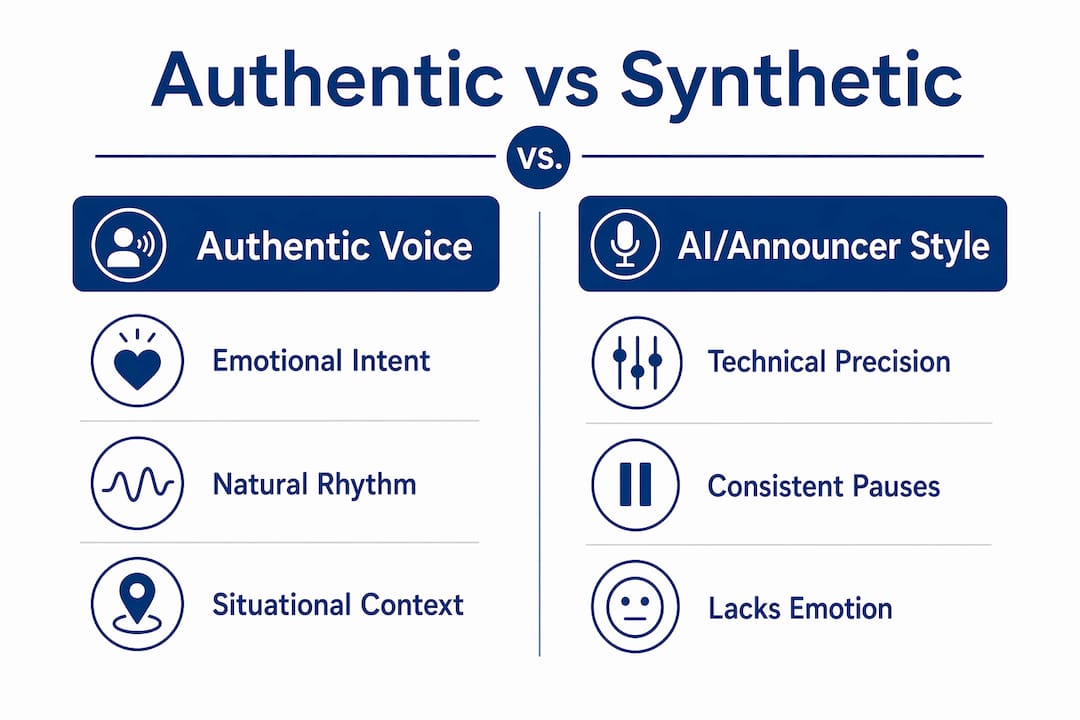
What is authentic voice over vs. synthetic or announcer style?

Authentic voice over is defined by the absence of performative artifice. The delivery feels like one person talking to one other person, not projecting to a crowd. Traditional announcer style does the opposite. It amplifies, rounds every vowel, and hits every word with equal weight. The result sounds professional but distant, like a stranger reading your mail aloud.

AI-generated voices fall into a different trap. They are technically precise but lack genuine emotional flow, which creates a feeling of manipulation or disconnection in the listener. Mission-driven campaigns, healthcare brands, and political messaging suffer most from this gap. Audiences in those categories are already skeptical. A voice that sounds manufactured confirms their suspicion.

Hands editing audio in home office

The tells are specific. Perfectly timed pauses, consistent breath patterns, and overpronunciation are the clearest signs a voice over is synthetic. Human speech does not work that way. A real person trails off slightly, breathes unevenly, and occasionally softens a consonant. Those imperfections are not flaws. They are the proof of life that builds trust.

Feature Authentic Human Voice AI or Announcer Style
Emotional intention Present at the thought level Absent or simulated
Breath and pacing Organic, slightly variable Consistent, mechanically timed
Imperfections Natural hesitations, soft consonants Smoothed out or absent
Listener response Trust and connection Distance or suspicion
Best use case Hero assets, sensitive campaigns High-volume localization with review

Pro Tip: When auditioning voice talent, ask for a cold read of two sentences from your script. A performer who sounds natural without preparation is already working from an authentic internal process.

How does situational direction improve voice over authenticity?

Vague direction is the single most common reason a voice over session produces an inauthentic read. Telling a performer to “sound warm” or “be conversational” gives them nothing to act on. Those are adjectives, not situations. Situational direction gives the actor a specific scenario to inhabit, and the emotional quality follows naturally from that context.

Infographic comparing authentic voice and AI voice styles

The deeper problem with vague direction is that it pushes performers toward imitation. They try to sound warm instead of feeling warm. That distinction shows up in the recording. Post-production cannot reliably recreate authentic pacing or emotion missing from the original performance. Editing in pauses after the fact does not fix a read that was never grounded in genuine thought.

Here is how to build a situational brief that works:

  1. Name the relationship. Tell the actor who they are talking to. “You’re explaining this to your neighbor who just got diagnosed” is more useful than “sound empathetic.”
  2. Set the physical context. “You’re sitting across a coffee table, not standing at a podium” changes posture, volume, and pace immediately.
  3. Define what the speaker wants. “You want this person to feel less afraid, not more informed” gives the actor an emotional objective, not a tonal instruction.
  4. Specify the stakes. Low stakes produce intimacy. “This is a casual observation you’re sharing, not a warning” removes the theatrical energy that kills authenticity.
  5. Give a lead-in line. A short preparatory phrase before the script starts helps performers enter the natural thought process needed for authentic pacing and tone.

Specific, contextual direction respects the actor’s craft and produces better results than any amount of post-session editing. The brief you write before the session is as important as the script itself.

Pro Tip: Write your direction brief as a short paragraph describing the scene, not a list of adjectives. Actors are trained to respond to situations. Give them one.

What techniques do voice actors use for genuine delivery?

Voice over authenticity explained from the performer’s side comes down to a set of specific mental and physical practices. These are not tricks. They are the mechanics of making a written script sound like a living thought.

  • Anti-announcer delivery. The performer treats the script as private thoughts spoken to one listener, not a public address. This preserves natural rhythm and allows minor speech flaws that build credibility. The goal is to sound like you just thought of what you’re saying, not like you memorized it.
  • Lead-ins. Before reading the first line, the actor speaks a short, improvised sentence that connects to the script’s opening thought. This technique, documented by voice coach Topher Keene, prevents the cold-start stiffness that makes the first few seconds of a read sound rehearsed.
  • The duologue concept. Performers who visualize a single listener behind the script sustain authentic engagement throughout the recording. VOBoss describes this as treating a monologue like a duologue. The imagined listener responds, reacts, and keeps the performer from drifting into reading mode.
  • Lowering the stakes. Artificially high stakes or overacting detract from authenticity. Talking as if to one intelligent peer, rather than performing for a crowd, creates genuine connection. Empathy and believable emotional grounding produce the read, not theatrical energy.
  • Embracing imperfection. A slight breath before a key phrase, a natural trailing off at the end of a thought, a soft consonant on a casual word. These are not mistakes to edit out. They are the texture of real speech, and they tell the listener’s brain that a real person is present.

For filmmakers working with off-camera narration, these techniques are especially relevant. Documentary narration that sounds performed breaks the viewer’s immersion. A narrator who sounds like they are remembering something, rather than reading it, keeps the audience inside the story.

How do you apply authentic voice over in real media projects?

The practical challenge for most creators is not understanding authenticity. It is maintaining it across different formats, budgets, and production timelines. The hybrid operating model is the current industry answer. Human voice talent anchors hero assets and emotionally sensitive content. AI voice handles high-volume localization and secondary content, provided it goes through expert native-speaker review.

The Darkest Dungeon development team offered a clear example of where this line sits. When narrator Wayne June passed away, the studio rejected an AI voice clone rather than risk the emotional inauthenticity that would have followed. That decision reflects a principle every brand should apply to flagship campaigns: the voice is the relationship. Replacing it with a simulation breaks the relationship.

For casting and directing, the voice over casting process should screen for performers who demonstrate natural delivery in auditions, not just technical range. The “booth barrier” is a real production problem. Some performers sound natural in conversation but stiffen the moment they are in a recording environment. Casting sessions that include a cold read of conversational copy reveal this quickly.

Project Type Recommended Voice Approach Key Authenticity Risk
Brand hero ad Human talent, situational direction Announcer style, over-performance
Documentary narration Human talent, duologue technique Reading mode, emotional flatness
High-volume localization Hybrid: AI with native-speaker review Mechanical pacing, tonal mismatch
Political messaging Human talent only AI disconnection, trust erosion
Long-form audiobook Human talent, lead-in technique Booth barrier, monotony over time

For ad campaigns in 2026, the standard is shifting. Audiences have been exposed to enough AI-generated content that they are developing an instinct for it. A voice that sounds too clean, too consistent, and too perfectly paced now triggers the same skepticism that stock photography did a decade ago.

Key takeaways

Authentic voice over succeeds because it sounds like genuine human thought directed at one listener, not a performance delivered to an audience.

Point Details
Anti-announcer delivery is the standard Treat scripts as private thoughts, not public addresses, to preserve natural rhythm and trust.
Situational direction outperforms tonal adjectives Give actors a specific scenario and relationship, not instructions like “sound warm.”
AI voices lack emotional intention Synthetic voices miss the thought-level emotion that builds trust in sensitive campaigns.
Hybrid models require quality control Use human talent for hero assets and native-speaker review for any AI-generated localization.
Imperfections build credibility Natural hesitations and breath patterns signal human presence and increase listener trust.

Why authenticity is the last competitive advantage in voice over

I have watched the voice over industry absorb wave after wave of technology promises, and the pattern is always the same. The tool improves. The audience adapts. The emotional gap stays exactly where it was. What strikes me most about the current AI voice moment is not the quality of the output. It is the speed at which audiences are learning to distrust it.

The creators who are winning right now are not the ones with the best microphones or the fastest turnaround. They are the ones who understand that a voice is a relationship. When you put a human voice on your content, you are making a claim: a real person cares enough about this message to say it out loud. That claim is worth protecting.

The practical recommendation I give to every filmmaker and advertiser I work with is this: cast for authenticity first, range second. A performer who sounds genuinely present in a cold read will serve your project better than a technically impressive performer who needs three takes to stop sounding like they are performing. The scene pacing and voice direction work you do before the session determines the ceiling of what you can achieve in it.

Authenticity is not a style choice. It is the mechanism by which a voice over earns the listener’s attention and keeps it.

— kribi

Work with a voice that sounds like a real person

Gregeschmeyervoice specializes in exactly the kind of grounded, conversational delivery this article describes. Greg Eschmeyer’s work spans commercials, political messaging, documentaries, and broadcast, and his clients consistently highlight one thing: the read sounds like a person, not a performance.

https://gregeschmeyervoice.com

If you are casting for a campaign where trust and emotional connection are non-negotiable, professional voice acting services from Gregeschmeyervoice deliver the anti-announcer quality that modern audiences respond to. For documentary projects, the narrator audition process at Gregeschmeyervoice is built around authentic storytelling from the first take. When the voice is the relationship, choose a voice that sounds like one.

FAQ

What is authentic voice over?

Authentic voice over is a vocal performance style that sounds like natural human speech directed at one listener rather than a broadcast audience. It uses anti-announcer delivery, natural imperfections, and emotional grounding to build listener trust.

How does authentic voice over differ from AI voice over?

AI voices are technically precise but lack emotional intention at the thought level, which creates a feeling of disconnection. Human authentic voice over includes organic pacing, breath variation, and genuine emotional grounding that synthetic voices cannot replicate.

What is anti-announcer delivery?

Anti-announcer delivery treats the script as private thoughts spoken to one person, preserving natural rhythm and minor speech flaws. It is the opposite of the projected, evenly weighted broadcast style associated with traditional commercial voice overs.

Why does situational direction produce better voice over?

Situational direction gives performers a specific scenario to inhabit, which produces natural pacing and emotional connection. Vague instructions like “sound warm” push actors toward imitation rather than genuine feeling, and post-production cannot fix a read that was never emotionally grounded.

When should you use human vs. AI voice over?

Human voice talent is the right choice for hero assets, political messaging, and emotionally sensitive campaigns. AI voice can work for high-volume localization when subjected to expert native-speaker review, following the hybrid model used by leading brands.

Authentic Voice Over Explained for Creators2026-06-18T04:36:27-04:00

How Voice Over Supports Sales Presentations

2026-06-17T04:08:27-04:00

Voice over for presentations is defined as recorded narration layered over visual slides to guide, persuade, and convert an audience without requiring a live presenter. Sales teams that add professional narration to their decks see conversion rates rise 20–24%, with some B2B cases reporting up to 4x improvement in sign-ups. Understanding how voice over supports sales presentations means understanding why the human voice carries trust, clarity, and emotional weight that bullet points simply cannot. Tools like PowerPoint’s built-in narration, AI platforms like Typecast and Rep.ai, and professional voice actors each offer a different path to the same goal: a presentation your prospect actually finishes.

What are the key benefits of voice over in sales presentations?

Voice over transforms a passive slide deck into an active selling tool. When a prospect reads your deck alone, they control the pace, skip slides, and miss your emphasis. A narrated presentation controls the story.

Man narrating and presenting sales slides to colleague

The numbers behind this are hard to ignore. Completion rates exceed 85% when voice over is combined with strong visuals, compared to far lower rates for static decks sent without audio. That means more of your prospects reach your pricing slide, your case study, and your call to action.

Here is what voice over specifically delivers for sales teams:

  • Clarity: Complex products become easier to understand when a voice explains each feature in real time, reducing the cognitive load of reading dense text.
  • Emotional connection: Emotionally delivered voice pitches consistently outperform scripted slides and monotone narration in both engagement and memorability.
  • Recall: High-quality narration paired with animation or visuals increases conversion by up to 20% by improving how well prospects remember your message after the presentation ends.
  • Accessibility: Narrated decks serve prospects who prefer audio learning, non-native readers, and anyone reviewing your deck in a noisy environment.
  • Consistency: Every prospect hears the same pitch, with the same emphasis, every time. No rep variation, no off days.

The importance of voice overs in sales goes beyond aesthetics. A narrated deck is a scalable sales asset. You record it once and it works around the clock, across time zones, without a rep on the line.

Pro Tip: Record a short 60-second narrated intro slide for your deck. Prospects who hear a real voice in the first 30 seconds are far more likely to keep watching than those who open to a silent title page.

AI vs. human voice actors: which wins for sales?

The choice between AI-generated narration and a professional human voice actor is not about quality alone. It is about stakes, volume, and what your audience needs to feel.

Factor AI Voice Over Human Voice Actor
Speed Sub-1-hour for a 20-slide deck Days to weeks depending on revisions
Cost Low per-unit cost at scale Higher upfront investment
Emotional nuance Limited contextual awareness Full range of tone, warmth, urgency
Best use case High-volume, quick-turnaround content High-stakes demos, enterprise pitches
Language support Multilingual with one tool Requires separate talent per language
ROI peak Volume and rapid prototyping Critical presentations requiring trust

Infographic comparing AI and human voice overs with key attributes

AI tools have largely overcome the uncanny valley problem. Modern platforms like Typecast and SyncSlide produce narration that sounds natural to most listeners. The real gap is contextual awareness. An AI voice cannot read the room, adjust emphasis based on a client’s industry, or deliver the kind of warmth that closes a seven-figure deal. Professional voice actors maximize ROI on critical presentations precisely because emotional nuance is where human voices still lead.

The smart approach for most sales teams is a hybrid model. Use AI narration for prospecting decks, product overviews, and onboarding content. Reserve professional human voice talent for executive-level demos, custom enterprise pitches, and any presentation where the relationship is the deal.

One technical issue that catches teams off guard is syncing. Audio must be tightly synced with slide transitions to avoid a stutter effect that reads as unprofessional. Set each slide’s advance timing to trigger just after the audio clip finishes, not simultaneously.

Pro Tip: When using AI voice tools, run your finished deck past one person outside your team before sending it to a prospect. Fresh ears catch robotic phrasing and awkward pauses that you stop noticing after the fifth review.

Best practices for using voice over in sales presentations

Getting voice over right is a craft, not just a technical task. The script, the pacing, and the structure all determine whether your narration closes deals or loses attention.

Write for conversation, not reading. The single biggest mistake sales teams make is narrating their slide text word for word. Conversational design in voice over scripts drives conversion lifts above 24% compared to linear narration. Write your script the way you would explain the product to a smart friend, not the way you would write a white paper.

Match voice style to your audience. A narration for a CFO audience should sound measured and precise. A narration for a startup founder should sound direct and energetic. The voice style you choose signals whether you understand your buyer. This is one reason voice over casting matters more than most sales managers realize.

Here is a practical workflow for building a narrated sales deck:

  1. Write your script slide by slide, keeping each narration under 45 seconds per slide.
  2. Read the script aloud before recording. If you stumble, rewrite the sentence.
  3. Record or generate audio, then import each clip into your slide tool.
  4. Set slide advance timings to trigger one second after each audio clip ends.
  5. Export the deck as a video or self-running presentation for async sharing.
  6. Test the full deck on both desktop and mobile before sending.

Pacing is everything. Narration that rushes through complex information loses the prospect. Narration that drags loses attention. Aim for a natural speaking pace of roughly 130–150 words per minute for sales content. Slower for technical explanations, slightly faster for momentum-building sections.

For teams working without a studio setup, the DIY voice over guide from Gregeschmeyervoice covers how to get clean audio from a home or office environment without professional equipment.

Which tools help sales teams build narrated presentations?

The right tool depends on your volume, budget, and how much customization your presentations require.

PowerPoint remains the most accessible starting point. Its built-in Record Slide Show feature lets you narrate each slide individually, sync timings automatically, and export the finished deck as a video. It supports multilingual narration and easy embedding and updating of audio clips across the full deck.

Typecast is an AI voice platform that integrates directly with PowerPoint workflows. You paste your script, select a voice, and generate narration in minutes. It supports dozens of languages and voice styles, making it practical for global sales teams.

Rep.ai focuses specifically on interactive sales demos. It layers voice over onto product walkthroughs and supports branching, so prospects can choose their own path through the demo while still hearing guided narration.

SyncSlide converts PowerPoint decks into fully narrated videos using AI-enabled voice generation with natural intonation. It is built for teams that need to produce polished video presentations at scale without a video production budget.

The efficiency gains from these tools are significant. AI-driven voice over tools reduce production time for narrated decks by up to 95%, making it possible to produce a polished 20-slide narrated presentation in under an hour. That changes the economics of personalized outreach entirely.

For teams exploring AI-powered production at a broader scale, platforms like Image Studio combine voice generation with visual content creation for a more complete production workflow.

Key takeaways

Voice over in sales presentations directly increases conversion rates, completion rates, and audience recall when applied with the right script, voice style, and technical setup.

Point Details
Conversion lift is measurable Professional narration drives 20–24% higher conversion rates in sales demos.
Completion rates depend on audio Narrated visual decks achieve over 85% completion, far above silent alternatives.
AI suits volume, humans suit stakes Use AI for high-volume content and human voice actors for critical enterprise pitches.
Conversational scripts outperform linear ones Writing for dialogue instead of reading drives 24%+ conversion gains in interactive demos.
Sync timing is non-negotiable Set slide advance timings just after each audio clip ends to avoid stutter and maintain professionalism.

What i have learned after watching hundreds of sales decks

Most sales managers I talk to underestimate how much the voice itself shapes the outcome of a presentation. They focus on the slides, the data, the design. The voice is almost an afterthought. That is a mistake I have seen cost deals.

The presentations that perform best share one quality: the narration sounds like a person who genuinely believes in what they are selling. Not a script reader. Not a corporate announcement. A person. That quality is hard to fake with AI, and it is hard to manufacture with a voice actor who does not understand the product. The best results come when the voice talent takes time to understand the buyer’s problem before recording a single word.

Pacing is the other thing most teams get wrong. They rush. They pack too much into each slide because they are afraid of silence. Silence in narration is not dead air. It is emphasis. The pause after a strong claim is where the prospect’s brain processes and agrees. Cut your script by 20% and your narration will perform better almost every time.

The other lesson worth sharing: test with real prospects, not internal reviewers. Your sales team will approve anything that sounds professional. Your prospects will tell you, through their behavior, whether the narration actually moved them. Watch completion rates, not compliments.

For teams serious about voice and pacing technique, the principles that work in film narration translate directly to sales presentations. The mechanics of holding attention are the same.

— kribi

Get a professional voice for your next sales presentation

When the deal is large enough to matter, the voice carrying your pitch should be built for it.

https://gregeschmeyervoice.com

Gregeschmeyervoice delivers professional narration with a grounded, conversational style that builds trust from the first sentence. Greg Eschmeyer has worked across commercials, B2B demos, and broadcast content, with clients consistently noting his fast turnaround and ability to match the exact tone a presentation needs. For sales teams that want a voice that sounds like a real person, not a generated track, professional voice over services from Gregeschmeyervoice are worth the conversation. You can also review voice over best practices to prepare your script before your first session.

FAQ

How does voice over improve sales presentation conversion rates?

Professional narration increases conversion rates by 20–24% by guiding prospects through the deck, reinforcing key claims with tone and emphasis, and reducing drop-off before the call to action.

When should i use a human voice actor instead of AI?

Use a professional human voice actor for high-stakes demos, enterprise pitches, and any presentation where emotional nuance and trust are critical. AI voice tools are better suited for high-volume or rapid-turnaround content.

What is the best script format for a narrated sales deck?

Write conversationally, not as a reading of your slide text. Conversational voice over design outperforms linear narration and drives conversion lifts above 24% in interactive demos.

How do i sync voice over with PowerPoint slides correctly?

Set each slide’s advance timing to trigger one second after the audio clip finishes. Tight audio-to-slide sync prevents stutter effects that undermine the professional quality of your presentation.

Can AI voice tools handle multilingual sales presentations?

Yes. Platforms like Typecast and SyncSlide support multiple languages within a single workflow, making them practical for global sales teams that need consistent narration across markets without hiring separate voice talent for each language.

How Voice Over Supports Sales Presentations2026-06-17T04:08:27-04:00

Vocal Performance in Film Tone: A Filmmaker’s Guide

2026-06-16T06:09:25-04:00

Vocal performance is the primary driver of emotional tone in film, operating through pitch, pace, volume, and non-verbal vocalizations to shape how audiences feel before a single word registers consciously. The role of vocal performance in film tone goes far beyond dialogue delivery. Speech prosody, micro-acoustic cues like breath and swallows, and the timing of voice within a sound mix all determine whether a scene lands as tense, tender, or comedic. Sound editor Walter Murch’s Law of 2½ establishes that audiences track roughly 2.5 sound layers at once, which means every vocal choice competes for emotional bandwidth. Get it right, and the voice carries the story. Get it wrong, and even brilliant visuals fall flat.

How does vocal performance shape film tone?

Vocal performance shapes film tone through two distinct channels: speech prosody and non-verbal vocalizations. Prosody covers the musical qualities of spoken language, specifically pitch variation, pacing, stress patterns, and volume. Non-verbal vocalizations include sighs, laughs, gasps, and the barely audible sounds actors produce between words.

Research confirms that these two channels are not equal in speed or impact. A 2026 PLOS ONE study found that listeners recognize emotions from vocalizations in a mean time of 417 ms, compared to 765 ms for native speech prosody. That gap matters enormously in film, where a single cut lasts two to four seconds and emotional tone must transfer instantly.

The practical implication is this: a character’s sharp intake of breath or a low, controlled exhale communicates fear or relief faster than any line of dialogue. Filmmakers who treat these micro-acoustic events as afterthoughts are leaving their most efficient emotional tools unused.

  • Pitch: Rising pitch signals uncertainty or excitement; falling pitch signals authority or resignation.
  • Pace: Slowed delivery creates weight and gravity; accelerated delivery creates urgency or panic.
  • Volume: Quiet, controlled speech reads as intimacy or threat; raised volume signals emotional escalation.
  • Non-verbal cues: Sighs, laughs, and breath patterns carry emotional nuance that prosody alone cannot replicate.

Pro Tip: Record a scene’s audio track in isolation and play it without picture. If the emotional arc is unclear from voice alone, the performance needs work before you lock picture.

Does vocal tone actually drive narrative coherence?

Vocal performance is a narrative engineering tool, not an aesthetic add-on. The timing and quality of a voice within the sound mix directly determines whether a scene’s story logic holds together. Sound design principles confirm that wrong layering makes scenes noisy, while correct layering produces audience engagement and emotional clarity.

Walter Murch’s Law of 2½ is the governing constraint here. When a scene stacks dialogue, score, and sound effects at equal volume, the audience cannot prioritize any single emotional signal. The voice gets buried. Directors and sound designers must make deliberate choices about which sound layer carries the scene’s emotional weight at any given moment.

Vocal timing relative to scene cuts is equally critical. A line delivered a half-second before a cut lands differently than the same line delivered across the cut. The former closes the scene emotionally; the latter opens the next one. This is why voice and scene pacing deserves the same attention as shot selection.

Infographic illustrating five key vocal performance elements

Sound Layer Function in Scene Vocal Priority
Dialogue Carries narrative information and character emotion Highest in most scenes
Score Reinforces or counterpoints emotional tone Secondary to dialogue
Sound effects Grounds scene in physical reality Tertiary unless used for shock
Silence Creates tension or intimacy Amplifies vocal impact when used deliberately

Pro Tip: Mix your dialogue track first, at the level it needs to be heard clearly. Then build music and effects underneath it. Never start with score and try to fit dialogue on top.

What happens to vocal tone during film dubbing?

Dubbing is where vocal tone most often breaks down, and the damage is more specific than most filmmakers realize. A 2025 acoustic study of the Ukrainian-dubbed version of Friends analyzed 1,050 non-verbal vocalizations and found that frequent alteration or deletion of these sounds directly degraded emotional resonance and comedic timing. The words were translated correctly. The tone was not.

The core problem is that dubbing workflows traditionally prioritize lip-sync and lexical accuracy. Micro-acoustic events like breath patterns, swallows, and wheezes are treated as incidental noise rather than performance data. When those sounds are removed or replaced with generic equivalents, the dubbed performance loses the texture that made the original feel authentic.

Effective dubbing requires a different approach at the director level. A 2026 AAAI conference paper proposes a director-actor interaction scheme in which actors internalize emotional context before recording, rather than simply matching syllables to picture. The result is dubbed performances that carry genuine emotional expressiveness instead of mechanical synchronization.

For filmmakers working in automated dialogue replacement (ADR), the same principle applies. Here are the practices that preserve tonal coherence:

  • Preserve non-verbal vocalizations: Catalog every breath, laugh, and sigh in the original performance and require the ADR session to match them acoustically, not just rhythmically.
  • Brief actors on emotional context: Before each ADR pass, remind the actor what the character is feeling in that moment, not just what they are saying.
  • Use acoustic phonetic analysis: Compare pitch, duration, stress, and amplitude between original and replacement recordings before approving a take.
  • Protect comedic timing: Non-verbal sounds carry comedic rhythm. A laugh replaced with a generic chuckle can kill a joke that worked perfectly in the original.

For teams recording outside a professional facility, the DIY voice-over guide from Gregeschmeyervoice covers how to maintain emotional nuance in non-studio ADR conditions.

Which vocal techniques create the strongest film performances?

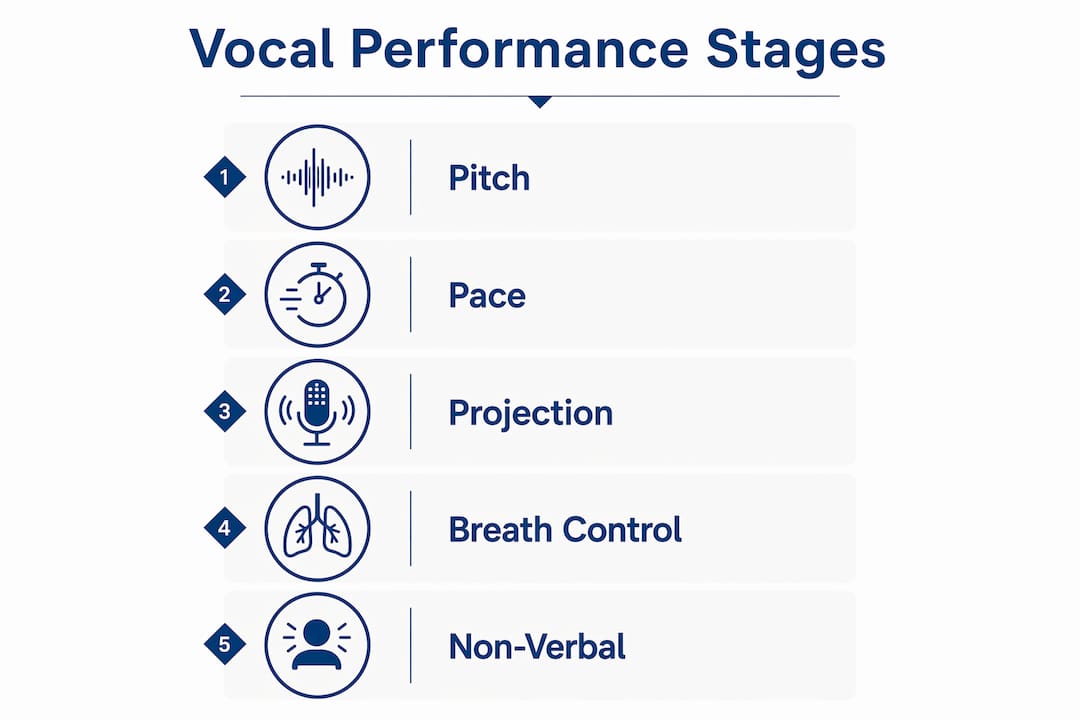
The most effective framework for cinematic vocal performance is Topher Keene’s Three-P Framework: Pitch, Pace, and Projection. Each element functions as a distinct control for emotional output, and the three work together to create what Keene describes as dynamic vocal shape, the rise and fall pattern that keeps audiences emotionally engaged across a scene.

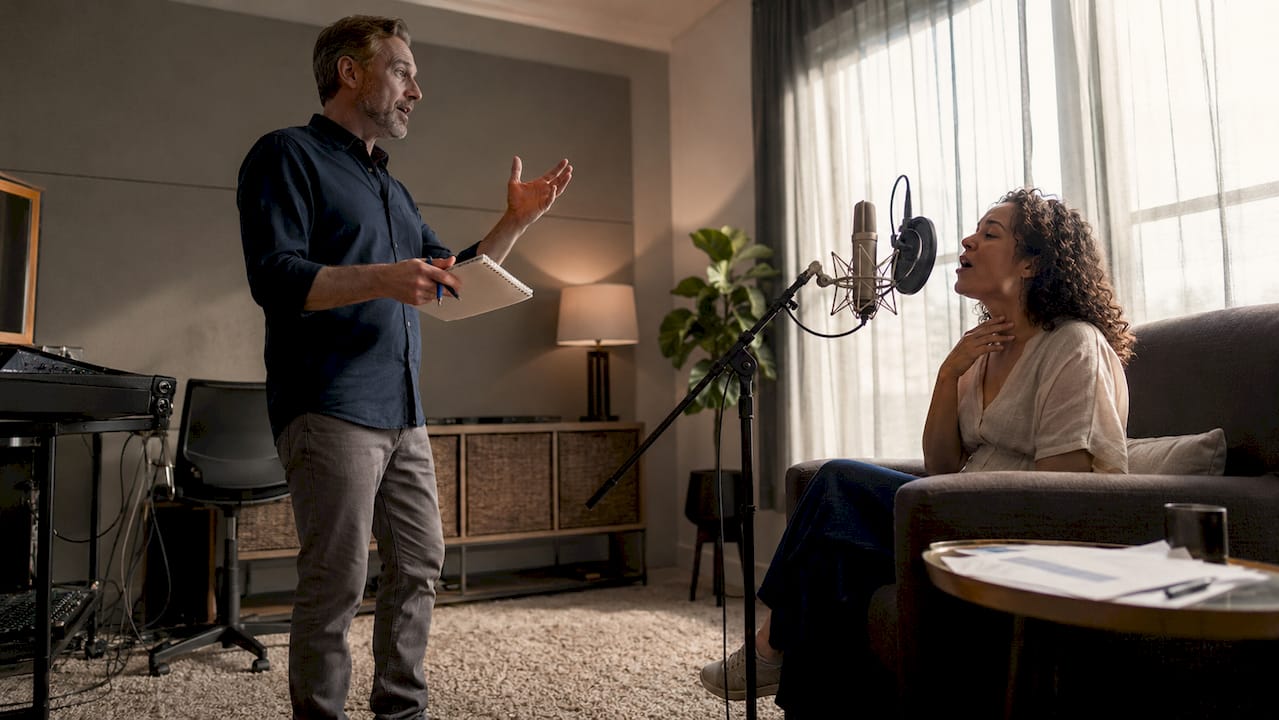
Voice coach assisting voice actor with vocal technique

A flat, constant-tone delivery is the single most common failure in voice performance for film. When pitch, pace, and projection stay at the same level throughout a scene, the audience’s nervous system stops registering the voice as emotionally significant. The brain habituates to the signal and stops listening.

Dynamic vocal shape works against that habituation. The pattern that Keene’s framework recommends moves from a quiet, conversational opening through an escalating peak and then pulls back to an intimate close. That arc mirrors the emotional structure of most well-written scenes and gives the audience a ride rather than a lecture.

Here is how to apply the Three-P Framework in practice:

  1. Map the scene’s emotional arc before recording. Identify the low point, the peak, and the resolution. Assign pitch, pace, and projection targets to each.
  2. Start quieter than feels natural. Most actors open at their peak and have nowhere to go. Beginning at 60–70% of your full vocal range leaves room to build.
  3. Use pace as a tension tool. Slow down at moments of high emotional weight. Speed up when the character is losing control or urgency is rising.
  4. Pull back at the end. The intimate pullback after a peak is where audiences feel the emotional payoff. Sustaining peak volume through the close kills the landing.
  5. Record multiple dynamic shapes for the same line. Give the director options. A line delivered with a rising arc reads differently than the same line with a falling arc, and the edit may need either.

Breath control underpins all three elements. Breath control in acting directly affects vocal stamina and the ability to sustain dynamic performance across long recording sessions without losing tonal consistency.

Pro Tip: After a long recording session, your pitch tends to drop and your pace tends to slow. Record a reference line at the start of the session and compare it to the same line recorded two hours later. Adjust before the fatigue becomes audible in the final cut.

Key takeaways

Vocal performance is the most direct and fastest-acting tool filmmakers have for establishing emotional tone, and it operates through prosody, non-verbal vocalizations, and deliberate sound design choices.

Point Details
Vocalizations beat prosody for speed Non-verbal sounds convey emotion in 417 ms vs. 765 ms for speech prosody, making them the fastest emotional signal in film.
Murch’s Law of 2½ governs vocal priority Audiences track 2.5 sound layers at once, so vocal tone must be deliberately foregrounded in the mix.
Dubbing destroys micro-acoustic cues Altering or deleting non-verbal vocalizations in dubbing degrades emotional resonance and comedic timing.
The Three-P Framework builds performance arcs Pitch, Pace, and Projection applied dynamically prevent flat delivery and sustain audience engagement.
Director-actor context briefings improve ADR Actors who internalize emotional context before recording produce more authentic tonal performances than those matching syllables alone.

Why i think filmmakers undervalue the voice until it’s too late

Most filmmakers I’ve observed treat vocal performance as a casting problem. Hire the right actor, and the voice takes care of itself. That assumption costs productions more in post-production than almost any other single decision.

The voice is a narrative instrument with as many variables as a camera lens. Focal length, aperture, and distance all change what a lens communicates. Pitch, pace, projection, and non-verbal texture all change what a voice communicates. You wouldn’t hand a cinematographer a camera and say “figure it out.” You shouldn’t hand an actor a script and assume the vocal tone will land correctly without direction.

The research on non-verbal vocalizations makes this concrete. The sounds between the words, the breath before a confession, the swallow before a lie, the laugh that doesn’t quite reach the eyes, these are the moments audiences remember. They are also the moments most likely to get cut, replaced, or ignored in post-production.

My practical advice: bring vocal performance into your pre-production conversations alongside shot lists and production design. Work with your actors on the emotional arc of each scene before you discuss blocking. And if you’re doing ADR or dubbing, treat every non-verbal sound in the original performance as a piece of narrative data that must be preserved or deliberately replaced with something equally specific.

The voice is not decoration. It is structure.

— kribi

Work with a voice that carries your film’s tone

https://gregeschmeyervoice.com

Gregeschmeyervoice delivers the kind of grounded, conversational performance that holds a scene’s emotional tone without artificial enhancement. Whether you need a narrator for a documentary, a character voice for a broadcast, or a professional ADR session that preserves every nuance of the original performance, Greg Eschmeyer brings the authenticity your project requires. His clients consistently highlight fast turnaround, precise tonal matching, and the ability to internalize emotional context before the mic opens. If you’re building a film that depends on voice to carry its story, start with a professional voice actor who treats vocal performance as narrative craft, not just delivery.

FAQ

What is speech prosody in film performance?

Speech prosody refers to the pitch, pace, stress, and rhythm patterns in spoken dialogue. In film, prosody shapes how audiences interpret a character’s emotional state and the scene’s overall tone.

How do non-verbal vocalizations affect film tone?

Non-verbal vocalizations like sighs, laughs, and breath patterns convey emotions faster than spoken words. They are the fastest emotional signal available to a performer and the most commonly lost in post-production.

What is walter murch’s law of 2½?

Walter Murch’s Law of 2½ states that audiences can consciously track approximately 2.5 sound layers simultaneously. Sound designers use this principle to decide which layer, usually dialogue, carries the scene’s primary emotional information.

Why does dubbing weaken vocal performance?

Dubbing typically prioritizes lip-sync and word accuracy over micro-acoustic vocal cues. When non-verbal sounds are altered or deleted, the emotional texture and comedic timing of the original performance degrade significantly.

What is the three-p framework for voice acting?

The Three-P Framework, developed by Topher Keene, organizes vocal performance around Pitch, Pace, and Projection. Applied dynamically across a scene, these three elements create the emotional arc that keeps audiences engaged and prevents flat delivery.

Vocal Performance in Film Tone: A Filmmaker’s Guide2026-06-16T06:09:25-04:00

Top 4 ChadErickson.com Alternatives for 2026

2026-06-14T23:13:02-04:00

Finding a voice over service that delivers authentic human voices without long quoting delays is unpredictable in 2026. Leading providers still require direct contact for quotes, hide pricing, or gate demos behind sales interactions. This comparison covers sample access, project fit, and responsiveness so you can select a service that meets your creative and timeline needs.

Table of contents

Greg eschmeyer voice

https://gregeschmeyervoice.com

At a glance

Greg delivers voice over work that is presented as always human and never AI. He focuses on grounded, conversational delivery for commercials, political spots, documentary narration, and broadcast work. Client testimonials emphasize quick turnaround, professionalism, and performances that aim to connect emotionally with audiences.

Core features

  • Grounded, conversational voice over delivery. Recordings favor an authentic, restrained tone suitable for narrative and persuasive scripts.

  • Experience across commercial, political, documentary, and broadcast projects. That range means he can adapt pacing and emphasis to different production needs.

  • Multiple demo recordings and sample videos available for review. You can audition tone and match a demo to your script before committing.

  • Professional and quick turnaround. Clients report short delivery windows for demo reads and final masters.

Key differentiator

Grounded, authentic voice delivery that emphasizes human connection over AI or synthetic voices. That focus shows up in the demo set and in the delivery choices Greg makes. The tone aims to sound conversational rather than polished into a generic narrators voice. For producers who need emotional truth rather than a perfected studio read, that distinction matters.

Pros

  • High quality voice talent with an authoritative, warm delivery. This helps advertisers and documentarians create believable narration.

  • Flexible performance options for different project types. He shifts tone between commercial urgency and documentary understatement.

  • Positive client testimonials citing professionalism and responsiveness. Those references indicate reliable client communication and scheduling.

  • Multiple samples let you evaluate fit before booking. You can compare reads for pace, inflection, and suitability to your script.

  • Fast turnaround on recordings and edits. Producers with tight deadlines can get finished files quickly.

Cons

  • Pricing is not publicly disclosed, which can make budget planning harder for producers who need clear rates upfront.

Who it’s for

Greg fits media producers, marketing teams, documentary filmmakers, and broadcasters who want a human-centered voice. He suits projects that need subtle emotional cues rather than performance that sounds processed. Choose him when authenticity and a conversational delivery are priorities.

Unique value proposition

Multiple demo recordings and sample videos let you audition specific tones and pacing before you hire. That practical auditioning reduces guesswork during casting. For producers this saves time in preproduction and lowers the risk of re-records when the final voice must match a precise editorial intent.

Real world use case

A documentary filmmaker needs a narrator who reads with calm authority and a conversational rhythm. The filmmaker reviews Gregs demo clips, selects the best fit for the film s tone, and commissions a session. Greg delivers a final narration that aligns with the film s emotional arc and meets the postproduction deadline.

Pricing

Pricing is not published on the site. Most direct hire voice over artists provide project quotes based on usage, length, and delivery specs. Contact Greg directly through his site to request a tailored estimate and licensing terms.

Website: https://gregeschmeyervoice.com

Gregthevoice.com

https://gregthevoice.com

At a glance

Worked with clients such as HBO and BMW, which is the most specific claim on the site. According to the vendor, Greg reports 15+ years of industry experience and a BBB A+ rating. That mix of high-profile credits and stated tenure signals an experienced independent voice professional.

Core features

Gregthevoice.com centers on three practical service areas for producers and creators.

  • Voice over and acting services for commercials, narration, and promos.
  • Audio mastering, editing, and corrections to deliver broadcast-ready files.
  • Voiceover career training and education targeted at aspiring talent.
  • Professional studio setup and client-facing production support.

These features match the needs of producers who want a single point of contact for performance and final audio delivery.

Key differentiator

Gregthevoice.com pairs recorded performance with hands-on audio engineering and coaching. That combination reduces handoffs between actor, engineer, and coach. For advertisers who want a single contractor to record, polish, and advise talent, that experience claim above matters more than a standalone voice service.

Pros

  • Experienced practitioner. The site claims 15+ years, which suggests familiarity with commercial and broadcast workflows.

  • High-profile credits. Listing clients such as HBO and BMW gives you a concrete portfolio item to reference during casting or procurement.

  • End-to-end service. Greg provides performance plus audio mastering, so you receive a finished master instead of raw takes.

  • Training offering. If you want to develop in-house talent, the training program lets you move from coaching to hiring the same provider.

  • Positive reputation indicators. The vendor advertises a BBB A+ rating and customer reviews that the site highlights.

Cons

  • No public pricing. The site does not list rates or package details, so you must request a quote.

  • Sparse service pages. Several website sections return errors, which makes it hard to confirm exact deliverables and turnaround times.

  • Limited technical specs. The site does not publish sample rates, file formats, or session policies needed for agency procurement.

Who it’s for

This service fits independent producers, small agencies, and content creators who need a single contractor to handle performance, file prep, and coaching. It also suits aspiring voice actors who want mentor-led training and access to a pro studio. Large-scale projects that require posted rate cards or enterprise contracts may not find the detail they need.

Real world use case

A regional ad agency hires Greg for a national spot. The agency books a session, receives edited masters ready for broadcast, and also enrolls a junior actor in a brief coaching package. The agency avoids separate engineering vendors and shortens its delivery loop.

Pricing

The website lists pricing as not applicable and provides no public rate card. Expect custom quotes based on usage, rights, and session length. Contact is required to get turnaround and license fees.

Website: https://gregthevoice.com

Adam lofbomm voice

https://adamlofbomm.com

At a glance

According to his site, Adam Lofbomm lists credits with Apple, Honda, IBM, and Coca-Cola. He records from a studio in Turin equipped with high quality microphones and remote recording tools. That setup supports directed sessions and final masters for broadcast and corporate use.

Core features

  • Wide range of voiceover services for commercials, automotive narration, eLearning, audiobooks, explainer videos, and audio description.

  • A professionally equipped studio with high quality microphones and remote recording capability for live direction.

  • Remote session support via Source Connect, ipDTL, and Zoom for real time direction and file handoff.

  • Experience handling projects for large corporate clients and agency workflows that require fast turnaround.

Key differentiator

Adam’s primary edge is his combination of brand credits and a fully outfitted studio. That mix suits projects that demand a polished, broadcast ready read and tight delivery windows. He fits clients who need studio polish rather than a scratch track or synthetic voice option.

Pros

  • Experienced with high profile clients. That background helps when buyers need a voice with proven corporate and commercial chops.

  • Professionally equipped studio. The setup produces clean, deliverable files ready for post production.

  • Versatile talent able to adjust tone from energetic commercials to measured audiobook narration.

  • Remote recording options let you direct sessions from your office and receive final masters quickly.

  • Reputation for reliability and fast delivery, which suits agency schedules and tight deadlines.

Cons

  • No public pricing. You must request a quote, which adds a step to procurement.

  • Service is bespoke voice work, not a self serve platform. That makes it less suitable for projects needing instant automated audio.

  • Third party reviews included in the dataset do not list specific negatives, so independent critique is limited.

When it may not fit

If you need transparent, fixed pricing for many short pieces, this approach may slow down buying. If you want an on demand synthetic voice or a self serve platform, this service will not match that workflow. Large scale productions requiring staffed punch in rooms might prefer a local casting agency.

Who it’s for

Business owners, marketers, publishers, and content creators who need polished, human narration for broadcast commercials, corporate videos, or audiobooks. Agencies that book studio sessions and expect tight turnarounds will find his offering practical. Solo creators who need low cost, instant output should look elsewhere.

Real world use case

A marketing agency hires Adam for a two week campaign for an automotive launch. The agency directs sessions remotely, receives final masters, and uses those files across TV and radio spots. An eLearning producer hires him for clear course narration and fast edits to meet a client deadline.

Pricing

Pricing is not listed publicly. The website instructs prospective clients to contact Adam directly for project quotes and availability. Expect custom quotes based on usage, deliverables, and turnaround.

Website: https://adamlofbomm.com

Bill DeWees

https://billdewees.com

At a glance

Bill records in a studio equipped with ISDN, a Whisper Room, and a Neumann TLM 103. That kit signals broadcast ready sessions and remote connections with agency producers. He lists work for major consumer brands and a broad demo library on his site. The profile reads like a reliable hire for commercial and corporate projects.

Core features

Bill offers a selection of voice types tailored to commercials, training, narration, and promo work. He records from a Chicago studio that supports professional routing and remote sessions. The site hosts multiple demos so producers can sample tones and pacing before booking.

  • Versatile voice styles for ad, corporate, and narration work
  • Professional studio with ISDN and isolation booth capability
  • Demo library available online for quick casting decisions
  • Experience with high profile brand campaigns and broadcast spots

Key differentiator

Bill stands out for his history on large brand campaigns and for maintaining an in‑studio setup in Chicago. That combination makes him a solid pick when you need recorded audio tracked under strict technical specs and delivered with broadcast quality. Compared with Gregeschmeyervoice, his profile reads more like a traditional commercial hire for national spots. Producers who need clear labeling, delivery stems, and consistent mic chain will notice the difference.

Pros

  • Experienced on recognized brand campaigns. His resume shows commercial work that matches agency expectations for tone and timing.

  • Professional studio chain in Chicago. The onsite equipment and booth support remote directors and ISDN style sessions.

  • Wide demo range. You can audition multiple tones without a preliminary session.

  • Delivery suited for broadcast and corporate distribution. Files come with the technical fidelity most post houses request.

  • Accessible, relatable delivery style. The voice works for friendly brand reads and straightforward narration.

Cons

  • Pricing requires direct contact. There is no published rate card so you must request a quote.

  • Turnaround details are project dependent. The site does not list standardized delivery windows.

  • Public scheduling and availability are not visible. You may need extra coordination for tight deadlines.

Who it’s for

This entry fits marketing teams, production companies, and agencies casting for national commercials, training series, or broadcast promos. Choose Bill when you need a seasoned commercial voice and predictable studio routing. If you prioritize conversational intimacy over a classic commercial sound, consider other options.

Real world use case

An agency casting a national radio spot hires Bill for a 30 second commercial. The producer requests ISDN session notes and a WAV deliverable at 24 bit 48 kHz. Bill records in his Chicago studio, supplies multiple takes, and the post team drops the clean file into the mix with minimal noise cleanup.

Website: https://billdewees.com

Comparison of alternatives

Choosing between voice-over service providers requires understanding which aspects—such as emotional authenticity, range of services, or production workflow—match your project requirements. Here, a comparison of Greg Eschmeyer Voice and its alternatives provides insights for making an informed decision.

Grounded emotional delivery versus integrated workflows

Greg Eschmeyer Voice delivers exceptional emotionally-authentic voice-over narration, characterized by its human-centric and conversation-style delivery. This aligns with producers prioritizing audience connection and storytelling depth. Gregthevoice.com, in contrast, integrates voice-over performance, audio engineering, and talent coaching, allowing for streamlined production workflows and reduced reliance on multiple vendors. This might appeal to projects requiring consolidated service management.

Specialization in remote and high-turnaround production

Both Adam Lofbomm Voice and Bill DeWees excel in accommodating tight production schedules with their professional recording capabilities enhanced by modern remote direction tools. Adam Lofbomm’s expertise with international clients and technical flexibility suits global campaigns. Meanwhile, Bill DeWees focuses on traditional professionalism and high-quality studio setups, providing consistent results for broadcast and corporate clients.

Best fit

  • For producers needing emotionally-authentic narrative performances for impactful storytelling, Greg Eschmeyer Voice is the right choice.
  • For clients seeking an integrated service combining performance, audio prep, and coaching, Gregthevoice.com provides extensive offerings.
  • For global productions requiring precise remote collaboration, Adam Lofbomm Voice’s studio capabilities stand out.
  • For agencies prioritizing established workflow predictability and broadcast quality, Bill DeWees offers reliability.

Our pick

For media producers emphasizing authentic, emotionally impactful storytelling, gregeschmeyervoice.com stands out as the preferred choice. However, if projects demand integrated coaching and mastering or necessitate a technical setup, one of the other listed providers could be a better match. This makes choosing Greg Eschmeyer Voice advantageous when human emotion and a conversational tone are critical to project success.

For media producers and clients searching for a voice over service provider prioritizing authenticity and professionalism, the following comparative table navigates the distinctive attributes of each option.

Service Primary Use Case Key Differentiator Best For Notable Limitation
Gregeschmeyervoice Authentic voice over for commercials and documentaries Grounded, human-centric delivery Marketing teams valuing authenticity Pricing not disclosed, contact required
Gregthevoice.com Commercial and narration voice services Integration of performance with audio mastering Producers wanting a single provider Limited detail on service pages
Adam Lofbomm Voice Corporate and broadcast narration with remote sessions High-tier studio with real-time direction capabilities Agencies needing precision and versatility Requires contact for pricing and availability
Bill DeWees Studio-quality commercial voice over from Chicago On-site ISDN equipped studio with brand campaign history National marketing campaigns Contact needed for pricing and scheduling

Authentic voice over solutions beyond chaderickson.com alternatives

Finding the right voice over for your project can feel overwhelming when faced with the many chaderickson.com alternatives. You need a genuine, human touch that connects emotionally and fits your specific production needs without sounding artificial or generic. Gregeschmeyervoice offers a grounded, conversational approach that ensures your message resonates with audiences across commercials, documentary narrations, and political spots.

https://gregeschmeyervoice.com

Experience professional service with quick turnaround times and multiple demos to help you select the perfect tone before you commit. Don’t wait to evoke authentic engagement in your content. Visit Gregeschmeyervoice and book a session today to deliver memorable narratives tailored just for your project.

FAQ

What sets Gregeschmeyervoice apart in voice over services?

Gregeschmeyervoice specializes in grounded, conversational delivery for various types of projects, ensuring authenticity and emotional connection in the voice work. This approach is emphasized through a collection of demo recordings and sample videos that allow potential clients to select a tone that matches their script. Producers can expect a seamless experience that prioritizes human-centered performance.

How does Gregeschmeyervoice compare with bill DeWees for commercial projects?

Bill DeWees is noted for his experience on recognized brand campaigns, making him a strong choice for commercial needs where name recognition and specific industry standards are essential. However, Gregeschmeyervoice provides a grounded and authentic voice that emphasizes emotional truth over a polished studio read, making it a better fit for projects focusing on connection rather than branding alone.

Can clients expect quick turnaround with Gregeschmeyervoice?

Yes, clients often report fast turnaround times on recordings and edits with Gregeschmeyervoice, which is vital for projects with tight deadlines. The service is designed to accommodate urgent requests, allowing producers to get finished files quickly for their productions.

What are the pricing options for Gregeschmeyervoice services?

Pricing for Gregeschmeyervoice is not publicly disclosed, which may make budgeting more challenging for some producers. To get a tailored estimate and licensing terms based on project specifics, potential clients are advised to contact Greg directly.

What range of voice over services can Gregeschmeyervoice provide?

Gregeschmeyervoice offers services across commercials, political spots, documentary narration, and broadcast work, making it versatile for various production needs. This range allows for adaptability in tone and pacing to cater to different project types, ensuring that clients receive exactly what they’re looking for.

Top 4 ChadErickson.com Alternatives for 20262026-06-14T23:13:02-04:00

Why Voice Talent Selection Matters for Media Pros

2026-06-14T05:19:53-04:00

Voice talent selection is the strategic process of matching the right vocal personality and skill set to your brand’s message, and it directly determines whether your audience connects, trusts, or tunes out. The human voice carries tone, subtext, and emotional weight that no script alone can deliver. For advertising, film, and media professionals, the role of voice talent reaches far beyond reading copy. It shapes perception, builds credibility, and drives the emotional response your project depends on. Getting this decision right is not a detail. It is the foundation of effective storytelling.

Why voice talent selection matters most in media

The biggest misconception in casting is that you are looking for a pleasant tone. You are not. You are looking for a voice that embodies your brand’s psychology and forges a genuine connection with your audience. That distinction changes everything about how you evaluate candidates. A voice that sounds technically clean but emotionally flat will underperform a less polished read that feels authentic and alive.

Voice-over casting, the formal industry term for this process, requires you to think about fit the same way a film director thinks about casting a lead actor. The voice is the character. In commercials, documentaries, and broadcast media, the narrator or spokesperson becomes the audience’s guide. When that guide feels wrong, the entire message loses credibility.

Hands holding voice talent brief and samples overhead view

Platforms like Voice123 have built entire ecosystems around this challenge, giving producers access to large pools of professional talent with searchable demos. That access is valuable. But access alone does not solve the selection problem. Knowing what to listen for does.

What vocal skills define successful voice talent?

Enunciation, pacing, tone, and inflection are the four core technical skills that separate professional voice talent from capable amateurs. Each one affects how your audience receives and retains information.

  • Tone sets the emotional register of the entire piece. A warm, grounded tone builds intimacy. A clipped, authoritative tone signals expertise.
  • Pacing controls how much time the listener has to absorb each idea. Rushed delivery loses nuance. Overly slow delivery loses attention.
  • Inflection is where meaning lives. The same sentence read with different inflection patterns can communicate confidence, doubt, warmth, or urgency.
  • Enunciation determines clarity. In broadcast and advertising, poor enunciation forces the listener to work harder, and most will not bother.

Beyond these fundamentals, specialized projects require additional skills. Character work demands vocal range and the ability to sustain distinct voices across long sessions. Political and corporate narration requires gravitas and precise emotional control. Documentary narration calls for a conversational authority that sounds informed without sounding scripted.

The best way to evaluate these qualities is through a demo reel. A strong reel shows range across project types, not just one polished sample. Listen for consistency across the full reel, not just the opening ten seconds.

Pro Tip: When reviewing demo reels, skip to the middle of each sample. Producers typically place their strongest work first. The middle of the reel reveals how the talent performs under sustained pressure.

Infographic illustrating key vocal skills for voice talent selection

How does voice talent impact brand perception and trust?

A mismatched voice tone causes cognitive dissonance in your audience. That dissonance does not just feel off. It actively erodes trust in your brand. The listener may not consciously identify the problem, but they will feel that something is wrong, and that feeling transfers to your product.

Consider a luxury automotive brand that uses a casual, upbeat voice for its flagship campaign. The tone signals accessibility, not aspiration. The audience receives a mixed message, and the brand’s premium positioning weakens. The reverse is equally damaging. A community health organization that uses a cold, authoritative voice signals distance rather than care.

Human voice actors interpret brand personality and communicate subtext that goes beyond the written script. That interpretive layer is what builds emotional bonds with audiences over time. It is the difference between a message that informs and one that resonates.

The table below maps common brand archetypes to the vocal characteristics that align with each one.

Brand Archetype Ideal Vocal Tone Pacing Example Context
Luxury / Premium Measured, sophisticated, warm Slow to moderate High-end automotive, fashion
Everyman / Friendly Conversational, approachable Moderate Consumer packaged goods, retail
Authority / Expert Confident, clear, direct Moderate to brisk Financial services, healthcare
Inspirational / Hero Energetic, passionate, grounded Dynamic Nonprofit, sports, political
Caregiver / Community Gentle, empathetic, sincere Slow Health services, education

Matching your voice talent to the correct archetype is not a creative preference. It is a brand strategy decision with measurable consequences for audience trust and recall.

What practical factors should guide your selection process?

The single most effective change you can make to your casting process is rewriting your brief. Briefs targeting emotional response outperform generic descriptors every time. “We want the audience to feel inspired and ready to act” produces far better auditions than “We want a friendly, professional voice.” The first brief gives talent a performance goal. The second gives them nothing to work with.

Beyond the brief, consider these practical factors when building your selection criteria.

Selection Factor Agency Marketplace (e.g., Voice123) Direct Freelancer
Talent pool size Curated, smaller Large, searchable Single talent
Cost Higher Moderate Variable
Turnaround Managed Fast Depends on talent
Brand relationship Transactional Transactional Long-term possible
Creative control Shared High High

Session type also matters. Live-directed sessions allow real-time feedback and performance adjustments, which is critical for commercials and character work where nuance is everything. Self-directed recordings work well for straightforward projects like e-learning modules where the copy drives the performance. Know which format your project requires before you start auditioning.

Responsiveness and professionalism are non-negotiable criteria. A voice talent who delivers on time, communicates clearly, and takes direction without friction is worth more than a technically superior performer who creates production delays.

Pro Tip: Treat your best voice talent as a brand communication partner, not a vendor. Brief them on your brand values, not just the script. Talent who understand the brand consistently deliver more aligned performances from the first take.

Do human voice actors outperform ai-generated voices?

Listeners expend more mental effort decoding synthetic speech than human speech. That extra cognitive load reduces attention span and lowers retention. For advertising and branded content, where every second of attention is earned, this is a significant performance gap.

The advantages of human voice talent over AI and synthetic alternatives are concrete and well-documented.

  • Comprehension: Human voices use natural rhythm and micro-variations in tone that help listeners process meaning faster and more accurately.
  • Emotional resonance: Synthetic voices can approximate warmth, but they cannot replicate the genuine emotional investment a skilled actor brings to a read.
  • Brand trust: Audiences increasingly recognize AI-generated audio. When they do, it signals that the brand chose efficiency over authenticity.
  • Nuance and subtext: A human actor can communicate hesitation, confidence, or irony through subtle vocal choices. Current AI voices flatten these distinctions.

Voice cloning technology can replicate voices quickly, but it introduces legal and ethical risks alongside its performance limitations. For commercial and branded content, hiring real human talent is both legally safer and emotionally more effective. The impact on audience engagement is not marginal. Clients who prioritize engagement, comprehension, trust, and retention will consistently find that synthetic voices underperform human actors across all four dimensions.

Key takeaways

Selecting the right voice talent is a brand strategy decision that directly determines audience trust, emotional connection, and message retention across every media format.

Point Details
Voice selection is brand strategy Mismatched tone causes cognitive dissonance and erodes audience trust in your brand.
Brief for emotion, not description Telling talent the feeling you want produces better auditions than generic descriptors like “friendly.”
Human voices outperform AI Listeners retain more and trust more when a skilled human actor delivers the message.
Match voice to brand archetype Luxury, authority, caregiver, and other archetypes each require distinct vocal characteristics.
Treat talent as brand partners Long-term voice relationships produce more consistent, aligned performances across campaigns.

The casting decision nobody talks about

I have sat through enough casting sessions to know where most projects go wrong. It is not the audition pool. It is the brief. Creative directors spend weeks on visual direction and thirty minutes on the voice brief, then wonder why the auditions feel generic. The voice carries half the emotional weight of any media project. It deserves the same strategic attention as the visual concept.

The most effective campaigns I have seen treat voice casting as an extension of brand identity work. They do not just ask “who sounds right?” They ask “who sounds like us?” That question requires knowing your brand’s emotional core, not just its tone guidelines. When you find a voice that answers that question, you hold onto it. Consistent voice talent across campaigns builds recognition the same way a visual identity does. Audiences start to associate that voice with your brand before they even process the message.

The other mistake I see constantly is treating the audition as the final performance. Live-directed sessions exist for a reason. The gap between a self-directed audition and a directed final session can be significant, especially for complex emotional reads. If your project requires precision, budget for the directed session. The difference in output quality justifies the cost every time.

For off-camera narration in particular, the casting decision shapes the entire film. Get it wrong and the most beautiful cinematography feels disconnected. Get it right and the voice becomes invisible in the best possible way. It stops being a voice and starts being the story.

— kribi

Work with a voice that fits your brand

https://gregeschmeyervoice.com

Gregeschmeyervoice delivers the kind of grounded, conversational performance that advertising, film, and broadcast professionals rely on when the message has to land. Greg Eschmeyer brings a natural, human quality to every project, from national commercials to political messaging to documentary narration, with the professionalism and fast turnaround that production schedules demand. If you are ready to match your brand with a voice that communicates more than words, explore professional voice talent services at Gregeschmeyervoice. You can also review the voice-over casting guide to sharpen your selection process before your next project.

FAQ

What is voice-over casting and why does it matter?

Voice-over casting is the process of selecting the right voice actor to match a project’s emotional and brand goals. The right casting decision directly affects audience trust, message retention, and brand perception.

How do i write a better brief for voice talent auditions?

Focus your brief on the emotional response you want from your audience rather than generic descriptors. A brief like “we want listeners to feel confident and reassured” produces more relevant auditions than “we need a warm, professional voice.”

When should i use a live-directed session vs. self-directed recording?

Live-directed sessions are best for commercials, character work, and any project requiring precise emotional nuance. Self-directed recordings work well for straightforward narration projects like e-learning where the copy drives the performance.

Why do human voice actors outperform AI voices in advertising?

Human voices reduce the cognitive effort required for listeners to process speech, which improves comprehension and retention. AI-generated voices also raise brand trust concerns as audiences become more skilled at recognizing synthetic audio.

What factors matter most when selecting voice talent for a brand campaign?

The most critical factors are vocal alignment with your brand archetype, the talent’s ability to take direction, professionalism, and turnaround reliability. Technical vocal quality matters, but brand fit and working relationship determine long-term campaign consistency.

Why Voice Talent Selection Matters for Media Pros2026-06-14T05:19:53-04:00

Top 5 Audioconnell.com Alternatives for Voice-Over 2026

2026-06-12T22:43:20-04:00

Finding a professional voiceover service that offers authentic human narration, clear pricing, and direct collaboration is more complicated than it should be. Many providers lack transparent rate calculators, gate audition demos, or only offer standardized AI voices instead of personalized sessions with real talent. This comparison covers rate transparency, demo access, vocal style, and session flexibility so you can pick a substitute that matches your workflow and creative needs.

Table of contents

Greg eschmeyer voice

https://gregeschmeyervoice.com

At a glance

Portfolio includes NBA on NBC, CBS Face The Nation, and TED Talks. That client list makes his voice familiar to broadcast and documentary audiences. He emphasizes authentic human takes and avoids AI generated voices to preserve natural emotion.

Core features

  • Grounded, conversational voice delivery for commercials, political spots, promotional work, narration, and trailers. This is the primary stylistic focus.

  • Diverse demo portfolio showing work for broadcast and documentary projects. Demos span short spots and longer narration samples.

  • Professional collaboration with clear communication and multiple takes available. The workflow prioritizes matching client direction and tone.

Key differentiator

A strict refusal to use AI or synthetic voices. That stance changes how he records and delivers audio. Sessions focus on human performance, not algorithmic output. You get takes that aim to match emotional nuance on the first pass.

Pros

  • Experienced and reputable voice talent. Broadcast credits and client testimonials back up the claim of consistent professional delivery.

  • Versatile across commercial, political, documentary, and broadcast formats. Demos show the same voice adapting to different pacing and intensity.

  • Highly responsive and professional to client needs. Communication and scheduling tend to be straightforward for producers.

  • Trusted for authentic human sound rather than AI generated results. That reduces the need for corrective editing to remove synthetic artifacts.

  • Excellent communication and willingness to record extra takes to nail a script. Multiple takes help you choose the right emotional match.

Cons

  • Specific pricing details are not provided on the website. You will need to request a custom quote for project length and usage.

Who it’s for

Media producers and marketing professionals who need trustworthy, human narrated voice over for commercials, political messaging, documentaries, or broadcast segments. You want a voice with authority and conversational warmth. You value direct collaboration and multiple takes to capture intent.

Unique value proposition

Always Human. Never AI. defines the service and sets expectations for final deliverables. Gregeschmeyervoice delivers human performed recordings that aim to minimize the time you spend fixing tone or removing synthetic artifacts. For producers this translates to fewer rounds of corrective editing and more usable takes on first delivery.

Real world use case

A documentary filmmaker hires Greg to narrate a historical film. His authoritative and trustworthy tone gives scenes emotional weight. The filmmaker requests direction and a few alternate reads. The project ships with usable narration that needs little tonal correction.

Pricing

Pricing is not listed on the site and appears to be custom based on project needs. Rates typically depend on script length, usage, and delivery timeline. Contact the website to request a quote and turn around details.

Website: https://gregeschmeyervoice.com

Debbie grattan voiceover

https://debbiegrattan.com

At a glance

Debbie Grattan brings 25 years of voice acting and stage experience to commercial and narration projects. Her site houses extensive demos and multiple audition options for each project. Marketing materials highlight positive testimonials about responsiveness and recording quality.

Core features

  • Wide service range covering commercials, narration, infomercials, character reads, and phone system audio.
  • Custom demos and auditions available online so clients can hear tailored samples before booking.
  • Fast turnaround and direct, personalized communication with the talent.
  • Extensive sample demos accessible on the site to match tone and style quickly.
  • Studio specifications and client-facing resources listed for production planning.

Key differentiator

Debbie pairs decades of professional training with hands-on experience in stage and studio work. That background supports consistent delivery across genres from broadcast spots to medical narration. For buyers who want a single, experienced voice with a polished, human delivery, her profile stands out.

Pros

  • Extensive experience. Her long career shows in controlled pacing and script interpretation, which helps complex reads land.
  • Versatile delivery. She handles commercial punch, steady narration, and character work without sounding forced.
  • Client-focused process. Testimonials in her materials emphasize quick responses and easy file exchanges.
  • Accessible auditioning. Multiple demo options let producers shortlist voices fast without waiting for full sessions.
  • Clear production notes. Studio specs and direction guidance make it easier to prep sessions on both ends.

Cons

  • Limited independent verification. There are few third-party review sources to confirm the testimonials she posts.
  • Solo operator. Projects that need multiple voice talents or a full production crew will require additional vendors.
  • Sparse public technical detail. Some clients may want deeper studio chain or equipment listings before hiring.

When it may not fit

If you need a multi-voice cast or on-site full production services, a single practitioner will not meet those needs. Large agencies handling multi-spot campaigns or sessions with on-site engineers will need a studio partner. Projects with strict budget transparency needs may find the bespoke pricing model inconvenient.

Who it’s for

Production managers, ad agencies, and marketing teams that need a reliable female voice for national or regional spots will find this fit. Corporate communications teams looking for warm narration for explainer or training videos will prefer her clear delivery. Phone system and IVR buyers who want polished prompts will appreciate her phone-ready reads.

Real world use case

A production company needed a consistent female voice for a nationwide TV campaign plus an IVR rollout. They used her multiple audition files to select reads and received final masters within the project window. The client praised the responsiveness and the range of demo options.

Pricing

Pricing is not listed publicly, so expect custom quotes based on job length, usage, and deliverables. Budget for buyout fees for broadcast or long-term commercial use. Ask for a written quote and usage terms before recording.

Website: https://debbiegrattan.com

Voice by maria

https://voicebymaria.com

At a glance

Over a decade of full time professional experience recorded in a personal broadcast quality studio. Maria Pendolino delivers a youthful, friendly, and approachable voice suited to brands targeting Millennials and Gen Z. She works from a private studio with professional microphones and soundproofing. Clients report responsive communication and flexible delivery for international projects.

Core features

Maria covers a broad set of categories and supports both finished reads and raw files for post production. She offers demo production, one on one coaching, and custom audition clips tailored to scripts. Recordings come from a broadcast quality personal studio equipped for commercial and narration work.

  • Commercials, radio imaging, and TV promos.
  • Narration, corporate videos, and e learning.
  • Animation, video game voices, and trailers.
  • Telephone and IVR recordings and medical narration.
  • Voiceover coaching and demo production services.

Key differentiator

Maria’s chief distinction is a signature youthful tone that matches Millennial and Gen Z-facing brands. That focus makes her a strong pick when a brand needs an authentic, conversational personality rather than a neutral announcer. Gregeschmeyervoice emphasizes grounded, human-centered delivery across varied tones. Maria occupies a narrower niche aimed at younger audience personas.

Pros

  • Experienced performer with more than ten years in paid voice work. This depth shows in consistent pacing and direction following.

  • Studio level recordings from a personal broadcast quality facility. The studio setup reduces background noise and saves editing time.

  • Wide service scope covering commercials, IVR, animation, and video games. One provider can handle multiple deliverables for a single campaign.

  • Offers coaching and demo production. That helps producers who need casting feedback or new talent development.

  • International availability and flexible delivery formats. She can send stems, MP3s, or WAV files to meet different post production needs.

Cons

  • No third party reviews are listed, so independent verification of client experiences is limited. Prospective buyers will want references or sample work.

  • Public pricing is not listed. You must request a custom quote to get rates and turnaround details.

  • The listing gives limited detail about platform or software integrations. That matters if you need direct upload into a specific content management tool.

When it may not fit

If you need clear rate cards for budgeting, this model will slow planning because pricing requires a quote request. If your project demands tight integration with a specific platform, public integration details are sparse. If you want a broader palette of vocal tones beyond youthful and friendly, another provider may offer more variety.

Who it’s for

Small to medium sized businesses, advertising agencies, and content creators seeking a female voice that sounds young, friendly, and conversational. Maria fits projects where brand personality needs to feel current and informal. She is a good choice when you want one reliable talent to handle multiple media types.

Real world use case

A startup needs an explainer video and a short social ad series that must speak to Gen Z users. They hire Maria for her energetic, approachable reads and request social length cuts plus a longer explainer narration. She delivers broadcast quality WAV files and a set of optimized MP3s for social platforms.

Pricing

Pricing is not published on the site. Clients are asked to request a custom quote that reflects script length, usage rights, and turnaround speed. Expect to provide project details to receive a rate and delivery timeline.

Website: https://voicebymaria.com

Stephanie riggio VO

https://stephanieriggio.com

At a glance

Her demo reel lists clients such as Marvel and McDonald’s. That client list shows commercial experience across high profile brands.

She records from a Northern Arizona studio equipped with SourceConnect and Neumann microphones, producing broadcast quality files for remote sessions. Her demos include both spoken voice and singing samples.

Core features

Stephanie offers a broad set of services for media producers. She covers TV commercial, radio, promo, narration, animation voiceover, and singing projects. Her studio supports remote sessions via SourceConnect and includes professional editing tools for delivery in common broadcast formats.

Key tangible features include a catalog of demos that span character work, documentary narration, and commercial reads. Representation by AVO Talent and STARS Agency helps with professional booking and contract handling.

Key differentiator

Stephanie pairs professional voiceover with active vocal singing in the same talent offering. That combination makes her useful when a project needs both spoken copy and a sung jingle performed by a single artist.

Compared with Gregeschmeyervoice, which emphasizes authenticity and conversational delivery, Stephanie is a narrower fit for projects that require singing or agency routed bookings alongside remote studio access.

Pros

  • Offers both spoken voice and singing performances, which reduces coordination when a project needs a vocalist and a voice actor on the same spot. This saves booking work for producers.

  • Studio supports high quality remote sessions, including source connect for direct patching into client studios. This produces files that require minimal cleanup.

  • Wide demo portfolio that covers commercial, promo, animation, and narration styles. The demos make casting decisions faster for producers.

  • Representation by AVO Talent and STARS Agency provides a professional booking path and helps with usage negotiations for broadcast and digital spots.

Cons

  • No third party user reviews are publicly available to confirm long term client satisfaction. That makes peer validation harder for new buyers.

  • Pricing is not published. The vendor lists custom quotes based on project scope and usage, so you must request a rate for each job.

  • Studio is based in Northern Arizona while representation sits in Los Angeles. That can complicate in person sessions for Los Angeles based teams who prefer face to face recordings.

Who it’s for

This offering suits media producers, advertising agencies, and content creators who need a female voice actor who also sings. It fits teams that want a single performer to handle both narration and short jingles. It also fits buyers comfortable booking through talent agencies and using remote studio feeds.

Real world use case

A Los Angeles marketing agency needs a TV spot voice plus a short sung jingle. They book Stephanie through her agency and patch into her Northern Arizona studio via SourceConnect. The team receives broadcast ready voice and vocal stems edited to spec for their delivery schedule.

Website: https://stephanieriggio.com

VoiceoverGenie

https://voiceovergenie.com

At a glance

John Lano reports more than 12 years of voiceover experience. He publishes a public rates calculator and offers custom quotes for each job. The service focuses on high quality recording, fast delivery, and collaboration tailored to client briefs.

Core features

  • Professional voice recordings tailored to client briefs and project tone. Short demo samples show different styles.
  • Portfolio of recent work and demos for reference when casting a tone or actor for a project.
  • Instant quote calculator on the site to estimate project cost before contacting the talent.
  • Expertise across multiple voice styles and genres for commercials, corporate pieces, and narration.
  • A personalized collaboration process that includes direction and revisions to reach the desired performance.

Key differentiator

VoiceoverGenie centers on a single practitioner delivering one to one collaboration. That model makes the process predictable and fast for teams that want direct work with the actor. Gregeschmeyervoice emphasizes broad authenticity and emotional connection across many projects. VoiceoverGenie narrows the choice to a single experienced voice and a partnership workflow.

Pros

  • Experienced talent: John Lano offers a wide vocal range that handles warm narration, authoritative reads, and up tempo commercial styles.

  • Repeat clients and testimonials indicate consistent satisfaction with delivery and tone.

  • Transparent pricing tools: the rates calculator reduces guesswork during budgeting and speeds approvals.

  • Emotionally focused delivery helps ads and explainers get measurable audience response from tone and phrasing.

  • Fast turnaround supports tight production schedules and short campaign windows.

Cons

  • Pricing detail is not listed as fixed tiers; you must use the site calculator or ask for a quote to confirm total cost.

  • There is no third party review aggregation linked on the site. That limits external validation beyond client testimonials.

  • The offering is anchored to a single practitioner. That creates dependency on availability for large volume projects.

Who it’s for

This service fits creative directors, agencies, and producers who prefer working directly with a single experienced voice talent. Choose this when you want a consistent vocal identity across a campaign and direct access to the actor for direction and revisions. It suits projects that value tone control and quick back and forth.

Real world use case

A marketing agency hired John Lano to voice a six part explainer series with tight deadlines. The agency used the online quote tool, sent scripts, and received drafts within the agreed window. The direct collaboration cut review cycles and kept the campaign on schedule.

Pricing

Rates are not published as fixed packages. The site directs buyers to use the rates calculator or contact John Lano for a custom quote. That model works for variable project lengths and deliverable counts.

Website: https://voiceovergenie.com

Comparison of alternatives

Professionals considering impactful, trustworthy voiceover services desire a clear understanding of current viable alternatives beyond the esteemed Greg Eschmeyer Voice platform. Below, we analyze dimensions such as creative collaboration, unique value propositions, and operational efficiency across select recommended providers.

Human-authored performance vs. capable versatility

Greg Eschmeyer Voice focuses uniquely on human-authored voiceovers, avoiding AI synthesis entirely. However, Voice By Maria specializes in offering multiple-market-fit services such as animation and video games, useful for diverse campaign demands with a youthful tone.

Technical studio networking for remote projects

Stephanie Riggio VO leverages tools like SourceConnect to enable high-quality, live-patched remote recording sessions, which can save time and ensure efficient project delivery for distance-involved productions.

Best fit

  • Producers desiring exclusively human-authored voiceovers will value Greg Eschmeyer Voice for its commitment to authentic expression.
  • Agencies focused on in-depth audition customizations and trial runs gain efficiency by working with Debbie Grattan Voiceover.
  • Brands promoting campaigns targeting specific youthful demographics benefit from Voice By Maria, due to her millennial-friendly sound.
  • Collaborations requiring studio-quality remote connectivity match well with Stephanie Riggio VO’s SourceConnect integrated setup for recording.

Our pick

Greg Eschmeyer Voice provides an offering that stands apart by committing to exclusively human voiceover performances unaltered by AI or synthesized voices. This service aligns with producers aiming to maintain emotionally resonant tones while reducing digital artifacts. However, for projects benefiting from audition procedures or highly technical studio-integration needs, additional alternatives detailed above may offer advantageous pathways.

When selecting a professional voiceover service, consider key factors such as unique style, delivery quality, and collaboration process to ensure the best match for your project’s needs.

Service Key Differentiator Best For Pricing Notable Limitation
Gregeschmeyervoice Always Human delivery for emotional nuance in narration Producers valuing authentic, human connections Not disclosed Pricing details require a custom quote
Debbie Grattan Voiceover Extensive sample demos for quick tone and style matching Ad agencies needing versatility and experience Not disclosed Limited independent testimonial verification
Voice By Maria Youthful and friendly tones for Millennial and Gen Z brands Dynamic advertisements and animation features Not disclosed Limited integration information available
Stephanie Riggio VO Combined spoken word and singing voiceover options Projects needing both voice and music tracks Not disclosed Studio location outside major production hubs
VoiceoverGenie Online cost calculator for transparent rate estimation Projects needing direct collaboration quickly Variable Dependence on availability of single talent

Discover authentic voice-over alternatives with Gregeschmeyervoice

Finding reliable audioconnell.com alternatives can be challenging when you want truly authentic, human voice-overs that connect emotionally with your audience. Many services rely on artificial or generic tones, which may leave your message feeling flat or impersonal. Gregeschmeyervoice addresses these common pain points by delivering grounded, conversational performances that fit commercials, political spots, documentaries, and broadcasts — all with a focus on genuine emotion and quick, professional turnarounds.

Choose Gregeschmeyervoice for:

  • Authentic human recordings without AI enhancements
  • Versatile voice styles tailored to your project’s needs
  • Proven professionalism backed by client testimonials

Explore Gregeschmeyervoice and experience voice-over work designed to make your message memorable.

https://gregeschmeyervoice.com

Visit https://gregeschmeyervoice.com today to request a custom quote and receive voice-over takes that capture your project’s full emotional impact on the first delivery.

FAQ

What unique features does Gregeschmeyervoice offer compared to other alternatives?

Gregeschmeyervoice provides grounded, conversational voice delivery emphasizing authentic human performances without the use of AI-generated voices. This approach is evident in his client work, which spans commercials, political spots, and documentaries, ensuring emotional nuance is prioritized in each recording. As a result, producers can expect recorded takes that often require little to no editing for tone.

How does pricing for Gregeschmeyervoice compare to debbie grattan’s services?

Debbie Grattan offers a wide service range with custom demos and auditions available online, but she does not publicly list pricing details. In contrast, Gregeschmeyervoice also requests custom quotes based on project needs, specifically for script length, usage, and delivery timeline. This pricing model can benefit clients looking for tailored solutions.

What are the benefits of choosing Gregeschmeyervoice for documentary narration over competitors like voice by maria?

Gregeschmeyervoice is focused on providing an authentic human sound rather than synthetic alternatives, making it ideal for projects that require emotional depth in narration. While Voice By Maria caters to brands targeting Millennials and Gen Z with a youthful tone, Gregeschmeyervoice excels in grounded, human-centered delivery that can resonate effectively in documentary formats.

Can i obtain multiple takes from Gregeschmeyervoice like i can with other options?

Yes, Gregeschmeyervoice is known for his excellent communication and willingness to record multiple takes, which allows clients to choose the right emotional match. This practice is in line with many competitors focusing on client collaboration, but his emphasis on avoiding AI-generated outcomes adds a unique dimension to the recording process.

Who should consider using Gregeschmeyervoice services for voice-over needs?

Media producers and marketing professionals looking for trustworthy, authentic voice-over talent for commercials, political messages, or documentaries would find Gregeschmeyervoice especially suitable. His focus on human performance and emotional nuance sets him apart, appealing to those who value direct collaboration in achieving the desired tone.

Top 5 Audioconnell.com Alternatives for Voice-Over 20262026-06-12T22:43:20-04:00

How to Audition Narrators for Documentary Projects

2026-06-12T04:42:09-04:00

Auditioning narrators for documentary projects is the process of identifying voice talent who can deliver grounded, paced, and emotionally calibrated narration that serves the film’s visuals and story. The narrator you choose shapes how audiences receive your subject matter. A wrong voice creates distance. The right one builds trust from the first sentence. This article covers the exact criteria, submission standards, and evaluation methods you need to cast a narrator who makes your documentary land.

What qualities matter when auditioning documentary narrators?

The single most important quality in a documentary narrator is trusted authority. That means the narrator sounds grounded and at home in the subject matter without overdramatizing it. Think of the David Attenborough model: knowledge and warmth delivered with restraint, inviting curiosity rather than manufacturing emotion. That quality cannot be faked in an audition, which is exactly why auditions matter.

Narrator recording voiceover in sound booth

Pacing and pause control are the second filter. Narrators who rush or pause unnaturally fight the edit rather than support it. Well-trained narrators create intentional flow that complements images. When you listen to an audition tape, notice whether the narrator’s breath placement feels organic or mechanical. A forced pause before every key word signals a performer reading for effect rather than telling a story.

Emotional range within a narrow band is another marker of documentary-specific skill. A narrator for a nature film needs a different register than one for a true crime series or a corporate history piece. The best candidates adapt their tone to genre without losing their core voice. Listen for whether the narrator sounds like themselves or like a generic “announcer.”

Here is what to listen for specifically during voice over auditions:

  • Does the delivery feel conversational or performed?
  • Are breath placements natural and unobtrusive?
  • Does the narrator leave space for imagery to land?
  • Is the emotional tone appropriate for the subject matter?
  • Does the voice carry authority without condescension?

Pro Tip: Request two takes of the same script side: one cold read and one lightly prepared. The gap between them tells you more about a narrator’s instincts than a polished demo reel ever will.

How to prepare and organize an effective audition process

A disorganized audition process produces unusable submissions and wastes everyone’s time. Start by preparing specific script sides drawn from your actual documentary. Generic sides produce generic reads. Pull 60 to 90 seconds of material that represents the tonal range of your project, including a factual passage, an emotional beat, and a transitional moment.

Follow these steps to structure the process from the start:

  1. Write clear submission instructions. Specify file format, length, and whether you want audio only or video. Ambiguity produces a flood of incompatible files.
  2. Set a firm deadline. Casting calls for narrator roles routinely specify self-tape submission deadlines to keep production timelines intact.
  3. Specify recording environment. Require a quiet location with no background noise, air conditioning hum, or room echo. Casting sides for film projects commonly specify quiet locations and horizontal filming when video is requested.
  4. Request multiple takes. Ask for at least two reads: one straight interpretation and one with a different emotional emphasis. This reveals range.
  5. Confirm technical specs upfront. State the required sample rate, file format, and loudness target before submissions open. Rejecting files after the fact delays your project.

The table below compares the two most common submission formats for narrator auditions:

Submission method Best for Drawbacks
Self-tape audio only Remote talent, fast turnaround No visual context for on-camera roles
Self-tape video On-camera narration or presenter roles Larger files, more variables to evaluate
Studio-recorded audition High-budget productions Higher cost, limits talent pool geographically

Pro Tip: If your documentary includes on-camera narration, ask for horizontal smartphone video filmed in a quiet room. This mirrors the Revolutionary Hampton casting approach and gives you a realistic preview of presence and delivery together.

What technical standards should narrator submissions meet?

Poor audio quality in an audition submission is a disqualifying signal, not a minor inconvenience. It tells you the narrator either lacks proper equipment or does not understand broadcast standards. Neither is acceptable for a documentary production.

Broadcast-quality audio for documentary narration auditions must meet specific benchmarks. ACX audio standards require a sample rate of 44,100 Hz, mono format, MP3 at 192 kbps CBR, RMS loudness between -23 and -18 dBFS, true peak below -3 dBFS, and a noise floor below -60 dBFS. Files that fall outside these specs are rejected outright. These same standards apply directly to documentary narration work.

The most common technical rejection reasons include:

  • Background noise above the -60 dBFS noise floor threshold
  • Clipping or distortion from recording too close to the microphone
  • Inconsistent room tone between sentences
  • Incorrect file format or bit rate
  • Missing head and tail silence padding

If you are requesting video submissions, specify 1080p minimum resolution, horizontal orientation, and a plain or neutral background. Poor lighting and vertical phone video signal a lack of professional awareness.

Pro Tip: Direct auditioners to the DIY spec voice over guide at Gregeschmeyervoice for a practical breakdown of how to record broadcast-quality audio without a professional studio. Sharing this resource upfront raises the quality floor of every submission you receive.

How do you evaluate audition tapes to find the right narrator?

Evaluation is where most filmmakers make their biggest mistake. They listen to audition tapes in isolation, away from the actual footage. The narrator’s voice must work with your visuals, not just sound good on its own. Play each submission against a rough cut or even a static image sequence from your documentary before making any judgment.

Infographic illustrating narrator audition evaluation steps

Cold reads reveal narrator interpretation and pacing instincts in ways that polished demos cannot. A narrator who interprets your script accurately on a cold read understands storytelling structure. One who misreads emphasis or rushes through complex sentences will require heavy direction in the studio, which costs time and money.

Use a scoring table to compare candidates objectively across the same criteria:

Evaluation criterion What to listen for Score (1 to 5)
Authenticity and authority Grounded delivery, no announcer affect 1 to 5
Pacing and breath control Natural pauses, no rushed passages 1 to 5
Emotional appropriateness Tone matches genre and subject matter 1 to 5
Technical audio quality Clean recording, correct loudness 1 to 5
Cold read accuracy Correct emphasis, natural interpretation 1 to 5

Versatility within a narrow range is the final test. A strong documentary narrator does not need to do character voices or dramatic swings. They need to sustain a consistent, trustworthy presence across 30 to 90 minutes of material. Ask yourself: could you listen to this voice for the full runtime of your film without fatigue or distraction?

Collaboration between producers and narrators during the recording phase significantly improves emotional authenticity. The audition is your first test of whether a narrator responds well to direction. Give one piece of specific feedback during the audition process and observe how they incorporate it.

Common mistakes when casting narrators for documentary projects

The most expensive mistake in narrator casting is choosing a voice that sounds impressive in isolation but disconnects from the visuals in context. A resonant, theatrical voice can overwhelm quiet footage. A soft, intimate voice can disappear under a full orchestral score. Match the voice to the film’s sonic environment, not just its subject matter.

Watch for these specific pitfalls:

  • Over-performance. Narrators who push emotion on every sentence exhaust the audience. Documentary narration requires restraint.
  • Ignoring pacing relative to visuals. Narrators must leave space for imagery to breathe. A narrator who fills every second of silence fights your edit.
  • Accepting poor-quality submissions. Low audio quality in an audition predicts low audio quality in the final recording. Do not assume it will improve.
  • Skipping the cold read. Demo reels are curated. Cold reads are honest.
  • Failing to give clear direction. Vague feedback produces vague results. Tell narrators specifically what you need from a second take.

Pro Tip: Read more about off-camera narration technique before your audition sessions. Understanding the craft from the narrator’s perspective makes you a sharper evaluator and a more effective director.

Key takeaways

Casting the right documentary narrator requires evaluating authentic authority, technical submission quality, and storytelling instinct together, not as separate criteria.

Point Details
Prioritize trusted authority Narrators must sound grounded and credible, not theatrical or performed.
Use cold reads, not just demos A 60 to 90 second cold read reveals interpretation and pacing instincts that polished reels hide.
Set technical standards upfront Require ACX-level audio specs before submissions open to eliminate unusable files.
Evaluate against your footage Play audition tapes against actual visuals before scoring any candidate.
Give specific direction Test how narrators respond to feedback during the audition to predict studio performance.

What I have learned from watching narrator auditions go wrong

The most revealing moment in any narrator audition is not the first sentence. It is the third paragraph, when the narrator stops performing and starts reading. That is where you hear the real voice. Most filmmakers stop listening too early, drawn in by a strong opening that masks a flat middle.

The difference between a narrator who reads a script and one who embodies a story is not talent alone. It is preparation and genuine curiosity about the subject. When I evaluate audition submissions, the narrators who ask questions about the documentary before recording always deliver more nuanced reads. They are not just filling time with words. They are building a relationship with the material.

I have also seen productions spend weeks searching for a “perfect” voice when the real problem was an unclear brief. If your audition sides do not reflect the actual tone of your film, you will attract the wrong candidates and reject the right ones. Specificity in your casting call is the single highest-leverage investment you can make before auditions open.

The voice talent roles and skills that documentary narration demands are distinct from commercial or corporate work. Recognizing that distinction early saves you from casting a technically skilled voice actor who has never told a long-form story.

— kribi

Find the right narrator for your documentary with Gregeschmeyervoice

https://gregeschmeyervoice.com

Gregeschmeyervoice specializes in the grounded, conversational delivery that documentary storytelling demands. Greg Eschmeyer’s narration style is built on authenticity and genuine human connection, the exact qualities that separate a memorable documentary from a forgettable one. Whether you are producing a 30-minute educational piece or a feature-length film, Gregeschmeyervoice offers professional documentary narration services with fast turnaround and the kind of collaborative approach that makes the recording process straightforward. Clients consistently highlight Greg’s ability to match specific project tone without requiring extensive direction. If you are ready to move from auditions to production, Gregeschmeyervoice is a trusted starting point.

FAQ

What is the best way to audition narrators for a documentary?

Request a 60 to 90 second cold read from your actual script alongside a lightly prepared take. Evaluate both against your footage, not in isolation.

How do I know if a narrator’s audio quality is good enough?

Submissions should meet broadcast standards: RMS loudness between -23 and -18 dBFS, noise floor below -60 dBFS, and a sample rate of 44,100 Hz. Files that miss these benchmarks signal a lack of professional readiness.

What is the difference between a demo reel and a cold read audition?

A demo reel is curated and edited to show a narrator’s best work. A cold read is an unpolished, first-pass interpretation of your specific material, which reveals how the narrator actually processes and delivers new content.

How many takes should I request in a narrator audition?

Request at least two takes: one straight interpretation and one with a different emotional emphasis. The variation between takes shows range and responsiveness to direction.

What makes documentary narration different from commercial voiceover?

Documentary narration requires sustained authority and emotional restraint across long-form content. Commercial voiceover prioritizes impact in short bursts. Experienced documentary narrators instinctively leave space for visuals in ways that general voiceover work rarely demands.

How to Audition Narrators for Documentary Projects2026-06-12T04:42:09-04:00

Voice Over Best Practices for Ad Campaigns in 2026

2026-06-11T10:24:10-04:00

Voice over best practices for ad campaigns are defined by three non-negotiable elements: a clear brand introduction, a direct benefit statement, and a strong call to action. Advertisers who treat audio as an afterthought consistently underperform against those who engineer every second of their voice delivery. The standard industry term for this discipline is commercial voice over production, and it covers everything from script architecture to casting decisions to pacing control. Gregeschmeyervoice works with brands across commercials, political messaging, and broadcast to demonstrate how much a grounded, conversational delivery changes campaign results.

1. Voice over best practices ad campaigns: start with a three-part script structure

The single most effective structural technique in ad voice over is the three-part framework: brand introduction, benefit argument, and call to action. Ads using this structure score five points higher on recall in audio-only environments. That five-point gap compounds across thousands of impressions, making structural discipline one of the highest-return decisions in audio advertising.

Every element of the script must earn its place. The brand intro anchors the listener immediately. The benefit statement answers the only question the listener is asking: “Why does this matter to me?” The CTA closes the loop with a specific, frictionless instruction. Remove any sentence that does not serve one of these three functions.

Annotated script with three-part structure

Pro Tip: Write your script backward. Start with the CTA, then write the benefit that justifies it, then write the brand intro that sets the stage. This forces every word to serve conversion.

2. How to match word count and pacing to ad length

Script length is not a creative preference. It is a performance constraint. 30-second audio ads perform best at 65 to 100 words, and exceeding 100 words reduces completion rate by up to 25%. That data point means a single overwritten sentence can cost you a quarter of your audience before the CTA lands.

For 15-second formats, target 35 to 50 words. For six-second bumper ads on YouTube, you have room for one sentence and one brand name. Pacing is not just about speed. It is about giving each word the space it needs to register. A rushed read at 110 words in 30 seconds sounds panicked, not confident.

Spotify’s internal analytics confirm that word count discipline directly affects completion rates. This means your script editor and your voice director need to be in the same conversation before the session begins, not after.

3. How to select voice talent that fits your brand

Defining your brand voice personality before you open a casting call is not optional. It is the filter that eliminates 80% of mismatched auditions before they waste your time. Write a one-paragraph brand voice brief that describes the emotional register, the audience relationship, and one or two reference points from culture or media.

When reviewing auditions, listen for these qualities:

  • Authenticity over performance. Does the read feel like a real person or a voice actor doing a voice?
  • Tonal range. Can the talent shift energy between the benefit statement and the CTA without sounding mechanical?
  • Pacing instinct. Does the talent naturally find the right tempo, or does the read feel forced into the time constraint?
  • Brand fit. Does the voice match the emotional world your brand lives in?

Request variation reads during auditions. Ask for the same 15-second script delivered at two different energy levels. This reveals range and coachability, both of which matter more than a single perfect take.

“Cast and direct voice reads against the final ad cut length; never reuse a long-form read without recalibrating pacing and energy for shorter formats.” — RealVOTalent

Pro Tip: Ask candidates to read a line as if they are explaining something to a friend over coffee. This single instruction reveals more about natural delivery than any technical note you can give.

4. Why emotional direction outperforms technical instruction

The most common mistake in voice direction is telling a talent to “sound natural” or “be warm.” Vague direction like this produces inconsistent results and wastes session time. It forces the talent to guess at your intent instead of executing a clear emotional brief.

Replace adjectives with situations. Instead of “sound friendly,” say “you are explaining this to your neighbor who just asked for a recommendation.” Instead of “sound authoritative,” say “you are a doctor telling a patient something they need to hear but do not want to.” Situational and emotional direction yields faster, more accurate first-take performances than any technical instruction.

This approach also protects your budget. Fewer re-records mean shorter sessions. Shorter sessions mean lower costs and faster delivery. The brief you write before the session is the most cost-effective investment in the entire production.

5. Pacing and pause techniques that drive CTA conversions

Strategic pacing is the difference between a voice over that informs and one that converts. The delivery techniques that move listeners from passive to active are specific and learnable.

  1. Set the tempo in the benefit section. Slightly slower delivery in the benefit statement gives the listener time to connect the product to their own life.
  2. Insert a 500 to 700 millisecond pause before the CTA. Pauses at this length improve listener attention shift from passive to active and boost conversion effectiveness. This is what audio professionals call conversion architecture.
  3. Use a lead-in phrase before the scripted opening. A casual, unscripted phrase before the first scripted word creates a conversational headspace. Lead-ins improve natural delivery by establishing the emotional context before the performance begins.
  4. Match energy to urgency. A limited-time offer reads differently than a brand awareness spot. The voice energy should reflect the stakes of the message.
  5. End with confidence, not a question. CTAs delivered with a slight downward inflection signal certainty. Upward inflection sounds like a request, not a direction.

Pro Tip: Record a scratch track of yourself reading the script before the session. Play it back at 1.25x speed. If it still sounds clear, your pacing is right. If it sounds rushed, cut words.

6. Comparison of voice over styles by ad platform

Not every platform calls for the same voice approach. Matching your style to the medium is one of the most overlooked ad campaign voice strategies in practice.

Commercial voice over styles divide primarily into narration style and dialogue style. Narration style suits TV spots, radio, and streaming pre-roll where one voice carries the full message. Dialogue style works for social media and podcast ads where a conversational exchange feels more native to the format.

Platform Style Pacing Energy Execution focus
TV (30s) Narration Measured Medium to high Brand clarity and emotional pull
Radio (15s) Narration or dialogue Fast High CTA prominence
Podcast (60s) Dialogue or conversational Relaxed Low to medium Trust and authenticity
Social media (6s) Single statement Very fast High Immediate brand recognition
YouTube pre-roll Narration Moderate Medium Hook in first three seconds

AI-generated voices have improved significantly, but they still underperform human talent on emotional nuance and trust signals. Use AI voices for high-volume, low-stakes placements like retargeting ads. Reserve human talent for brand campaigns where authentic emotional connection is the primary goal.

7. Common voice over mistakes that kill ad performance

The most damaging errors in ad voice over are not technical. They are directional and strategic.

  • Overacting. Pushing too hard reduces authenticity and listener engagement. The listener hears effort instead of message.
  • Skipping the brand voice brief. Casting without a defined voice personality produces a read that fits no one’s expectations.
  • Reusing long-form reads in short formats. A 60-second read cut to 15 seconds sounds rushed and loses the structural integrity of the original script.
  • Relying on AI voices for emotional campaigns. AI voices lack the micro-variations in tone that signal genuine human feeling. Listeners notice, even when they cannot name what feels off.
  • Poor briefing before the session. Vague direction costs money. Every re-record adds time and reduces the talent’s confidence in the material.

Each of these mistakes shares a root cause: treating voice over as a production checkbox rather than a strategic communication decision. Ad voice over scripts must be engineered for conversion with clear structure, not assembled for storytelling fullness.

Key takeaways

Effective ad voice over production requires structural discipline, precise direction, and platform-matched delivery to convert listeners into customers.

Point Details
Use the three-part structure Every ad script needs a brand intro, benefit statement, and CTA to maximize recall.
Control word count by format Keep 30-second ads at 65 to 100 words to protect completion rates.
Direct with situations, not adjectives Replace “sound warm” with a specific emotional scenario for faster, better takes.
Pause before the CTA A 500 to 700 millisecond pause shifts listener attention from passive to active.
Match style to platform Narration works for TV and radio; conversational dialogue fits podcasts and social media.

What I’ve learned from watching great voice direction work in real time

Most marketing teams spend weeks on visual creative and 20 minutes on voice direction. That imbalance shows up in the final product every time. The voice is the emotional carrier of the ad. The visuals confirm what the voice already made the listener feel.

The most effective campaigns I have seen share one trait: the creative brief for the voice talent is as detailed as the brief for the visual designer. It names the audience, describes the emotional situation, and specifies what the listener should feel at the end of the ad. Not what they should know. What they should feel.

Small pacing adjustments produce outsized results. Slowing the benefit statement by half a beat, adding a genuine pause before the CTA, using a lead-in to warm up the delivery. These are not production tricks. They are communication decisions that respect the listener’s attention. Gregeschmeyervoice consistently demonstrates that a grounded, conversational read built on this kind of intentional direction outperforms a technically perfect but emotionally flat performance.

Iterate based on listener response. Run two versions of the same ad with different pacing or energy levels. The data will tell you more about your audience’s emotional preferences than any focus group. Voice over is not a one-time decision. It is a testable, refinable asset.

— kribi

Work with a voice actor who makes your ad campaigns convert

https://gregeschmeyervoice.com

The techniques in this article only produce results when the voice talent can execute them with precision and authenticity. Gregeschmeyervoice specializes in the grounded, conversational delivery that modern ad campaigns require, from 30-second TV spots to six-second social bumpers. Clients consistently highlight fast turnaround, professional direction, and performances that match the emotional brief on the first take. If you are ready to put these best practices into production, Gregeschmeyervoice is the place to start. For teams building their own production workflow, the DIY voice over guide covers everything you need to get a quality read without a studio.

FAQ

What is the ideal word count for a 30-second voice over ad?

A 30-second audio ad performs best at 65 to 100 words. Exceeding 100 words reduces completion rate by up to 25%, according to Spotify’s 2026 audio ad analytics.

How do you direct a voice actor to sound natural?

Replace vague instructions like “sound natural” with specific emotional situations, such as “explain this to a friend who just asked for advice.” Situational direction produces faster, more consistent first-take performances than adjective-based notes.

When should you use AI voices instead of human talent?

AI voices work well for high-volume, low-stakes placements like retargeting ads. Human talent is the better choice for brand campaigns where emotional authenticity and listener trust are the primary objectives.

What is the best voice over format for podcast ads?

Podcast ads perform best with a conversational or dialogue style delivered at a relaxed pace with low to medium energy. The format rewards authenticity and trust over high-energy sales delivery.

How long should the pause before a CTA be?

A pause of 500 to 700 milliseconds before the CTA shifts listener attention from passive to active and improves conversion effectiveness, according to Murf AI’s 2026 marketing voice over workflow research.

Voice Over Best Practices for Ad Campaigns in 20262026-06-11T10:24:10-04:00
Go to Top