
Authentic voice over is a style of vocal performance that connects emotion to meaning by sounding like a real person speaking naturally to one listener, not performing for an audience. In the industry, this approach is often called “anti-announcer delivery,” a term that captures exactly what it rejects: the polished, projected, broadcast-trained read that audiences have learned to tune out. Authentic voice over explained simply means the voice sounds like thought, not theater. For advertisers, filmmakers, and content creators, this distinction determines whether a viewer leans in or checks their phone. Understanding authentic voice overs requires knowing what separates a genuine human read from a technically perfect but emotionally hollow one, and that gap is wider than most producers expect.
What is authentic voice over vs. synthetic or announcer style?
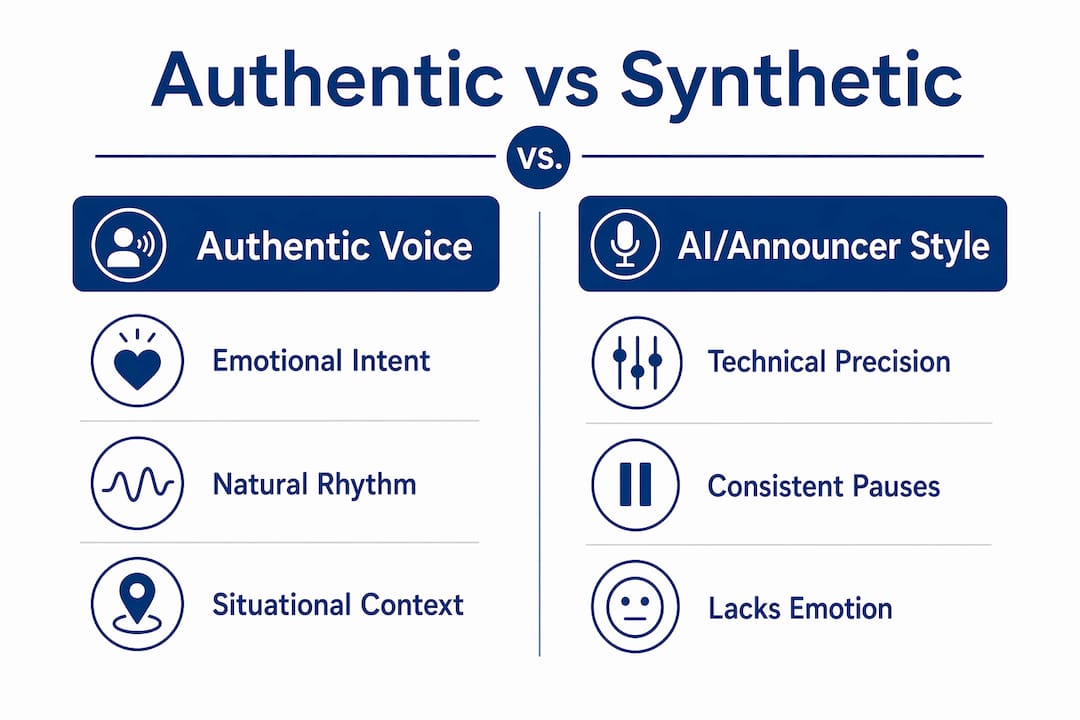
Authentic voice over is defined by the absence of performative artifice. The delivery feels like one person talking to one other person, not projecting to a crowd. Traditional announcer style does the opposite. It amplifies, rounds every vowel, and hits every word with equal weight. The result sounds professional but distant, like a stranger reading your mail aloud.
AI-generated voices fall into a different trap. They are technically precise but lack genuine emotional flow, which creates a feeling of manipulation or disconnection in the listener. Mission-driven campaigns, healthcare brands, and political messaging suffer most from this gap. Audiences in those categories are already skeptical. A voice that sounds manufactured confirms their suspicion.

The tells are specific. Perfectly timed pauses, consistent breath patterns, and overpronunciation are the clearest signs a voice over is synthetic. Human speech does not work that way. A real person trails off slightly, breathes unevenly, and occasionally softens a consonant. Those imperfections are not flaws. They are the proof of life that builds trust.
| Feature | Authentic Human Voice | AI or Announcer Style |
|---|---|---|
| Emotional intention | Present at the thought level | Absent or simulated |
| Breath and pacing | Organic, slightly variable | Consistent, mechanically timed |
| Imperfections | Natural hesitations, soft consonants | Smoothed out or absent |
| Listener response | Trust and connection | Distance or suspicion |
| Best use case | Hero assets, sensitive campaigns | High-volume localization with review |
Pro Tip: When auditioning voice talent, ask for a cold read of two sentences from your script. A performer who sounds natural without preparation is already working from an authentic internal process.
How does situational direction improve voice over authenticity?
Vague direction is the single most common reason a voice over session produces an inauthentic read. Telling a performer to “sound warm” or “be conversational” gives them nothing to act on. Those are adjectives, not situations. Situational direction gives the actor a specific scenario to inhabit, and the emotional quality follows naturally from that context.
The deeper problem with vague direction is that it pushes performers toward imitation. They try to sound warm instead of feeling warm. That distinction shows up in the recording. Post-production cannot reliably recreate authentic pacing or emotion missing from the original performance. Editing in pauses after the fact does not fix a read that was never grounded in genuine thought.
Here is how to build a situational brief that works:
- Name the relationship. Tell the actor who they are talking to. “You’re explaining this to your neighbor who just got diagnosed” is more useful than “sound empathetic.”
- Set the physical context. “You’re sitting across a coffee table, not standing at a podium” changes posture, volume, and pace immediately.
- Define what the speaker wants. “You want this person to feel less afraid, not more informed” gives the actor an emotional objective, not a tonal instruction.
- Specify the stakes. Low stakes produce intimacy. “This is a casual observation you’re sharing, not a warning” removes the theatrical energy that kills authenticity.
- Give a lead-in line. A short preparatory phrase before the script starts helps performers enter the natural thought process needed for authentic pacing and tone.
Specific, contextual direction respects the actor’s craft and produces better results than any amount of post-session editing. The brief you write before the session is as important as the script itself.
Pro Tip: Write your direction brief as a short paragraph describing the scene, not a list of adjectives. Actors are trained to respond to situations. Give them one.
What techniques do voice actors use for genuine delivery?
Voice over authenticity explained from the performer’s side comes down to a set of specific mental and physical practices. These are not tricks. They are the mechanics of making a written script sound like a living thought.
- Anti-announcer delivery. The performer treats the script as private thoughts spoken to one listener, not a public address. This preserves natural rhythm and allows minor speech flaws that build credibility. The goal is to sound like you just thought of what you’re saying, not like you memorized it.
- Lead-ins. Before reading the first line, the actor speaks a short, improvised sentence that connects to the script’s opening thought. This technique, documented by voice coach Topher Keene, prevents the cold-start stiffness that makes the first few seconds of a read sound rehearsed.
- The duologue concept. Performers who visualize a single listener behind the script sustain authentic engagement throughout the recording. VOBoss describes this as treating a monologue like a duologue. The imagined listener responds, reacts, and keeps the performer from drifting into reading mode.
- Lowering the stakes. Artificially high stakes or overacting detract from authenticity. Talking as if to one intelligent peer, rather than performing for a crowd, creates genuine connection. Empathy and believable emotional grounding produce the read, not theatrical energy.
- Embracing imperfection. A slight breath before a key phrase, a natural trailing off at the end of a thought, a soft consonant on a casual word. These are not mistakes to edit out. They are the texture of real speech, and they tell the listener’s brain that a real person is present.
For filmmakers working with off-camera narration, these techniques are especially relevant. Documentary narration that sounds performed breaks the viewer’s immersion. A narrator who sounds like they are remembering something, rather than reading it, keeps the audience inside the story.
How do you apply authentic voice over in real media projects?
The practical challenge for most creators is not understanding authenticity. It is maintaining it across different formats, budgets, and production timelines. The hybrid operating model is the current industry answer. Human voice talent anchors hero assets and emotionally sensitive content. AI voice handles high-volume localization and secondary content, provided it goes through expert native-speaker review.
The Darkest Dungeon development team offered a clear example of where this line sits. When narrator Wayne June passed away, the studio rejected an AI voice clone rather than risk the emotional inauthenticity that would have followed. That decision reflects a principle every brand should apply to flagship campaigns: the voice is the relationship. Replacing it with a simulation breaks the relationship.
For casting and directing, the voice over casting process should screen for performers who demonstrate natural delivery in auditions, not just technical range. The “booth barrier” is a real production problem. Some performers sound natural in conversation but stiffen the moment they are in a recording environment. Casting sessions that include a cold read of conversational copy reveal this quickly.
| Project Type | Recommended Voice Approach | Key Authenticity Risk |
|---|---|---|
| Brand hero ad | Human talent, situational direction | Announcer style, over-performance |
| Documentary narration | Human talent, duologue technique | Reading mode, emotional flatness |
| High-volume localization | Hybrid: AI with native-speaker review | Mechanical pacing, tonal mismatch |
| Political messaging | Human talent only | AI disconnection, trust erosion |
| Long-form audiobook | Human talent, lead-in technique | Booth barrier, monotony over time |
For ad campaigns in 2026, the standard is shifting. Audiences have been exposed to enough AI-generated content that they are developing an instinct for it. A voice that sounds too clean, too consistent, and too perfectly paced now triggers the same skepticism that stock photography did a decade ago.
Key takeaways
Authentic voice over succeeds because it sounds like genuine human thought directed at one listener, not a performance delivered to an audience.
| Point | Details |
|---|---|
| Anti-announcer delivery is the standard | Treat scripts as private thoughts, not public addresses, to preserve natural rhythm and trust. |
| Situational direction outperforms tonal adjectives | Give actors a specific scenario and relationship, not instructions like “sound warm.” |
| AI voices lack emotional intention | Synthetic voices miss the thought-level emotion that builds trust in sensitive campaigns. |
| Hybrid models require quality control | Use human talent for hero assets and native-speaker review for any AI-generated localization. |
| Imperfections build credibility | Natural hesitations and breath patterns signal human presence and increase listener trust. |
Why authenticity is the last competitive advantage in voice over
I have watched the voice over industry absorb wave after wave of technology promises, and the pattern is always the same. The tool improves. The audience adapts. The emotional gap stays exactly where it was. What strikes me most about the current AI voice moment is not the quality of the output. It is the speed at which audiences are learning to distrust it.
The creators who are winning right now are not the ones with the best microphones or the fastest turnaround. They are the ones who understand that a voice is a relationship. When you put a human voice on your content, you are making a claim: a real person cares enough about this message to say it out loud. That claim is worth protecting.
The practical recommendation I give to every filmmaker and advertiser I work with is this: cast for authenticity first, range second. A performer who sounds genuinely present in a cold read will serve your project better than a technically impressive performer who needs three takes to stop sounding like they are performing. The scene pacing and voice direction work you do before the session determines the ceiling of what you can achieve in it.
Authenticity is not a style choice. It is the mechanism by which a voice over earns the listener’s attention and keeps it.
— kribi
Work with a voice that sounds like a real person
Gregeschmeyervoice specializes in exactly the kind of grounded, conversational delivery this article describes. Greg Eschmeyer’s work spans commercials, political messaging, documentaries, and broadcast, and his clients consistently highlight one thing: the read sounds like a person, not a performance.
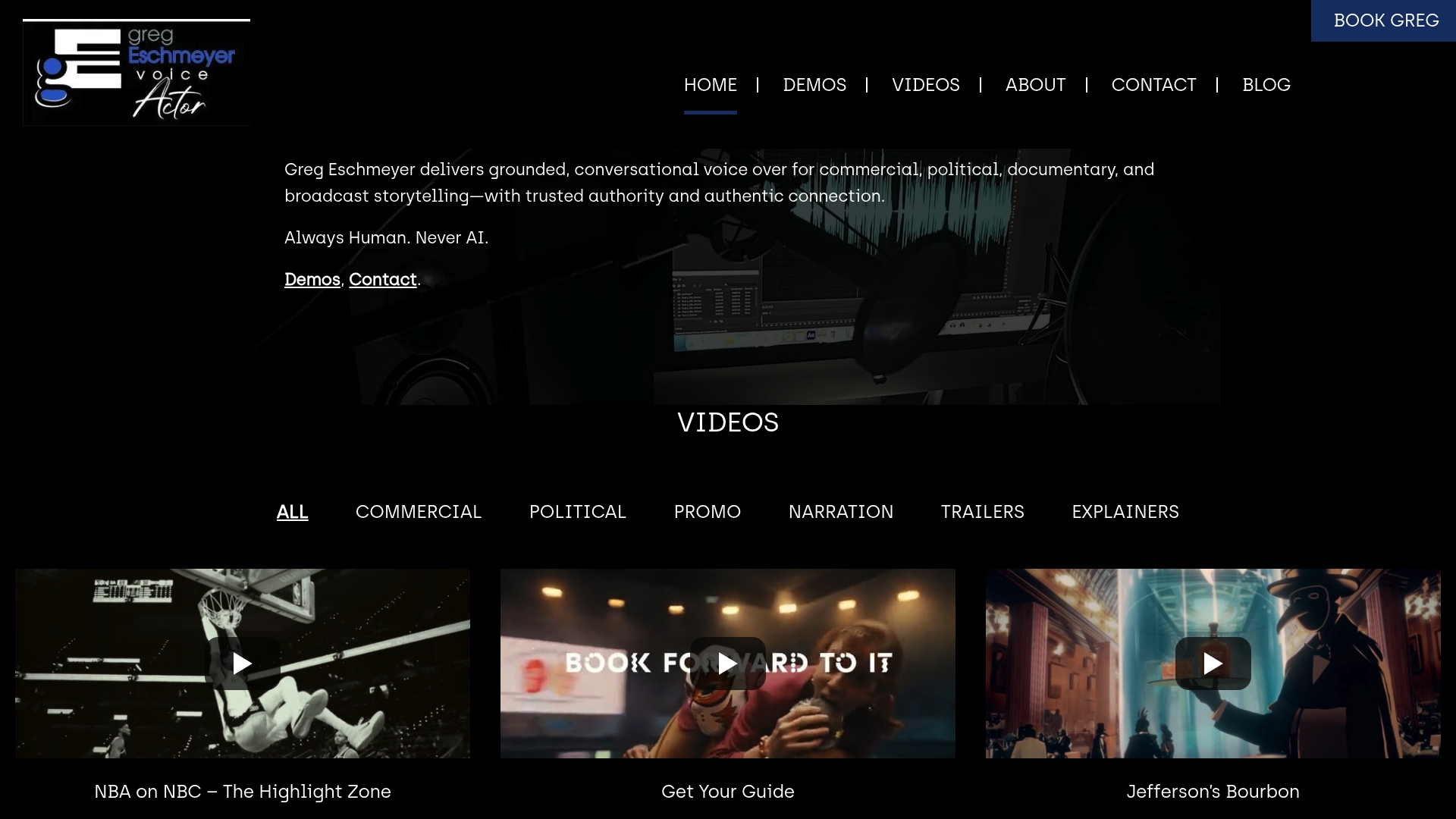
If you are casting for a campaign where trust and emotional connection are non-negotiable, professional voice acting services from Gregeschmeyervoice deliver the anti-announcer quality that modern audiences respond to. For documentary projects, the narrator audition process at Gregeschmeyervoice is built around authentic storytelling from the first take. When the voice is the relationship, choose a voice that sounds like one.
FAQ
What is authentic voice over?
Authentic voice over is a vocal performance style that sounds like natural human speech directed at one listener rather than a broadcast audience. It uses anti-announcer delivery, natural imperfections, and emotional grounding to build listener trust.
How does authentic voice over differ from AI voice over?
AI voices are technically precise but lack emotional intention at the thought level, which creates a feeling of disconnection. Human authentic voice over includes organic pacing, breath variation, and genuine emotional grounding that synthetic voices cannot replicate.
What is anti-announcer delivery?
Anti-announcer delivery treats the script as private thoughts spoken to one person, preserving natural rhythm and minor speech flaws. It is the opposite of the projected, evenly weighted broadcast style associated with traditional commercial voice overs.
Why does situational direction produce better voice over?
Situational direction gives performers a specific scenario to inhabit, which produces natural pacing and emotional connection. Vague instructions like “sound warm” push actors toward imitation rather than genuine feeling, and post-production cannot fix a read that was never emotionally grounded.
When should you use human vs. AI voice over?
Human voice talent is the right choice for hero assets, political messaging, and emotionally sensitive campaigns. AI voice can work for high-volume localization when subjected to expert native-speaker review, following the hybrid model used by leading brands.