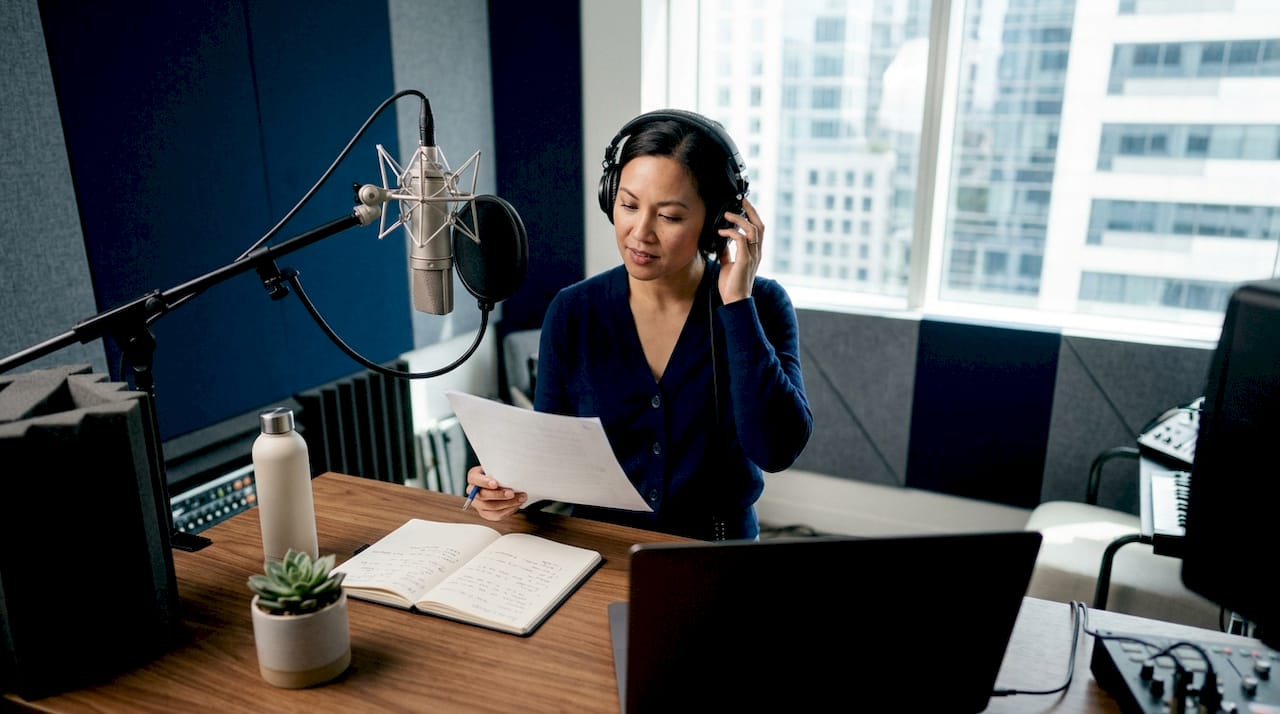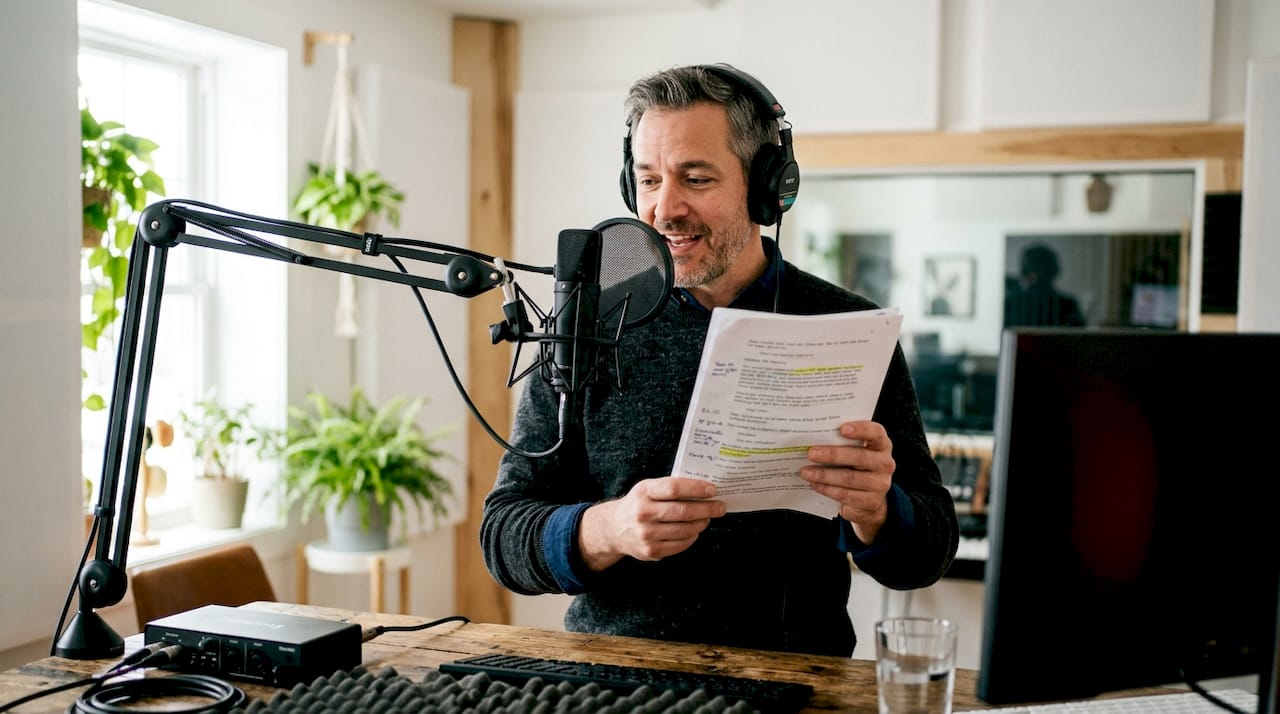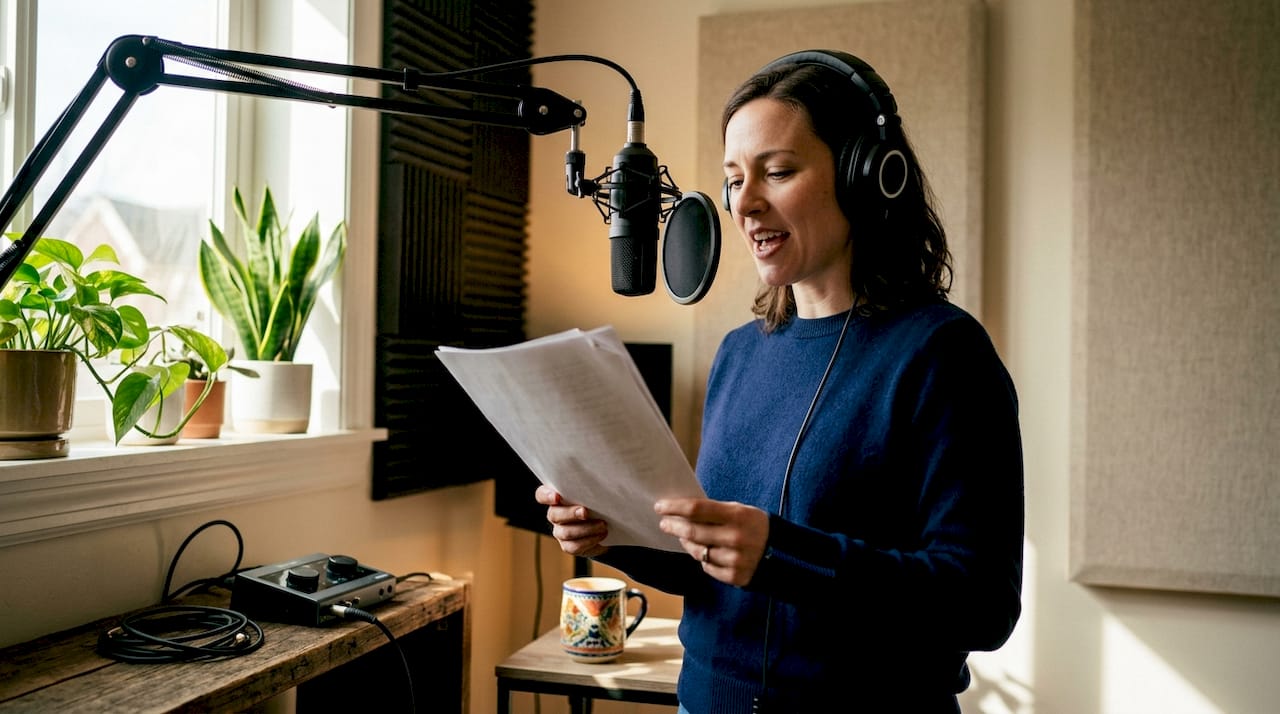
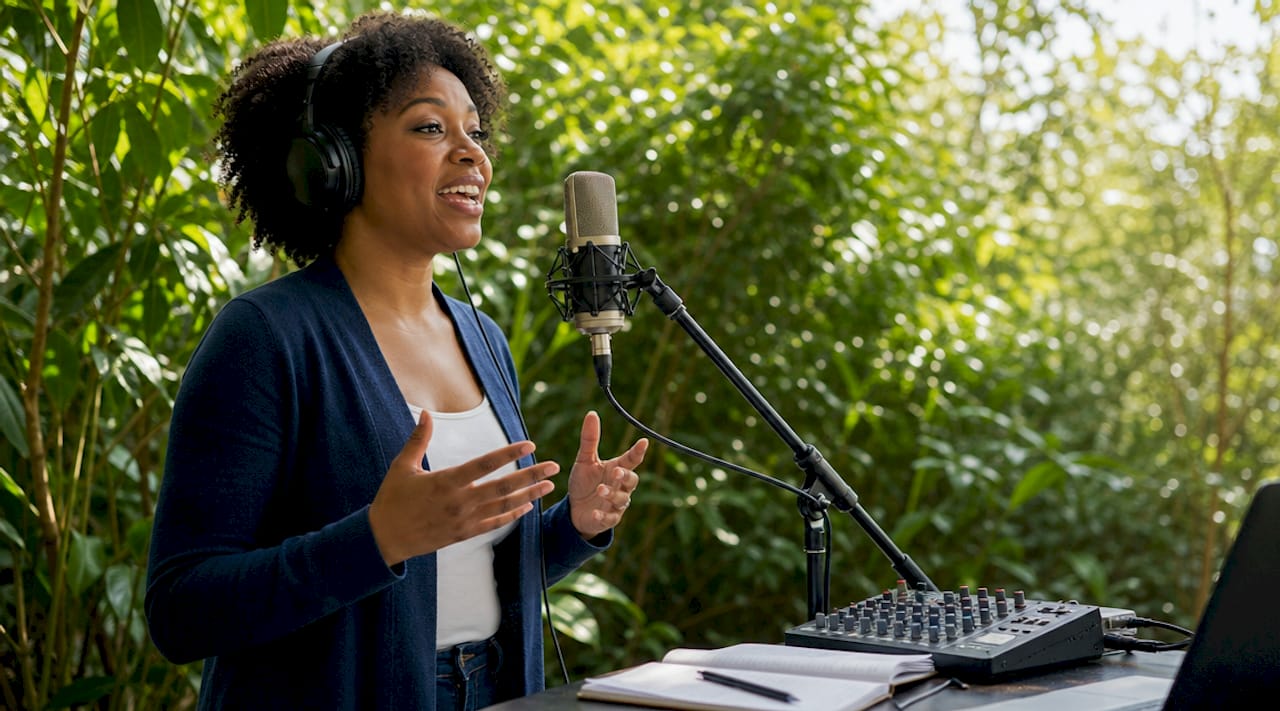
Conversational voice overs are defined as narration delivered in a natural, spoken style that mirrors how people actually talk, rather than how they write. The benefits of conversational voice overs extend far beyond tone preference. They directly affect how much of your message audiences retain, how much they trust your brand, and whether they finish watching at all. Research shows that human voice overs outperform synthetic narration by 8–13 percentage points in viewer retention. For content creators, advertisers, and marketers, that gap is the difference between a campaign that converts and one that gets skipped.
1. Benefits of conversational voice overs for trust and authenticity
Audiences trust voices that sound like them. When narration matches the natural rhythm of everyday speech, listeners lower their guard. That psychological shift is the foundation of every effective ad, tutorial, and brand video.
Formal or scripted narration creates distance. It signals “this is a performance,” which triggers skepticism. Conversational delivery removes that signal. The listener stops analyzing and starts absorbing.
- Consumers respond more readily to voices that match their age, gender, and regional tone
- Warm pacing and natural pauses signal honesty, not polish
- Scripted monotone delivery reads as corporate, even when the words are friendly
One brand reported a 73% increase in engagement after switching to a professional voice artist using conversational delivery, with the same script and visuals. The only variable was how the narration sounded. That result shows that delivery style, not content alone, drives audience response.
Pro Tip: Record a 30-second test clip with both a formal and a conversational read of the same script. Play both to five people outside your team. Their reaction time and word choice will tell you which version they trusted faster.
2. How conversational delivery improves comprehension and retention
Conversational voice guides listeners the way a knowledgeable friend would explain something. It uses pacing, emphasis, and pauses to signal what matters, which reduces the mental work required to follow along.

Voice-over acts as a substitute for visual explanation in short videos, providing the causal structure that fragmented visuals cannot. This is especially true in short-form content where cuts happen fast and context is thin. A well-placed pause or a slightly slower read on a key phrase does more than any graphic overlay.
Synthetic voices force listeners to work harder. Listeners expend more mental effort decoding AI-generated narration than human speech, which directly reduces retention. That extra cognitive load is invisible to producers but felt immediately by audiences.
| Narration Style | Cognitive Load | Retention Impact |
|---|---|---|
| Conversational human voice | Low | High |
| Formal scripted narration | Moderate | Moderate |
| Synthetic AI voice | High | Low |
Pro Tip: Script sentences at 8–15 words each for spoken delivery. Shorter sentences reduce cognitive load and give the narrator natural breath points, which listeners subconsciously interpret as clarity.
3. Why professional voice artists make conversational delivery work
Skilled voice actors bring more than a pleasant voice to a project. They understand pacing, emphasis, and emotional nuance at a level that transforms a written script into a spoken experience.
Professional voice artists also act as script editors, identifying phrasing that reads well on paper but sounds unnatural when spoken aloud. A sentence like “Utilize our comprehensive solution” becomes “Use our tool” in a conversational rewrite. That shift changes how the audience receives the entire message.
Effective direction for conversational voice overs focuses on the narrator’s intention rather than their emotion. Direction based on intention prevents forced performances and keeps the delivery believable. Telling a voice actor to “sound excited” produces a caricature. Telling them “you’re sharing something you genuinely think will help this person” produces authenticity.
- Human narrators read subtext and adjust tone mid-sentence
- Professional pacing creates natural emphasis without sounding rehearsed
- Script rewrites for spoken delivery improve naturalness before recording begins
- Intention-based direction produces performances that hold up across repeated listens
Gregeschmeyervoice specializes in exactly this kind of grounded, authentic conversational delivery, built for commercials, documentaries, and broadcast content where trust is non-negotiable.
4. Where conversational voice overs have the most impact
The advantages of voice overs delivered conversationally show up most clearly in content where the audience needs to stay engaged long enough to act. Product demos, onboarding tutorials, explainer videos, and advertisements all depend on completion rates. A warm, relatable voice keeps viewers watching.
Conversational delivery reduces intimidation in complex topics, which is why finance, health, and technical content benefit most from this style. When the narration sounds approachable, the subject matter feels approachable too. That shift directly improves completion rates and viewer satisfaction.
- Product demos: Conversational narration makes features feel like benefits rather than specs
- Onboarding tutorials: A friendly voice reduces drop-off during multi-step instructions
- Advertisements: Relatable delivery builds brand affinity faster than polished announcements
- Educational videos: Natural pacing helps viewers absorb dense information without rewinding
SEO is another measurable benefit. Clear professional narration improves auto-caption accuracy on platforms like YouTube, and algorithms reward videos with strong viewer engagement signals. A conversational voice that keeps people watching longer directly feeds those signals.
Understanding voice over best practices for ad campaigns helps marketers choose the right delivery style before production begins, which saves time and budget on reshoots.
5. The human voice advantage over AI narration
Human voice overs carry something AI narration cannot replicate: authentic emotional nuance. Audiences detect its absence subconsciously. Humans subconsciously detect the lack of genuine emotional nuance in AI voices, and that detection triggers an unconscious bounce response before the viewer even realizes why they stopped watching.
The retention gap is measurable. Human narration holds a 8–13 percentage point advantage over AI voice overs in competitive content niches. In a crowded feed, that margin determines whether your content gets shared or scrolled past.
Voice-over also provides what researchers call the “internal life” of a piece. Voice-over provides the internal life listeners need to stay engaged, something synthetic or monotonous speech cannot supply. That internal life is the difference between content that feels alive and content that feels like a text-to-speech demo.
For marketers running paid campaigns, this matters at the budget level. A video with a human conversational voice over earns more watch time, which lowers cost-per-view and improves return on ad spend across platforms.
6. How to write scripts that support conversational delivery
Conversational voice overs start on the page. A script written for reading looks and sounds completely different from one written for speaking. The gap between the two is where most voice over projects lose their naturalness.
Effective scripting for conversational narration means rewriting sentences to 8–15 words with spoken-friendly vocabulary. Contractions, direct address, and short declarative sentences all signal to the listener that a real person is talking. Passive constructions and nominalized phrases do the opposite.
The voice over storytelling benefits of a well-written script compound when paired with skilled delivery. A professional narrator can elevate a good script, but even the best voice actor cannot save a script written for a corporate memo. Writing for the ear is a distinct skill, and it is worth investing in before the recording session begins.
Pro Tip: Read your script aloud before sending it to your voice artist. If you stumble, rewrite. If it sounds like a legal document, simplify. Your narrator will thank you, and your audience will stay.
Key takeaways
Conversational voice overs outperform formal and synthetic narration because they reduce cognitive load, build trust faster, and keep audiences watching long enough to act.
| Point | Details |
|---|---|
| Trust through tone | Conversational delivery removes listener skepticism and builds brand credibility faster than scripted narration. |
| Retention advantage | Human voice overs hold an 8–13 percentage point retention edge over AI narration in competitive content niches. |
| Comprehension support | Conversational pacing and emphasis guide interpretation, reducing the mental effort required to follow complex content. |
| Script quality matters | Sentences written at 8–15 words with spoken vocabulary produce more natural delivery and better audience response. |
| SEO and completion rates | Clear human narration improves auto-caption accuracy and viewer watch time, both of which feed platform algorithms. |
Why I think most marketers underestimate the voice
Most marketers treat voice over as the last step in production. The visuals get months of attention. The script gets a legal review. Then someone books a voice artist two days before the deadline and wonders why the final product feels flat.
The voice is not a finishing touch. It is the primary carrier of meaning in any video. Visuals set the scene, but narration tells the audience what to think about what they are seeing. When that narration sounds like a real person talking directly to them, the entire piece lands differently.
What I have observed consistently is that the projects with the strongest audience response share one trait: the voice sounds like it belongs to someone who actually cares about the listener. Not performed care. Not scripted warmth. Genuine, grounded delivery that treats the audience as intelligent adults.
The industry is moving toward authenticity because audiences have become fluent in detecting its absence. They cannot always name what feels off about a synthetic or over-produced voice, but they act on that feeling by clicking away. Conversational delivery is not a trend. It is the baseline expectation for content that wants to be trusted.
If you are a content creator or advertiser still treating voice as an afterthought, the retention data alone should change your production order. Cast the voice early. Involve the voice artist in the script. Give them direction based on intention, not emotion. The results will show up in your watch time before they show up anywhere else.
— kribi
Gregeschmeyervoice: professional conversational voice talent
Gregeschmeyervoice delivers the grounded, natural narration that content creators and advertisers need when authenticity is the goal. Greg Eschmeyer’s approach prioritizes genuine human connection over polished performance, which is exactly what modern audiences respond to.
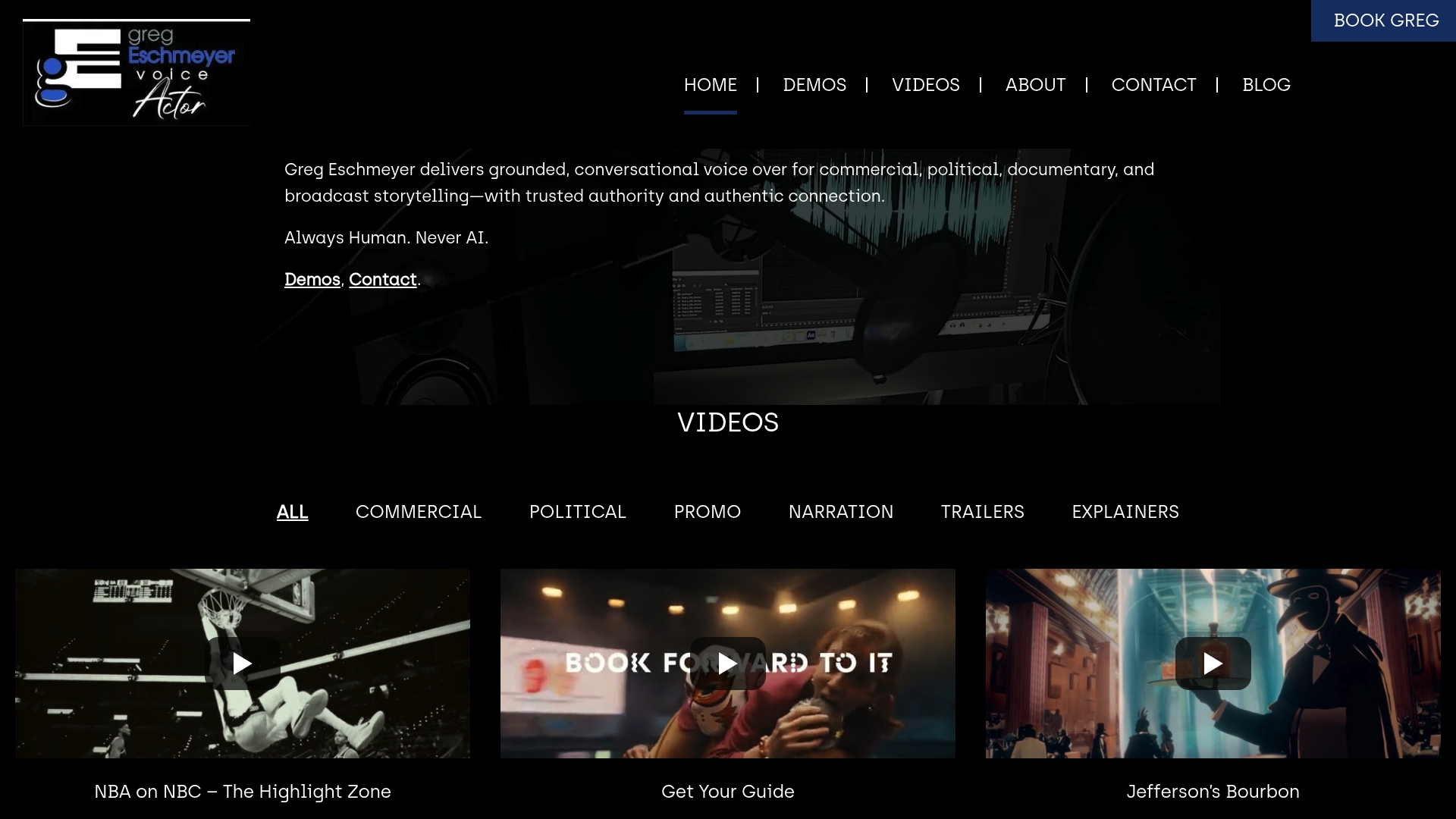
Whether your project is a product demo, a broadcast spot, or a political message, Gregeschmeyervoice brings the conversational tone that keeps audiences engaged from the first word to the last. Clients consistently highlight fast turnaround, clear communication, and performances that match the specific emotional register of each project. For creators who want professional voice acting that sounds like a real person and not a recording, Gregeschmeyervoice is the right call.
FAQ
What are the main benefits of conversational voice overs?
Conversational voice overs build trust faster, reduce listener cognitive load, and improve content completion rates. Research shows they outperform formal narration in viewer engagement and retention.
Do voice overs increase retention compared to AI narration?
Human voice overs hold an 8–13 percentage point retention advantage over AI narration in competitive content niches. Audiences subconsciously detect the absence of authentic emotional nuance in synthetic voices and disengage.
What types of content benefit most from a conversational tone in audio?
Product demos, onboarding tutorials, advertisements, and educational videos in complex fields like finance and health see the strongest results. Conversational delivery reduces intimidation and improves completion rates across all these formats.
How does voice over improve SEO performance?
Clear professional narration improves auto-caption accuracy on platforms like YouTube, and stronger viewer engagement signals earn algorithmic preference. Both factors contribute to better organic reach for video content.
How should scripts be written for conversational voice overs?
Scripts for conversational delivery work best with sentences of 8–15 words, contractions, direct address, and spoken-friendly vocabulary. Reading the script aloud before recording is the fastest way to identify phrasing that needs revision.