

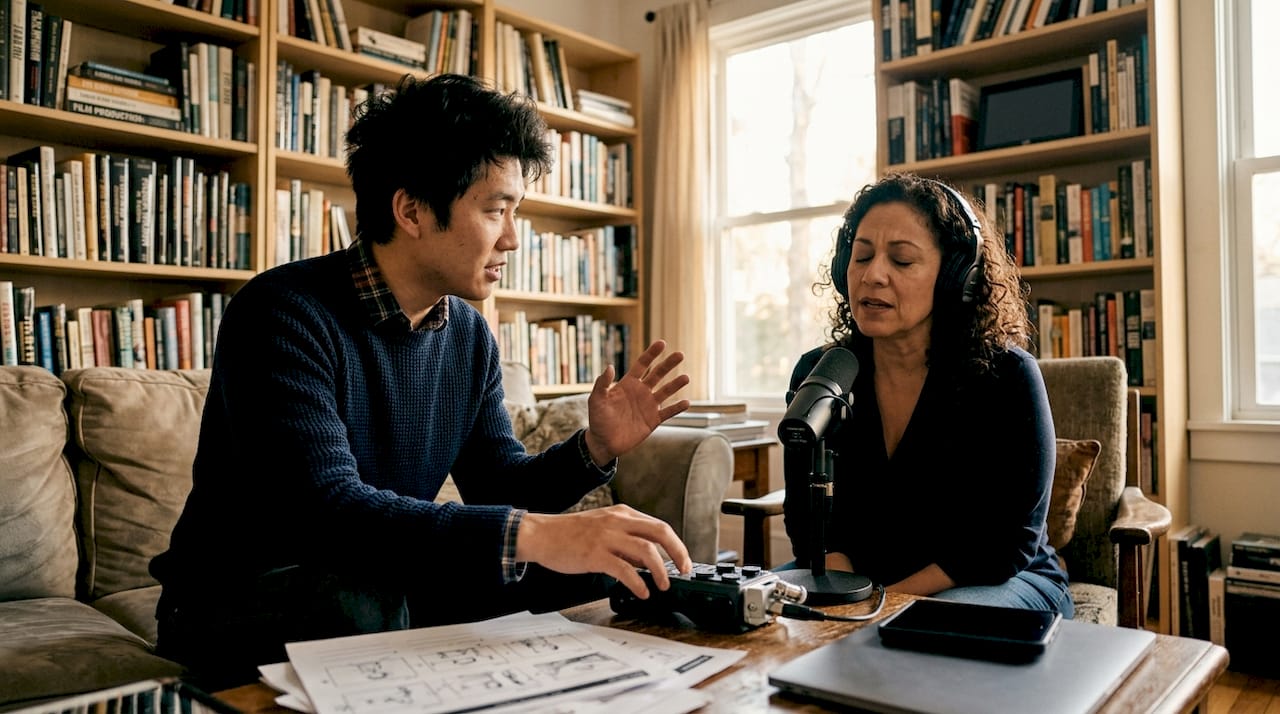
Vocal delivery is the most subconscious emotional channel in film, reaching audiences at a neurological level that visuals alone cannot match. Understanding how voice adds emotional depth in film means recognizing that tone, pitch, pacing, and authenticity do more than support a script. They decode character psychology, signal hidden intentions, and create the feeling that a story is alive. Filmmakers and screenwriters who treat voice as a formal storytelling tool, on par with cinematography or editing, unlock a dimension of audience connection that most productions leave untapped. This guide covers the specific techniques, theories, and practical approaches that make vocal performance the invisible architecture of emotional cinema.
How does voice add emotional depth in film?
Voice is defined in film sound theory as the invisible narrative, a formal cornerstone of film sound design that strikes the nervous system in ways images cannot replicate. That phrase is not poetic license. Sound bypasses conscious analysis and lands in the body first. A trembling voice, a sudden drop in register, a long pause before a single word: each of these cues triggers an emotional response before the brain has time to process the dialogue.
The standard industry term for this field is film sound design, but the specific study of voice as emotional instrument draws from vocal performance theory, Michel Chion’s audio-visual analysis, and Robert Plutchik’s wheel of emotions. These three frameworks give filmmakers and voice actors a shared vocabulary for what is otherwise an intuitive craft.
Vocal delivery operates on at least two levels simultaneously. The surface level carries the literal meaning of the words. The deeper level carries the character’s psychological state, which often contradicts the words entirely. A character who says “I’m fine” in a flat, controlled tone tells the audience something very different from one who says it with a slight upward pitch and a shortened breath. That gap between text and subtext is where emotional depth lives.
What vocal techniques convey complex emotions on screen?
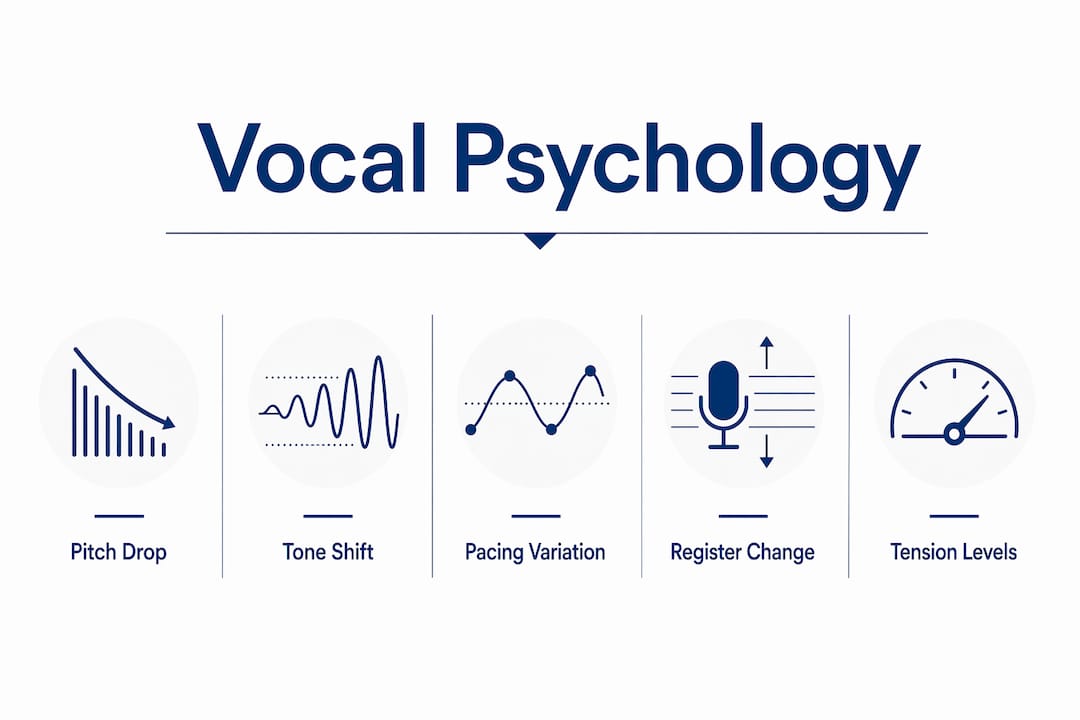
The core vocal elements that communicate emotion are pitch, tone, tension, pacing, and register. Each one functions as a distinct signal, and skilled performers layer them to create performances that feel three-dimensional rather than illustrative.
Pitch is the most immediate signal. A rising pitch at the end of a statement reads as uncertainty or vulnerability. A sudden drop in pitch signals authority, finality, or suppressed anger. Characters in animated features like Zootopia and live-action series like Stranger Things use pitch shifts to mark villain reveals and personality changes, cuing audiences before any visual confirmation arrives.
Register shifts carry equal weight. A confident character who is caught off-guard may involuntarily move from chest voice to a higher, thinner mix voice. A timid character who finds courage gains fullness and resonance in the lower register. These register changes signal emotional states in ways that feel biological rather than performed, which is exactly why audiences trust them.
Pacing and tension shape the emotional rhythm of a scene. A performer who rushes through a grief-stricken line signals avoidance. One who slows down and lets silence sit signals weight. Tension in the throat and jaw creates a physical quality in the voice that listeners recognize as suppressed emotion, even without seeing the actor’s face.
- Pitch variation signals vulnerability, authority, or surprise depending on direction and context.
- Register shifts from chest to mix voice mark involuntary emotional transitions.
- Pacing controls the perceived weight of a moment; slower delivery signals significance.
- Vocal tension in the throat and jaw communicates suppressed or controlled emotion.
- Layering secondary emotions beneath the dominant one creates performances that avoid flatness.
Pro Tip: Avoid playing the literal emotion written in the stage direction. If the script says “angry,” find what sits beneath the anger. Hurt, betrayal, and fear all produce anger, and each one sounds different. The secondary emotion is what makes the performance specific.
How does voice-over narration contribute to emotional storytelling?
Voice-over narration, known in the industry as VO, is one of the most powerful tools for emotional storytelling in film when used with clear intention. Its power comes from a specific structural advantage: VO gives the audience access to a character’s inner life without requiring the camera to show it.
Films adapted from first-person source material rely on VO to preserve the intimacy of the original text. The Shawshank Redemption and Fight Club are the two most cited examples of VO narration that elevates emotional impact beyond what the visuals alone could achieve. In both films, the narrator’s voice creates a layer of irony, retrospection, and emotional distance that reframes every scene the audience watches.
The relationship between VO and on-screen visuals is not redundant. It is contrapuntal. When the narration says one thing and the image shows another, the tension between the two creates meaning. A narrator describing hope while the camera shows despair forces the audience to hold both truths at once, which is a far more complex emotional experience than either element could produce alone.
Effective VO follows four principles:
- The narrator’s voice must carry a distinct psychological perspective, not just describe events.
- The VO should add information the image cannot show, specifically internal states, memory, or irony.
- Pacing must match the emotional register of the scene, not the speed of the dialogue.
- The narrator’s tone should evolve across the film, reflecting the character’s arc rather than staying static.
Pro Tip: Record VO after picture lock when possible. The final cut’s rhythm will tell you exactly where the narration needs to breathe and where it needs to push.
How does vocal variation reveal character psychology on screen?
Vocal variation is the primary tool audiences use to decode character psychology, often before the screenplay makes a character’s internal conflict explicit. This is the role of voice in film emotion at its most sophisticated: the voice tells the truth when the character is lying.
Michel Chion’s concept of the Acousmêtre describes the unique narrative authority held by off-screen voices in film. An Acousmêtre is a voice whose source is not yet visible on screen. Chion argues that this invisible voice holds god-like power over the narrative because the audience cannot anchor it to a body, a face, or a set of limitations. The moment the voice is attached to a visible character, that power diminishes. This is why the unseen villain, the voice on the phone, and the narrator we never meet carry such disproportionate emotional weight.
The table below maps common vocal variations to the psychological states they signal in performance.
| Vocal variation | Psychological signal | Film application |
|---|---|---|
| Pitch drop mid-sentence | Suppressed authority or controlled threat | Villain reveals, power shifts |
| Involuntary register shift | Emotional vulnerability breaking through | Characters under pressure |
| Slowed pacing with silence | Grief, deliberation, or moral weight | Confession scenes, climactic decisions |
| Increased vocal tension | Suppressed anger or fear | Confrontation scenes |
| Breathy, reduced resonance | Intimacy, exhaustion, or defeat | Quiet emotional turning points |
Pro Tip: When directing voice actors, avoid emotion labels like “sound sad.” Instead, give them a psychological situation: “You just found out, and you’re trying not to let anyone see it.” The voice will find the right quality on its own.
Practical approaches to emotional voice acting in film production
The most common failure in voice acting is oversimplification. A performer identifies the dominant emotion in a scene, plays it directly, and delivers a performance that is technically correct but emotionally flat. Plutchik’s wheel of emotions offers a practical solution: every dominant emotion contains secondary emotions that give it texture and specificity.
Veteran voice actor Cissy Jones states that raw human emotion is irreplaceable in storytelling, and that vocal mechanics are secondary to authentic performance. This is not a soft observation. Audiences instinctively detect artificiality in vocal performance because the human auditory system evolved to read emotional states in other humans’ voices. A performer who smiles while reading a happy line, or who tightens the jaw to “sound angry,” produces a result that registers as false even when listeners cannot articulate why.
Authenticity in vocal performance requires psychological vulnerability, not technical precision. The performer must access a genuine internal state that matches the character’s situation, then let the voice respond naturally rather than manufacturing a sound.
For filmmakers and directors working with voice talent, these approaches produce the most consistent results:
- Use Plutchik’s wheel to identify the secondary emotion beneath the dominant one before recording begins.
- Give performers psychological context, not emotional instructions.
- Allow silence and pacing to carry weight; resist the urge to fill every moment with vocal activity.
- For off-screen or ambiguous characters, use restraint. Less vocal information creates more audience projection.
- Actors voicing characters without visible facial expressions rely on pacing and restraint to convey emotional core, since no visual performance supports them.
- Review takes for authenticity, not technical quality. A slightly imperfect take with genuine emotion outperforms a clean take with manufactured feeling.
The importance of voice in films becomes most visible in post-production, when a flat vocal performance cannot be fixed by editing or scoring. The emotional architecture of a scene is built in the recording booth, not the edit suite.
Key Takeaways
Vocal delivery is the primary emotional instrument in film, and its power comes from authenticity, layered emotion, and psychological specificity rather than technical execution alone.
| Point | Details |
|---|---|
| Voice operates subconsciously | Vocal cues reach the nervous system before conscious analysis, making them the most direct emotional channel in film. |
| Secondary emotions create depth | Using Plutchik’s wheel to layer emotions beneath the dominant one prevents flat, one-note performances. |
| Off-screen voices hold more power | Michel Chion’s Acousmêtre theory shows that invisible voices carry greater narrative authority than embodied ones. |
| VO works best contrapuntally | Voice-over narration is most effective when it adds internal information that contradicts or reframes the on-screen image. |
| Authenticity beats technique | Audiences detect artificial vocal performances instinctively; genuine psychological vulnerability produces the most resonant results. |
Why I think most filmmakers underestimate the voice
The film industry spends enormous resources on visual storytelling: lighting, lensing, color grading, visual effects. Voice gets a fraction of that attention, and the gap shows up on screen in ways that are hard to name but easy to feel.
What I have observed across productions is that the voice is treated as a delivery mechanism for dialogue rather than as a narrative instrument in its own right. The result is films where the performances look right but do not land emotionally. The audience watches but does not feel.
The most effective vocal performances I have encountered share one quality: the performer is not performing. They are experiencing. The voice follows the psychology, not the script. That distinction sounds simple, but it requires a director who understands voice and scene pacing well enough to create the conditions for it, and a performer willing to be genuinely vulnerable rather than technically impressive.
The Acousmêtre concept from Michel Chion is the single most underused idea in contemporary film sound. Filmmakers who understand that an invisible voice holds more power than a visible one will make different choices about when to show a character and when to let the voice work alone. That restraint is where emotional depth actually lives.
— kribi
Professional voice acting for your film project
Emotional storytelling through voice requires a performer who brings genuine psychological depth to every take, not just a clean read.
Gregeschmeyervoice delivers grounded, conversational vocal performances built for film, documentary, broadcast, and commercial work. Greg Eschmeyer’s approach centers on authentic human connection rather than manufactured tone, which is exactly what separates a memorable performance from a functional one. Filmmakers and producers who need professional voice acting that holds up emotionally across every scene will find a resource built for that standard. For a deeper look at how off-camera narration shapes audience experience, the off-camera narration guide at Gregeschmeyervoice covers the technique in practical detail.
FAQ
What is the role of voice in film emotion?
Voice is the most direct emotional channel in film, reaching the nervous system before conscious thought processes the dialogue. Tone, pitch, pacing, and register each signal distinct psychological states that audiences decode instinctively.
How does voice-over narration add emotional depth?
Voice-over narration adds emotional depth by giving audiences access to a character’s internal state, especially when the narration contradicts or reframes what the image shows. Films like The Shawshank Redemption demonstrate how VO creates retrospective irony that visuals alone cannot produce.
What is the Acousmêtre in film sound theory?
The Acousmêtre, defined by Michel Chion, is an off-screen voice whose source is not yet visible. This invisible voice holds disproportionate narrative authority because audiences cannot anchor it to a body, making it one of the most emotionally powerful tools in film sound design.
How do voice actors avoid flat emotional performances?
Voice actors avoid flat performances by identifying secondary emotions beneath the dominant one, using Plutchik’s wheel of emotions as a practical framework. Genuine psychological vulnerability, rather than technical vocal mechanics, produces performances that audiences recognize as authentic.
Why does vocal authenticity matter more than technique?
Audiences evolved to detect emotional states in human voices, which means artificial or manufactured vocal performances register as false even when listeners cannot explain why. Veteran voice actor Cissy Jones identifies raw human emotion as irreplaceable, with technical mechanics serving only a supporting role.