

Voice characterization is defined as the creation of a consistent, recognizable vocal identity for a character using multiple dimensions of sound, including pitch, resonance, rhythm, speech patterns, and emotional expressiveness. It is the foundation of every compelling performance in animation, audiobooks, commercials, and broadcast media. Without it, characters blur together and audiences disengage. Understanding what does voice characterization mean gives voice actors and content creators the technical and creative framework to deliver performances that stick.
What does voice characterization mean in practice?
Voice characterization creates a consistent, recognizable identity for a character solely through sound. That definition carries real weight: no costumes, no facial expressions, no body language. The voice carries everything. Every personality trait, emotional state, and backstory must come through in how the words are spoken, not just what the words say.
The standard industry term for this discipline is vocal characterization, though voice actors and directors use both terms interchangeably. The concept covers five core elements: character psychology, physical traits implied by the voice, speech patterns, vocal performance elements, and distinctive vocal markers. Each element works together to build a complete sonic portrait of a person.
Voice characterization also functions as both direct and indirect storytelling. Voice conveys personality and emotions through distinctive style and tone, revealing character through vocabulary, accent, and speech patterns without a single line of exposition. A character who speaks in clipped, short sentences signals urgency or authority. One who trails off mid-thought signals uncertainty or distraction. The voice does the writing.

What are the key vocal and linguistic components?
A voice actor’s toolkit for characterization is multidimensional. Each component adds a layer of specificity that separates a real character from a generic voice.
Vocal performance elements include:
- Pitch: The highness or lowness of the voice, which signals age, energy, and emotional state
- Resonance: Where the sound vibrates in the body, which shapes warmth, authority, or tension
- Rhythm and tempo: How fast or slow a character speaks, which reveals confidence, anxiety, or deliberateness
- Pauses and breath: Strategic silence that signals thought, hesitation, or emotional weight
- Verbal tics: Repeated phrases, filler words, or speech habits that make a voice instantly recognizable
Linguistic elements add the second layer:
- Vocabulary register: Formal versus casual word choices that signal education, class, or background
- Sentence architecture: Long, complex sentences versus short, punchy fragments
- Emotional expressiveness: How openly or guardedly a character reveals feeling through word choice
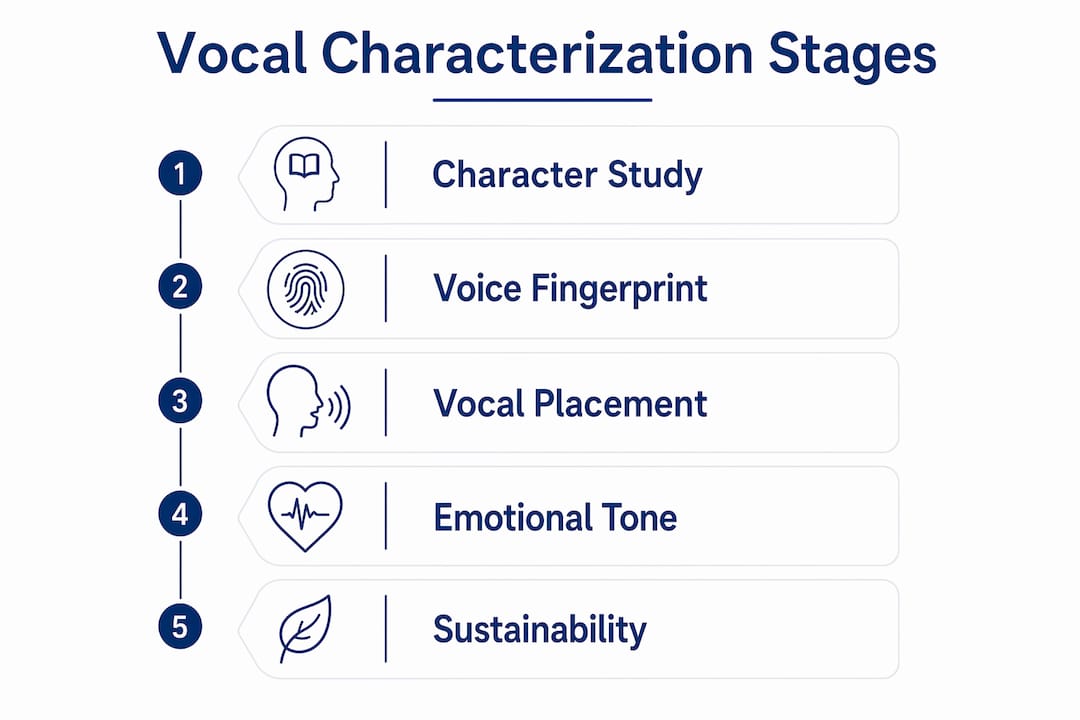
Together, these elements form what voice coaches call a voice fingerprint. Voice fingerprints of 100–200 words help voice actors maintain consistency across a long project. Think of it as a character’s vocal DNA: a short document that captures the key linguistic and tonal markers so the voice stays true from scene one to the final chapter.
Pro Tip: Record a 100-word sample of your character speaking in their natural voice before you begin a project. Play it back at the start of every session to recalibrate before the first take.
How does vocal placement enhance character differentiation?
Vocal placement is the technique of shifting where sound resonates in the body to create distinct character voices. It is more effective than pitch changes alone, and it protects the voice from strain.
The three primary placements are:
- Chest resonance: A deep, grounded sound that signals authority, calm, or physical size. Useful for commanding characters or narrators who need gravitas.
- Nasal resonance: A brighter, more forward sound that signals energy, youth, or comic sharpness. Useful for sidekick characters or high-energy personalities.
- Throat resonance: A tighter, more constricted sound that signals tension, age, or emotional suppression. Useful for villains or characters under pressure.
Mastering three placements expands a voice actor’s character range without requiring extreme pitch shifts. This matters because forcing the voice into unnatural pitch territory is the leading cause of vocal fatigue and injury in professional voice work.
Vocal compression and expansion techniques protect vocal health while producing distinctive character voices. Compression tightens the resonant space to create smaller, more contained sounds. Expansion opens it to create larger, more resonant ones. Neither requires the performer to push volume or strain the throat.
Practical placement exercises include humming into different parts of the face and chest, then speaking a neutral sentence from each position. The goal is to feel the vibration shift, not to force a new pitch. Once you can move placement reliably, you can build a full cast of characters that all live within your natural vocal range.
Pro Tip: Practice moving between chest and nasal placement using the same sentence. If the sentence sounds like two different people, your placement shift is working. If it just sounds louder or softer, you are changing volume, not resonance.
What are best practices for authentic, sustainable voice characterization?
Authentic voice characterization starts with psychology, not sound. Vocal coaches recommend understanding a character’s motivations and background rather than mimicking a surface sound. When you know why a character speaks the way they do, the voice emerges naturally from the role.
The most common mistake in voice acting characterization is trying to “sound like” a character instead of thinking like one. A nervous accountant does not just speak quietly. He speaks in qualifiers, trails off before committing to a statement, and speeds up when challenged. Those behavioral patterns shape the voice more than any pitch adjustment.
Character profiles that describe behaviors and motivations help voice actors internalize roles better than adjective lists. “Confident” tells you nothing useful. “A former military officer who still speaks in commands and never asks questions” tells you exactly how to open your mouth.
Key best practices for sustainable characterization:
- Limit each character to three or four defining vocal dimensions to avoid caricature
- Write and maintain a voice fingerprint document for every character in a long-form project
- Test character distinctiveness by reading dialogue without attribution tags. If you cannot tell who is speaking, the voices are not different enough
- Warm up with placement exercises before sessions, not pitch drills
- Rest the voice between characters that use extreme resonance positions
“Distinctive character voices require coordinated vocal movements across resonance, breath, and pace. Isolated muscle strain is not characterization. It is damage.” — Topher Keene, vocal coach
Maintaining a voice fingerprint document prevents character voice drift in long-form narratives. Voice drift happens when a character gradually starts sounding like the performer’s natural voice or like another character in the cast. A fingerprint document catches the drift before the audience does.
How does voice characterization impact audience engagement?
Well-crafted character voices shape how audiences feel about a story, not just how they follow it. Voice is the primary tool for audience immersion in media where visuals are absent or secondary, such as audiobooks, radio drama, and podcast fiction.
A consistent vocal identity builds audience memory. When a listener can identify a character from the first syllable without a visual cue, the performer has succeeded. That recognition creates emotional investment. Audiences do not just follow a character. They root for them, fear them, or laugh with them because the voice has made them real.
The table below shows how different vocal characterization choices map to audience response across common media formats.
| Media format | Characterization priority | Audience impact |
|---|---|---|
| Animation | Placement and pitch variety | Immediate character recognition across a large cast |
| Audiobooks | Voice fingerprint consistency | Sustained emotional investment over hours of listening |
| Commercials | Tone and vocabulary register | Brand personality conveyed in under 30 seconds |
| Documentary narration | Resonance and pacing | Credibility and authority that guides viewer interpretation |
| Podcast fiction | Speech patterns and verbal tics | Character memory without visual reinforcement |
Voice acting as a core storytelling element goes beyond reading lines with feeling. Every vocal choice is a narrative decision. The speed of a character’s speech tells the audience how that character processes the world. The warmth or coldness of their resonance tells the audience whether to trust them. These signals operate below conscious awareness, which is exactly why they work.
Key Takeaways
Voice characterization is the multidimensional craft of building a consistent vocal identity through placement, fingerprinting, and psychology rather than pitch alone.
| Point | Details |
|---|---|
| Core definition | Voice characterization creates a consistent, recognizable character identity using pitch, resonance, rhythm, and speech patterns. |
| Vocal placement over pitch | Shifting chest, nasal, or throat resonance builds varied characters without straining the voice. |
| Voice fingerprint documents | A 100–200 word fingerprint document prevents character voice drift across long-form projects. |
| Psychology drives authenticity | Understanding character motivations produces more believable voices than mimicking surface sounds. |
| Audience impact | Consistent vocal identity builds emotional investment and character memory across all media formats. |
Why I think most voice actors are solving the wrong problem
The most common question I hear from voice actors is “how do I make my character sound different?” That is the wrong question. The right question is “how does this character experience the world differently from the last one?”
When you chase sonic difference, you end up with caricatures. Exaggerated accents. Forced pitch. Voices that tire out by take three. When you chase psychological difference, the voice follows naturally. A character who grew up being ignored speaks louder than necessary. A character who learned early that words have consequences speaks slowly and chooses them carefully. Neither of those voices requires a trick. They require understanding.
The technical side matters enormously, and I would never dismiss placement work or fingerprint documents. But technique without psychology produces technically correct performances that feel hollow. Audiences sense the absence of a real inner life even when they cannot name it. The voice talent qualities that separate good from great almost always come down to this: the performer believed the character before they opened their mouth.
My practical advice is to write a character profile before you record a single word. Not adjectives. Behaviors. What does this person do when they are nervous? What do they want that they will never admit? How do they treat people they consider beneath them? Answer those questions and your voice will find the character. The placement and fingerprint work then locks it in.
— kribi
Gregeschmeyervoice: professional voice acting built on character
Gregeschmeyervoice brings the principles of authentic vocal characterization to every project, from commercial campaigns to documentary narration and broadcast work. Greg Eschmeyer’s approach centers on genuine human connection, not processed tone or generic delivery.
If you are a producer, advertiser, or content creator who needs a voice that carries real personality and emotional depth, explore professional voice acting services at Gregeschmeyervoice.com. Greg’s track record of fast turnaround, client-matched delivery, and consistent vocal identity across projects makes him a trusted choice for media professionals who need characterization that works on the first listen.
FAQ
What does voice characterization mean in voice acting?
Voice characterization is the process of creating a consistent, recognizable vocal identity for a character using pitch, resonance, rhythm, speech patterns, and vocabulary. It allows a performer to convey personality and emotional depth through sound alone.
What are the core elements of vocal characterization?
The core elements are pitch, resonance, rhythm, speech tempo, vocabulary register, emotional expressiveness, and distinctive verbal markers. Effective characterization uses at least three of these dimensions to distinguish one character from another.
How does vocal placement differ from pitch changes?
Vocal placement shifts where sound resonates in the body, such as chest, nasal, or throat, while pitch changes raise or lower the fundamental tone. Placement creates more believable and sustainable character variety without the vocal strain that comes from forcing unnatural pitch.
What is a voice fingerprint and why does it matter?
A voice fingerprint is a 100–200 word document that captures a character’s key linguistic patterns, speech habits, and tonal markers. It prevents voice drift in long-form projects by giving the performer a consistent reference point across sessions.
How does voice characterization affect audience engagement?
Consistent vocal identity builds audience memory and emotional investment by making characters instantly recognizable without visual cues. In formats like audiobooks and podcast fiction, strong characterization is the primary driver of listener connection to the story.