

Voice is the primary social cue in internal training videos, shaping learner attention, emotional engagement, and knowledge retention more than any visual element alone. Corporate trainers and HR professionals who treat narration as an afterthought leave measurable learning gains on the table. Research from 2026 confirms that voice-related social cues outperform visual-only cues in driving learning outcomes, with a moderate-to-strong effect size. The role of voice in internal training videos extends far beyond reading a script. It directs pacing, signals importance, and creates the social presence that keeps employees watching and learning.
How vocal characteristics influence learner engagement in training videos
Voice is not a single variable. Pitch, intensity, emotional tone, and vocal quality each affect how learners process and respond to training content.
A large-scale analysis of 1,188 videos and 40,742 observations found that pitch and intensity follow a U-shaped curve in their effect on audience engagement. Too flat or too extreme, and attention drops. The sweet spot sits in a moderate range that feels natural and authoritative without sounding robotic or theatrical.
Emotional tone matters just as much as pitch. A study analyzing 210 video lectures and 738 student feedback responses found that positive high-arousal vocal emotions such as happiness and surprise improve learner affective engagement. Negative high-arousal emotions, particularly anger, reduce it. This finding holds even when the verbal content is enthusiastic. The voice itself carries the emotional signal, independent of the words.

Vocal quality metrics like jitter and shimmer also play a role. Jitter refers to micro-variations in pitch frequency, and shimmer refers to variations in amplitude. Excessive jitter or shimmer makes a voice sound strained or unsteady. Listeners perceive this as low credibility, even if they cannot name the acoustic cause.
Speaker presence on camera amplifies these effects. When a trainer appears on screen, visual presence strengthens vocal cue effects, meaning the voice and face work together to create a stronger social signal. Off-camera narration still works, but it requires a higher standard of vocal delivery to compensate for the missing visual layer.
- Pitch and intensity: Stay in the moderate range. Avoid monotone delivery and avoid exaggerated theatrical highs.
- Emotional tone: Use happiness and surprise as your emotional anchors. Avoid urgency that tips into frustration or pressure.
- Vocal quality: Record in a treated space to minimize jitter and shimmer caused by room noise or mic distortion.
- Pacing: Treat pauses as punctuation. A deliberate pause after a key point signals importance better than repeating the line.
Pro Tip: Direct your voice talent to deliver the script as if explaining something exciting to a trusted colleague, not presenting to a boardroom. That single direction shifts tone from formal to engaging without losing professionalism.
Human voice vs. AI avatar: which works better for corporate training?
The debate between human and synthetic narration is no longer theoretical. A 2026 JMIR randomized crossover study compared AI avatar-based explainer videos directly against human-presented ones. The results are instructive for any HR team weighing production costs against learner experience.
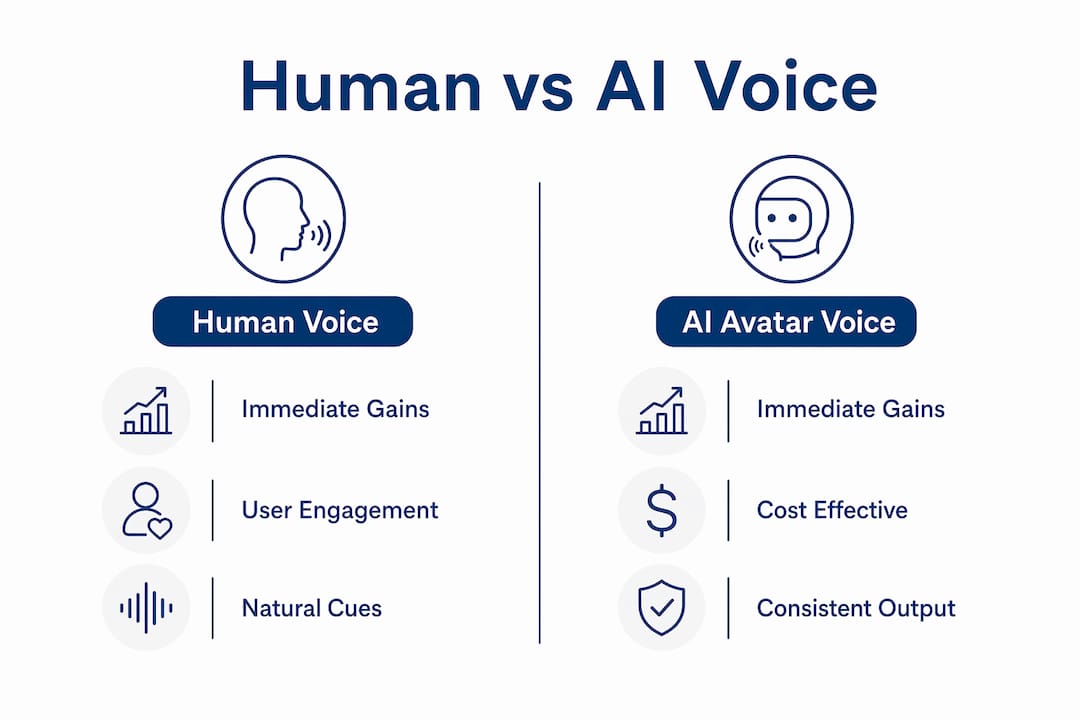
| Factor | Human voice presenter | AI avatar voice |
|---|---|---|
| Immediate learning gains | Comparable | Comparable |
| User experience (UX) ratings | Significantly higher | Lower |
| Social presence | Strong | Reduced |
| Natural prosody | Yes | Limited |
| Facial expression alignment | Yes | Partial |
| Long-term learner motivation | Higher | Uncertain |
The key finding is that learning gains are similar short-term, but human presenters score significantly higher on user experience. That gap matters more than it appears. UX ratings predict completion rates and learner persistence over time. An employee who finds a training video credible and engaging is more likely to finish it, revisit it, and apply what they learned.
Humanlike social cues such as natural voice, facial gestures, and conversational prosody activate social agency mechanisms in the learner’s brain. AI voices attract novelty, but they do not yet replicate the social engagement that a skilled human narrator delivers. For compliance training, onboarding, or any content where trust and credibility matter, human voice remains the stronger choice.
The practical implication for corporate trainers is this: if budget forces a choice, invest in a professional human voice talent for your highest-stakes training modules. Reserve AI voice tools for lower-stakes content updates where speed and cost outweigh the social presence gap.
How voice interacts with subtitles and visuals in multilingual training
Global enterprises face a specific challenge: the same training video must work across language groups. Voice strategy in this context is not just about delivery. It is about how narration interacts with subtitles, dubbing, and visual attention.
An eye-tracking study with 40 participants found that subtitle area dominates viewer gaze in bilingual instructional videos, regardless of whether the subtitle is in the learner’s first or second language. Learners spend the majority of their visual attention on text, not on the speaker’s face. This has a direct consequence for voice design: when subtitles are present, the voice must carry emotional and pacing cues that the face cannot deliver, because learners are not watching the face.
Dubbing shifts this pattern. When audio is dubbed into the learner’s language, gaze moves from the speaker’s mouth to the speaker’s eyes. Comprehension remains high across both subtitle and dubbing conditions. The difference is in nonverbal cue processing. Dubbed audio allows learners to read facial expressions more fully, which reinforces the social presence of the narrator.
| Audio condition | Primary gaze area | Comprehension | Nonverbal cue access |
|---|---|---|---|
| Original audio with L1 subtitles | Subtitle area | High | Limited |
| Original audio with L2 subtitles | Subtitle area | High | Limited |
| Dubbed audio | Speaker’s eyes | High | Strong |
Pro Tip: If your training video will be localized, record the original narration with extra deliberate pacing and clear sentence breaks. This gives your localization team clean audio segments and reduces cognitive load for learners reading subtitles simultaneously.
The research recommends testing audio-visual integration before rolling out multilingual training at scale. A short pilot with eye-tracking or attention surveys reveals whether your subtitle placement and audio pacing are working together or competing for learner attention.
Best practices for corporate trainers to optimize voice in training videos
Voice works best when you treat it as an attention and pacing system, not just narration. The following practices reflect current research and professional voiceover standards.
Select voice talent strategically
Understand that voice talent selection directly affects learner trust and engagement. Match the voice to the content’s emotional register. Compliance training calls for calm authority. Leadership development content benefits from warmth and confidence. Safety training needs clarity and measured urgency, never panic.
- Audit your training catalog by content type and emotional register before casting.
- Request audition samples with a line from your actual script, not a generic demo reel.
- Direct talent toward positive high-arousal delivery. Avoid coaching that produces flat, corporate-sounding reads.
- Test the final recording with a sample of your actual learner population before full production.
- Review vocal quality for jitter and shimmer using audio editing tools like Adobe Audition or iZotope RX before final export.
Integrate voice with visual design
Social voice cues activate emotional engagement that visual cues alone cannot replicate. The meta-analysis of 40 studies found that combining social and visual cues without careful integration actually produced a negative effect. That is a warning, not a green light to layer every element simultaneously.
- Time vocal emphasis to align with on-screen text or graphic reveals, not before or after.
- Avoid narrating every visual. Let silence carry moments where the graphic speaks for itself.
- Use vocal pacing changes, not just volume, to signal transitions between sections.
- Keep narration sentences short in complex technical content to reduce cognitive load.
Coach for emotional tone, not just accuracy
Vocal delivery coaching should focus on managing emotional tone shifts throughout the video. A narrator who starts warm and slides into flat delivery by minute four loses the learner’s emotional engagement before the key content arrives. Brief the talent on the arc of the module, not just the individual lines.
Key takeaways
Voice functions as a social cue system in training videos, and its emotional tone, pitch, and integration with visuals directly determine whether employees engage, complete, and retain the content.
| Point | Details |
|---|---|
| Vocal tone drives engagement | Positive high-arousal delivery (happiness, surprise) increases learner engagement; negative high-arousal tones reduce it. |
| Human voice outperforms AI on UX | Human presenters score significantly higher on user experience despite similar short-term learning gains. |
| Subtitles redirect visual attention | When subtitles are present, voice must carry all emotional and pacing cues because learners are not watching the speaker’s face. |
| Combined cues need careful timing | Layering social and visual cues without deliberate timing produces negative learning effects, not additive ones. |
| Voice talent selection is a training decision | Matching voice register to content type and coaching for emotional arc directly affects completion rates and retention. |
Why voice strategy is the most underrated decision in training production
Corporate trainers spend weeks on content accuracy and slide design, then spend 30 minutes casting a narrator. That order of priorities is backwards. The voice is what the learner experiences for the entire duration of the video. Every other production decision sits underneath it.
What I have seen repeatedly in professional voiceover work is that the scripts are often excellent and the visuals are polished, but the vocal direction is vague. “Sound professional” is not a direction. It produces a flat, credentialed-sounding read that learners tune out by the third module. The research backs this up. Verbal enthusiasm alone does not move the needle. The acoustic properties of the voice, its pitch curve, its emotional warmth, its pacing, are what create the social presence that keeps a learner engaged.
The comparison between human and AI voices is real, but it is also a distraction from the bigger issue. A poorly directed human narrator is worse than a well-configured AI voice. The question is not human versus synthetic. The question is whether you have given your voice talent a clear emotional brief and tested the result with real learners before publishing.
One more thing worth saying plainly: the multilingual training challenge is not solved by subtitles alone. If your global workforce is reading subtitles while a narrator speaks in a language they do not understand, the voice is still doing work. It is setting pace, signaling importance, and creating or destroying credibility. Treat localization as a voice strategy decision, not just a translation task.
— kribi
Professional voiceover for your internal training videos
Corporate training content earns its return when learners actually engage with it. A professional narrator with a clear emotional brief and strong vocal delivery is the most direct path to that outcome.
Gregeschmeyervoice delivers grounded, conversational narration built for corporate training, onboarding, and employee development content. Greg Eschmeyer brings a natural, credible tone that holds learner attention across full-length modules, not just the first two minutes. Clients consistently highlight his quick turnaround and ability to match the specific emotional register each project requires. To hear examples and explore professional voiceover services for your next training video, visit Gregeschmeyervoice. You can also review voice-over scene types to identify the right narration style for each module in your training catalog.
FAQ
What is the role of voice in internal training videos?
Voice is the primary social cue in training videos, directing learner attention, setting emotional tone, and creating the social presence that drives engagement and retention. Research shows voice-related social cues produce a stronger effect on learning outcomes than visual cues alone.
Does human voice outperform AI voice in corporate training?
A 2026 JMIR study found that human presenters and AI avatars produce comparable immediate learning gains, but human presenters score significantly higher on user experience ratings. Higher UX scores predict better completion rates and long-term learner motivation.
How does vocal tone affect learning retention?
Positive high-arousal vocal tones such as happiness and surprise improve learner affective engagement, while negative high-arousal tones like anger reduce it. This effect is acoustic, meaning the emotional signal comes from the voice itself, not just the words spoken.
How should voice be handled in multilingual training videos?
Eye-tracking research shows learners prioritize subtitle text over the speaker’s face when subtitles are present. Voice must carry all pacing and emotional cues in subtitle conditions, and dubbed audio allows learners to read facial expressions more fully, strengthening social presence.
What is the biggest mistake trainers make with voiceover direction?
The most common mistake is giving vague direction such as “sound professional,” which produces flat delivery. Effective direction specifies the emotional register, the pacing arc across the module, and the target feeling the learner should have at each key content moment.