Conversational voice acting is defined as the professional technique of delivering scripted copy as if speaking naturally and personally to a single listener, blending technical precision with authentic emotional expression. Known in the industry as the “peer-to-peer” or “trusted friend” style, this approach has replaced formal announcer voices as the dominant style in commercial production. It requires far more craft than simply relaxing your voice. The goal is to make dense, tightly written scripts sound like spontaneous thought, while keeping every word clear and every beat intentional.
What is conversational voice acting and how does it differ from other styles?
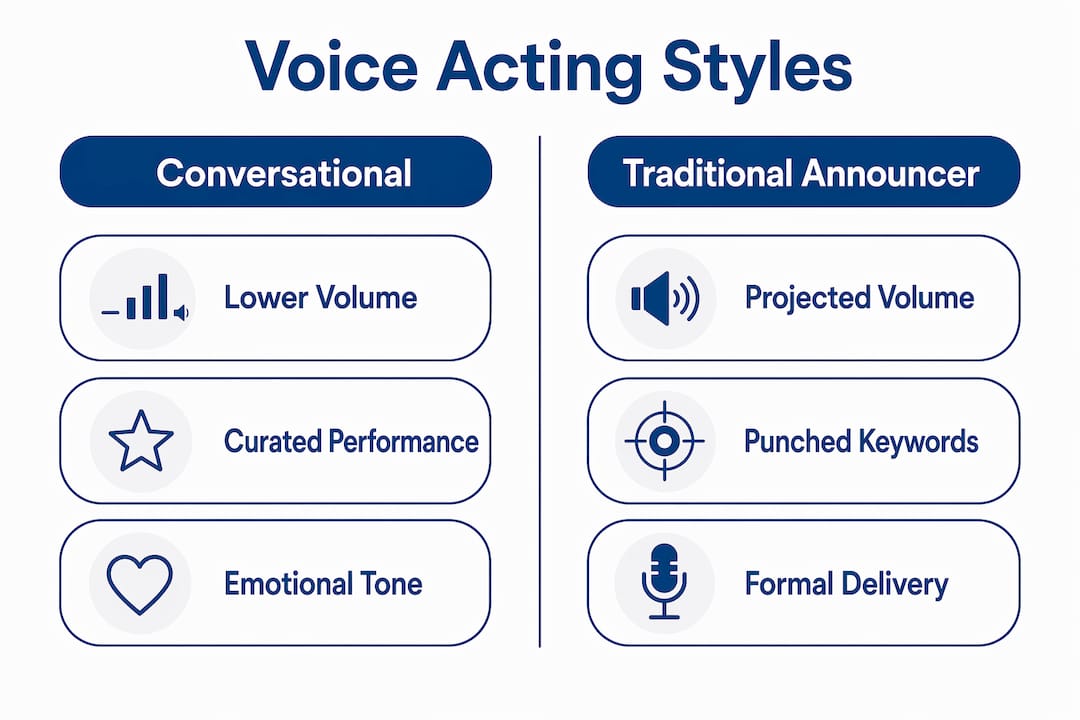
Conversational voice acting is a controlled, curated performance that creates the feeling of intimacy. It is not casual speech. The traditional announcer style projects authority outward, using wide dynamic range, theatrical emphasis, and a broadcast tone aimed at a crowd. Conversational delivery does the opposite. It adjusts volume downward, narrows emotional focus, and speaks directly to one person as if sharing a confidence.

The distinction shows up immediately in how each style handles a commercial script. An announcer read punches keywords and builds to a climax. A conversational read lets ideas unfold naturally, with pitch variation and rhythm shifts that signal a real person rather than a performer. That difference in listener perception is the entire point.
Conversational vs. traditional announcer style
| Feature | Conversational style | Traditional announcer style |
|---|---|---|
| Volume | Lower, intimate | Projected, broadcast-level |
| Pacing | Varied, natural rhythm | Steady, controlled cadence |
| Emotional tone | Warm, empathetic, specific | Authoritative, declarative |
| Listener relationship | One-on-one, peer | Crowd-facing, distant |
| Pauses | Used deliberately for connection | Minimized or avoided |
| Script treatment | Sounds spontaneous | Sounds performed |
Conversational voice acting also demands a different technical skill set. Making dense commercial scripts sound spontaneous requires the actor to internalize the copy, not just read it. The words must feel like the actor’s own thoughts arriving in real time.
Pro Tip: Record yourself reading a script twice: once as an announcer, once as if explaining the product to a close friend. Play both back. The gap between those two reads is exactly what you need to close.
Clients in 2026 describe their ideal voice with words like warm, natural, friendly, and authoritative. That combination is not accidental. Conversational style commands premium rates precisely because it is difficult to execute well. The market pays for the illusion of effortlessness.
Common misconceptions about conversational voice acting
The biggest misconception is that conversational means casual, untrained, or low energy. Conversational delivery is a curated performance that controls tone and pacing to sound like a trusted friend. Dropping your energy and reading loosely produces a flat, disengaged read, not an intimate one.
A second misconception is that natural imperfections happen by accident. Pitch variation, rhythm shifts, and subtle vocal inflections are tools the actor deploys deliberately. They signal authenticity to the listener. Beginners often fail by equating conversational voice acting with simply talking normally, missing the crafted performance aspect that creates naturalness with precise timing.
The third trap is ignoring emotional stakes. Many actors focus entirely on sounding relaxed and forget that conversational performance demands high energy and specificity. The read must feel like it matters. Without emotional investment, the delivery falls flat no matter how natural the pacing sounds.
- Conversational does not mean monotone. Pitch variation is required, not optional.
- Relaxed delivery is not the same as low energy. The stakes must feel real.
- Imperfections are crafted, not accidental. Every breath and pause is a choice.
- Clarity cannot be sacrificed for naturalness. Articulation still matters.
Pro Tip: Before you start a read, define the “moment before.” Ask yourself: what just happened that made you want to share this information right now? That mental context changes your vocal energy immediately.
Practical techniques to develop a conversational voice acting style
The most effective technique for conversational reads is the mental lead-in. Lead-ins prepare the mindset for delivery without being heard on the recording. Before your first word, silently complete a sentence that leads naturally into the script. For example, if the script opens with “This summer, everything changes,” your silent lead-in might be “I have to tell you something.” That mental setup shifts your vocal tone before you speak a single word.
Breath placement is equally critical. Strategic breath placements make scripted speech sound like spontaneous conversation. Breathing in unexpected places, mid-thought rather than at punctuation marks, signals to the listener that ideas are forming in real time. It is one of the fastest ways to break the “reading” quality out of a performance.
A step-by-step practice routine
- Read the script silently first. Understand the meaning before you touch the microphone. Know what you are actually trying to communicate, not just what the words say.
- Identify the emotional stakes. What does the listener gain or lose based on this message? Define that before you record.
- Write a mental lead-in. Create a silent sentence that ends exactly where your script begins. Practice saying it aloud, then drop it and start the script.
- Mark your breaths. Choose two or three places to breathe mid-thought. These should feel slightly unexpected but not disruptive.
- Record and listen critically. Ask yourself: does this sound like a person thinking, or a person reading? If you can hear the script, keep working.
- Adjust pitch variation deliberately. Find one word per sentence that deserves a slight drop or lift in pitch. Do not apply the same inflection pattern to every line.
Emotional activation is the piece most beginners skip. Before recording, spend 30 seconds thinking about a real person you want to help. Picture their face. That specificity changes your vocal tone in ways no technical adjustment can replicate. Understanding the emotional stakes behind a script, not just the text itself, produces the best conversational performances.
For pacing work, study voice and scene pacing techniques used in film narration. The principles transfer directly to commercial reads and help you understand how silence functions as a structural tool, not dead air.
How conversational voice acting builds audience engagement
Audiences have shifted their preferences toward genuine, relatable voices. Brands seek voices that build trust by sounding like a friend rather than a distant authority figure. That shift reflects a broader cultural move toward authenticity in media consumption. Listeners are more skeptical than ever, and a broadcast-style read triggers that skepticism immediately.
Conversational delivery builds trust through empathy. When a voice sounds like it understands the listener’s situation, the message lands differently. The listener stops evaluating the ad and starts absorbing the content. That is the commercial goal, and conversational tone achieves it where traditional announcing fails.
“The most effective voice acting does not sound like voice acting at all. It sounds like a person who genuinely cares about what they are saying.” This is the standard the market now expects across commercials, political messaging, documentaries, and branded content.
Strategic pauses are moments of connection that allow listeners to process and engage emotionally. Traditional announcers avoid silence. Conversational actors use it deliberately. A well-placed pause after a key claim gives the listener time to feel the weight of what was just said. That emotional processing is what turns a message into a memory.
For producers and advertisers, understanding why voice talent selection matters is the first step toward choosing a voice that actually moves audiences. The wrong tone can undermine an otherwise strong script. The right conversational read can make a modest script perform far above expectations.
Key Takeaways
Conversational voice acting is a premium professional skill that requires emotional investment, technical precision, and deliberate vocal choices to create the illusion of natural, intimate speech.
| Point | Details |
|---|---|
| Definition is precise | Conversational voice acting is a controlled performance, not casual speech or low-energy delivery. |
| Technique drives authenticity | Mental lead-ins, strategic breaths, and pitch variation create the sound of spontaneous thought. |
| Emotional stakes are required | Defining the “moment before” and picturing a real listener transforms vocal tone immediately. |
| Market demand is real | Clients in 2026 pay premium rates for warm, natural, and authoritative conversational reads. |
| Pauses are tools | Deliberate silence after key claims gives listeners time to process and connect emotionally. |
Why I think “just sound natural” is the worst advice in voice acting
The phrase “just sound natural” has derailed more voice acting careers than any bad microphone or cheap preamp. It sounds helpful. It is not. Natural is the result of a performance, not the starting point. Telling an actor to sound natural is like telling a novelist to just write good sentences. The advice skips every step that actually produces the outcome.
What I have found, working across commercials, political spots, and documentary narration, is that the actors who sound most natural are the ones doing the most deliberate work before the mic goes live. They have defined their emotional context. They have written their lead-in. They have chosen their breaths. By the time they record, the performance sounds effortless because the craft is invisible.
The future of voice acting belongs to people who can do this consistently across genres and client types. AI-generated voices are improving at surface-level naturalness. What they cannot replicate is genuine emotional specificity. A voice actor who understands the stakes of a script and brings real human investment to the read will always outperform a generated voice on the metrics that matter: trust, recall, and emotional response. Embrace your imperfections. Develop your technique. Those two things together are what make a voice irreplaceable.
— kribi
Professional conversational voice acting for your next project
Gregeschmeyervoice delivers the grounded, peer-to-peer vocal style that modern audiences respond to. Whether the project is a commercial, a political message, a documentary, or a broadcast, the performance is built around genuine human connection, not generic tone.
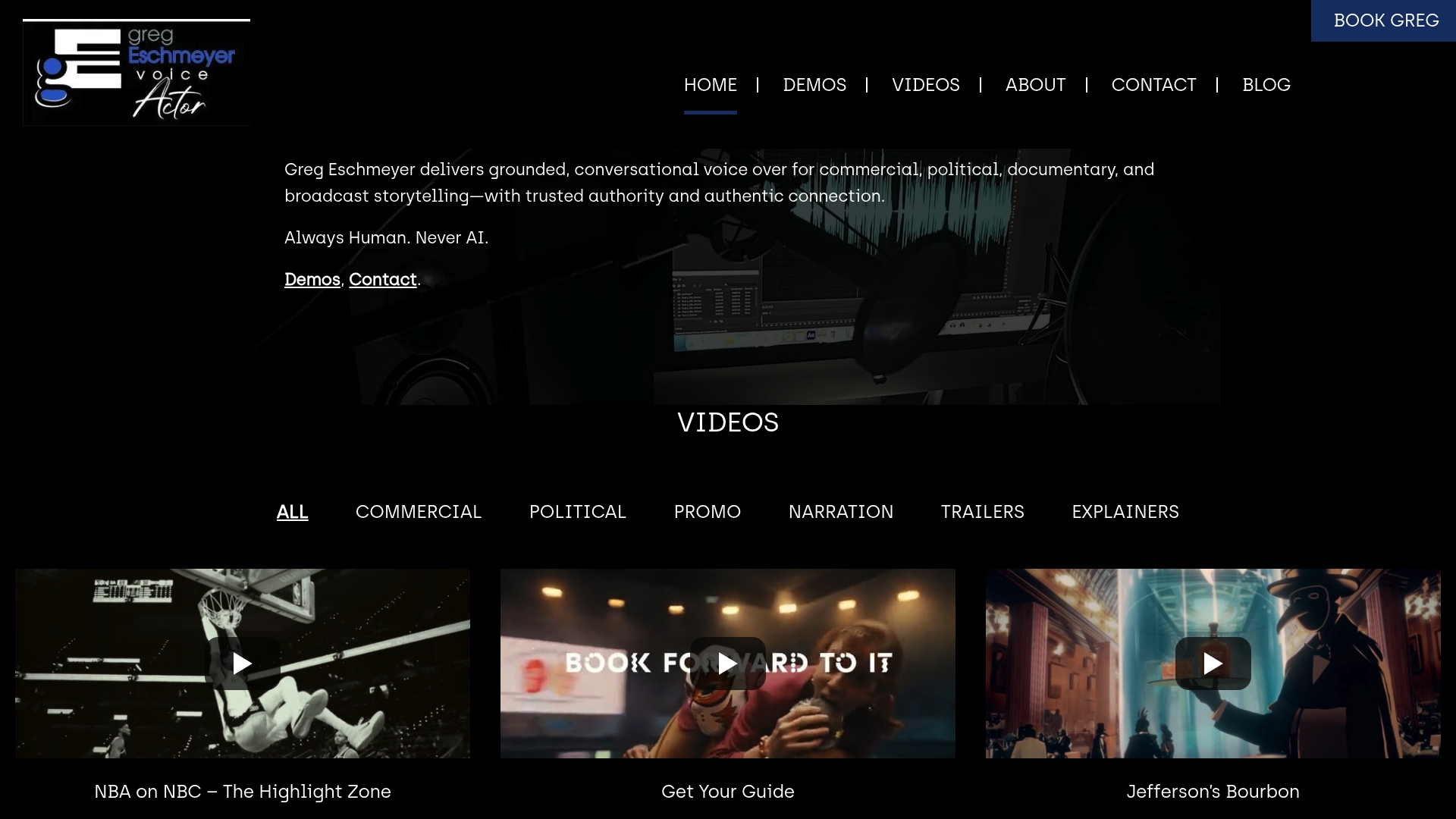
Greg Eschmeyer’s clients consistently highlight quick turnaround, professional delivery, and reads that match the specific emotional needs of each project. If you are looking for a voice that sounds like a trusted friend rather than a distant announcer, explore professional voice acting services at Gregeschmeyervoice. For producers building ad campaigns, the voice over best practices guide for 2026 is a strong next step before your next casting decision.
FAQ
What is conversational voice acting in simple terms?
Conversational voice acting is the skill of delivering scripted copy as if speaking naturally to one person, using controlled tone, pacing, and emotional investment to create intimacy and trust.
Is conversational voice acting harder than traditional announcing?
Yes. Conversational style requires making dense, tightly written scripts sound spontaneous, which demands more technical and emotional preparation than a standard announcer read.
What does “conversational” actually mean in voice acting?
“Conversational” means a curated, controlled performance that sounds like a trusted friend speaking directly to you. It does not mean casual, low-energy, or untrained delivery.
How do I start developing a conversational voice acting style?
Start with mental lead-ins before each line, practice strategic breath placement mid-thought, and define the emotional stakes of every script before you record. These three techniques produce the fastest improvement.
Where is conversational voice acting used most?
Conversational voice acting is used across commercials, political advertising, documentary narration, branded content, and broadcast media. It is now the dominant style in commercial production across all major formats.